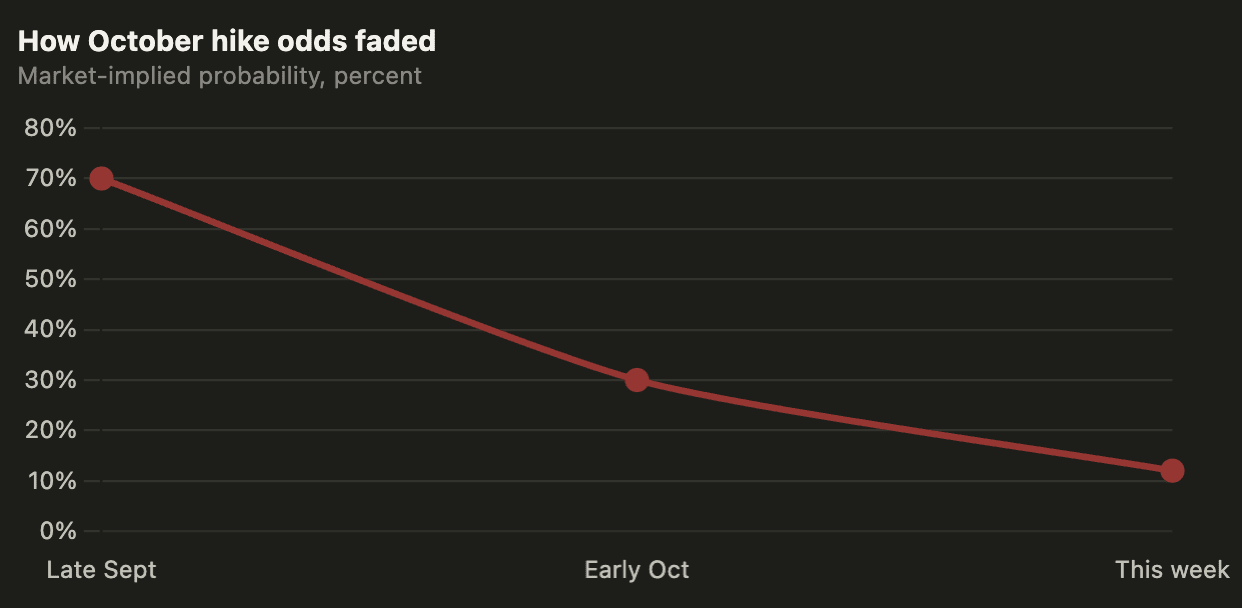
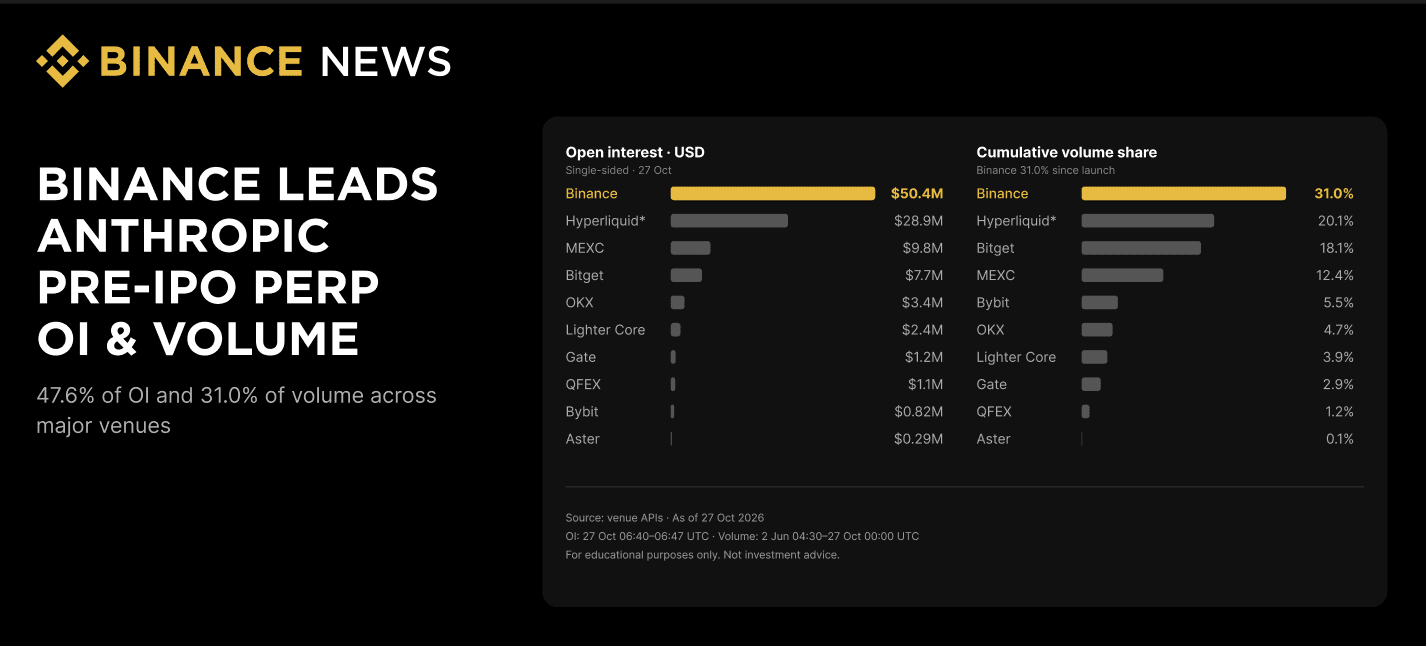
The Fed is widely expected to hold at 3.75%-4.00% Wednesday, with October hike odds at ~12% after Williams, Jefferson, and Waller signaled patience in late September. Warsh’s task: explain the hold despite persistent inflation, reaffirm the fight, and keep December alive — without appearing politically motivated six days before November 3 midterms, after Trump criticized September’s hike. Galaxy’s Alex Thorn says Bitcoin’s bear market ended in June near $58,000, with $76,540 as the line that challenges the thesis. Binance leads Anthropic pre-IPO perpetual futures with 47.6% of open interest ($50.4M) and 31% of cumulative volume since launch. SK Hynix reports Q3 Wednesday with a shareholder-return plan. S&P 500 futures +0.3% ahead of the decision.
Binance Research data as of October 27: Binance holds $50.4M in single-sided open interest — 47.6% of $106M total across 10 major venues — and 31.0% of cumulative trading volume since June 2. Hyperliquid second at $28.9M OI (20.1% of volume), Bitget $7.7M (18.1% volume), MEXC $9.8M OI (12.4% volume). Bybit 5.5%, OKX 4.7%, Lighter Core 3.9%. NYC Comptroller Mark Levine wrote to Anthropic CEO Dario Amodei in October urging a pause of the planned IPO to address AI safety concerns — the pre-IPO perpetual market continues regardless. $106M in total open interest across 10 venues is a meaningful signal of institutional demand for pre-IPO AI company exposure through crypto-native instruments.
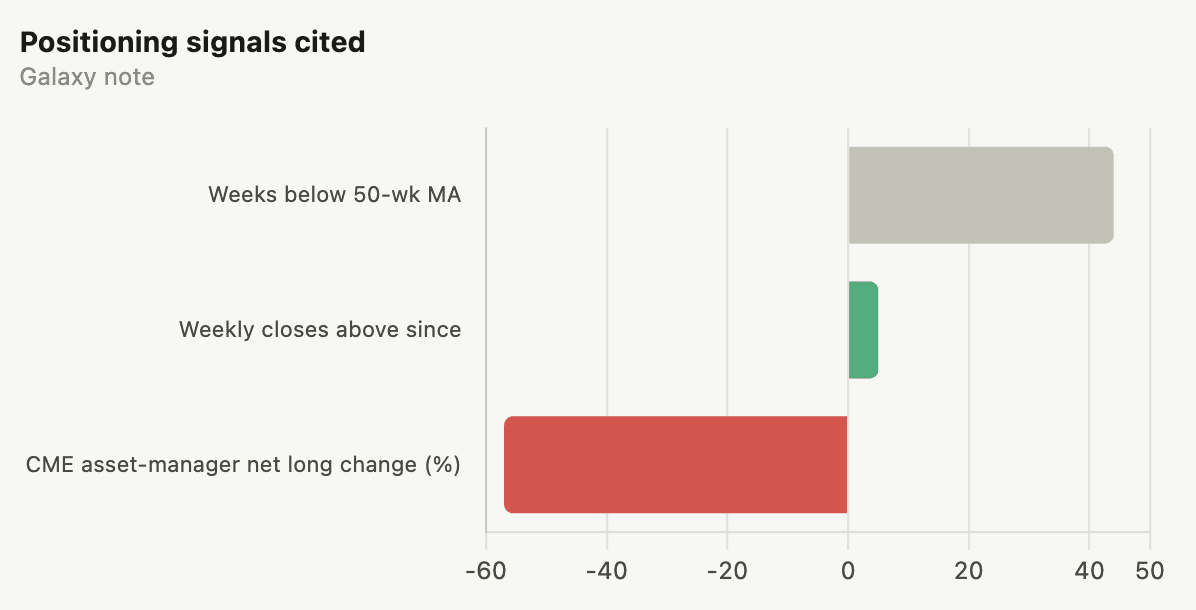
Alex Thorn, Galaxy head of firmwide research: Bitcoin is in the accumulation phase that has preceded every prior advance, with the bear market likely ending in June below $58,000. Current price: up ~38% from the June low, still ~36.5% below the $126,080 record (a 58% gain needed to recover the high). Technical signals: recovery above the 50-week MA after 44 weeks below it, with five consecutive weekly closes above it. Positioning: asset managers’ net CME futures long exposure down 57% from the record-high week; several major firms cut ETF holdings substantially; spot ETFs added 87,000 BTC since June — Galaxy reads this as directional demand rather than arbitrage. Fiscal thesis: rising US debt, persistent deficits, and higher interest costs strengthen Bitcoin’s fixed-supply appeal. Risk line: a weekly close below $76,540 followed by failure to recover within a month challenges the technical thesis. “The fast money has left, the base stayed, and everything else is priced for perfection.”
SK Hynix Reports Q3 With a New Shareholder-Return Plan as Investors Test the AI Memory Supercycle
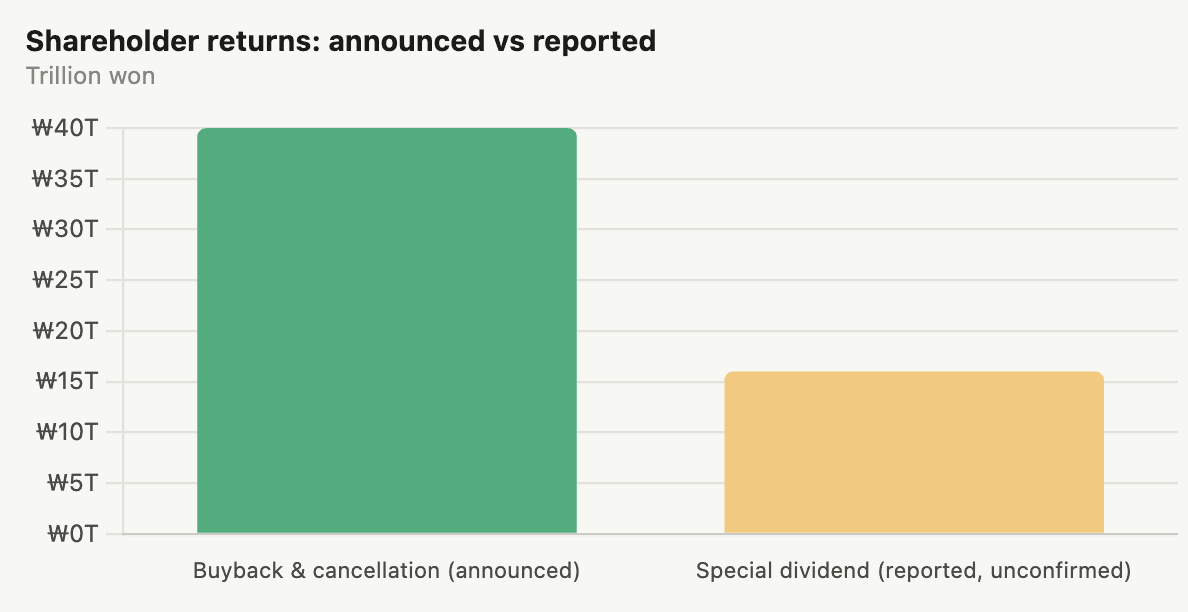
SK Hynix reports after US market close Tuesday (Wednesday morning Seoul). Key disclosures: Q3 results plus a new shareholder-return plan simultaneously. Already announced: ₩40T in treasury share repurchase and cancellation, 50%+ free cash flow return to shareholders over 2025-2027. Dong-A Ilbo reported SK Hynix is weighing a ₩16T special dividend — the company says no decision has been made. KB Securities: more than 70% of Samsung and SK Hynix’s planned output next year is already covered by five-year supply agreements with major tech companies — long-term contracts underpin the demand thesis. The read-through matters beyond Korea: SK Hynix’s HBM guidance is the clearest available signal on whether the AI memory supercycle can sustain the valuation multiple that drove KOSPI to its June record (now 39.3% below it). Samsung, Kioxia and other memory makers report shortly after.
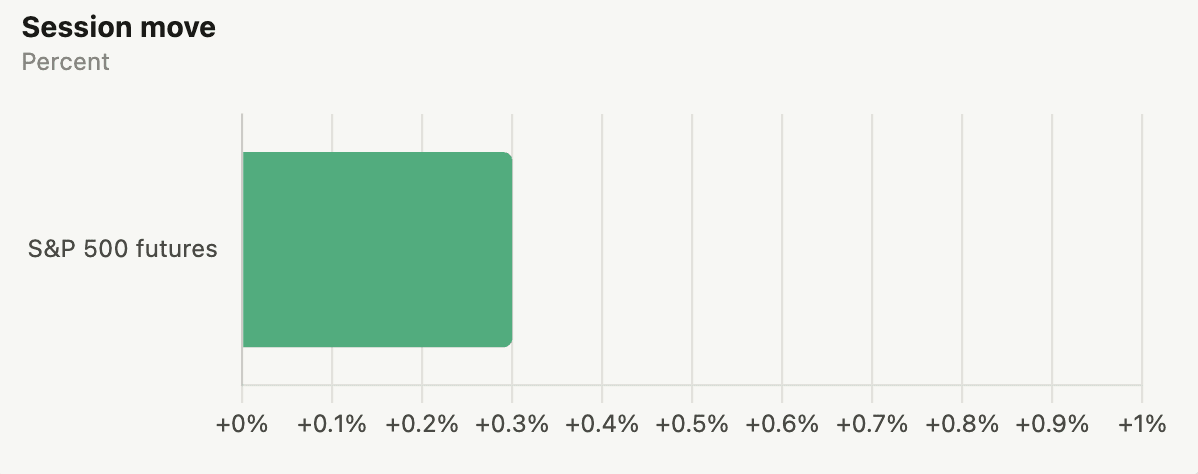
S&P 500 Futures Extend Gains to an Intraday High, Up 0.3% Ahead of Wednesday’s Fed Decision
S&P 500 futures reached an intraday high Tuesday at +0.3% ahead of the 2:00pm ET decision. The Nasdaq 100 is down more than 7% since its October 6 record high; the 10-year yield held above 5% for several weeks before recent easing. Markets have largely priced the hold — the risk is in the press conference framing, not the decision itself.
Warsh Must Explain Why the Fed Is Holding This Week While Keeping a December Hike Alive
October hike odds: ~12%, down from 70%+ post-September hike, after Williams, Jefferson, and Waller each signaled patience. The hold is priced; the communication is the event. Warsh’s three tasks: explain why not acting in October despite persistent inflation; reaffirm price stability commitment; keep December alive (December odds remain near 90%). Santander’s Stephen Stanley: Warsh needs to explain “why not act in October, and why December is still under consideration.” Political sensitivity: the decision falls six days before the November 3 midterms; Trump criticized September’s hike; any impression of political motivation would undermine the Fed’s credibility at a moment when 1-year consumer inflation expectations have risen to 4.7% and are described as at risk of becoming entrenched. Warsh has offered little forward guidance since May — his July hold press conference unsettled markets; September’s hawkish pivot and dot plot restored stability. The pattern suggests markets are sensitive to what he declines to say as much as what he does.