
Can you believe so many people don’t know what an IPO roadshow is?
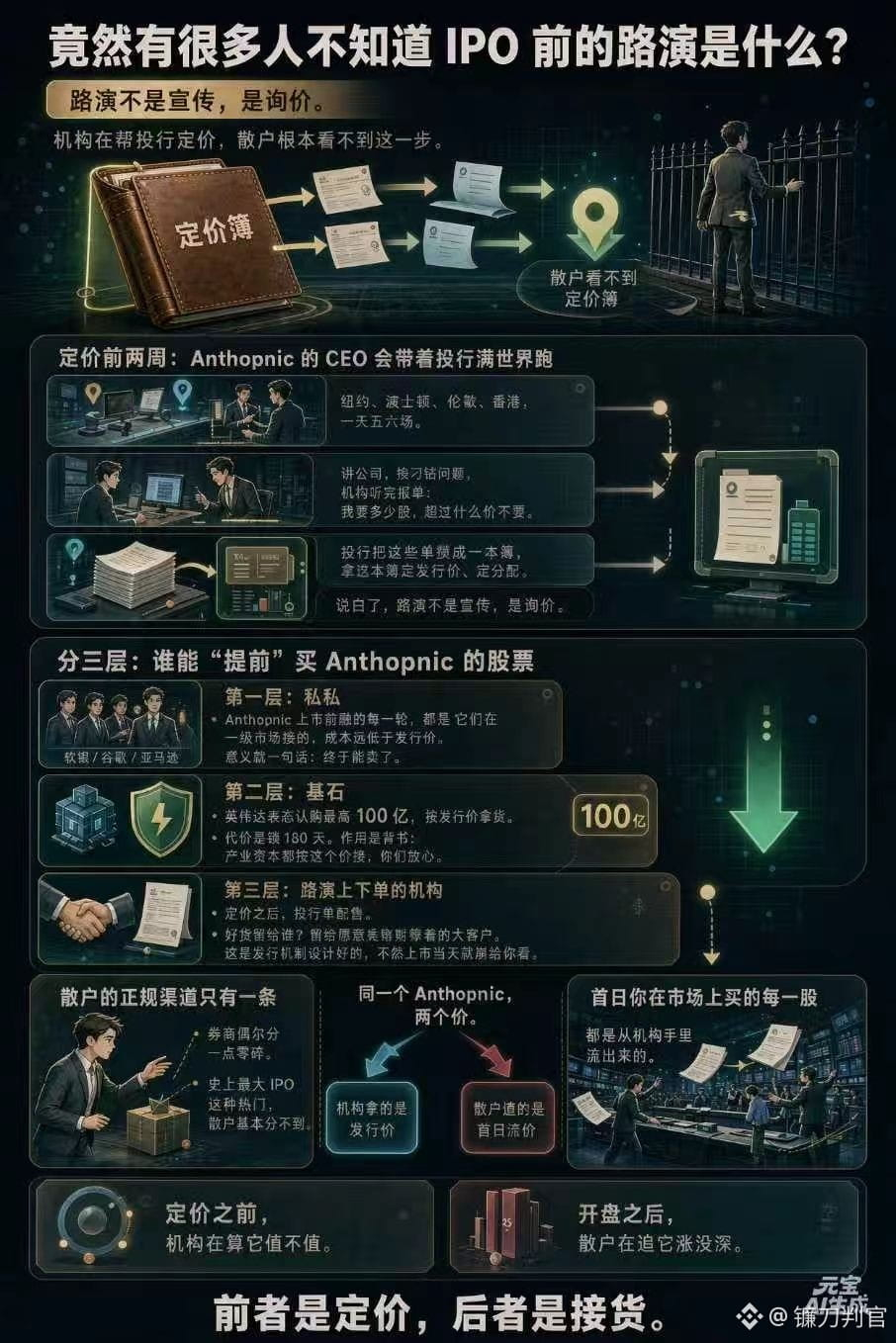
A roadshow isn’t the kind where people sing and dance.
It’s the most crucial step before a company goes public—and one retail investors never get to see.
In the two weeks before pricing, Anthropic’s CEO travels around the world with investment bankers, meeting major institutions. New York, Boston, London, Hong Kong—five or six meetings a day.
They pitch the company and field tough questions. After listening, institutions place orders: how many shares they want, and above what price they’re out.
The investment banks compile those orders into a book, which they use to set the offering price and allocate shares.
Put simply, a roadshow isn’t about publicity—it’s about gauging demand.
Institutions help the investment banks set the price. Retail investors never see this step.
That’s also why some people always manage to buy Anthropic shares “early.”
There are three tiers.
The earliest investors are private-market investors.
SoftBank, Google, Amazon—every funding round Anthropic raised before going public was taken up by investors in the private market, at prices far below the offering price.
For them, an IPO means just one thing: they can finally sell.
The second tier is cornerstone investors.
Nvidia has said it will subscribe for up to $10 billion worth of shares at the offering price.
The trade-off is a 180-day lock-up.
The point is to lend credibility: industry players are willing to buy at this price, so you can feel confident.
The third tier is the institutions that place orders during the roadshow.
After pricing, the investment banks allocate shares based on those orders.
Who gets the good shares?
Big clients who are willing to hold them for the long term.
That’s built into how the offering is structured—otherwise, the stock could collapse on its first day of trading.
Retail investors have just one legitimate route: their broker may occasionally get a few leftover shares to distribute.
For a hot deal like the biggest IPO in history, retail investors will barely get any.
Every share you buy on the market on the first day comes from an institution.
Here’s the bottom line.
Same Anthropic, two prices.
Institutions get the offering price; retail investors chase the first-day premium.
Before pricing, institutions are figuring out whether it’s worth the price.
After trading opens, retail investors are chasing whether it’s gone up.
One side sets the price. The other gets stuck buying.
$ANTHROPIC
#Anthropic预计今日公布S1招股书