CHIP tops the gainers list: governance launch is a catalyst, not a breakout pass
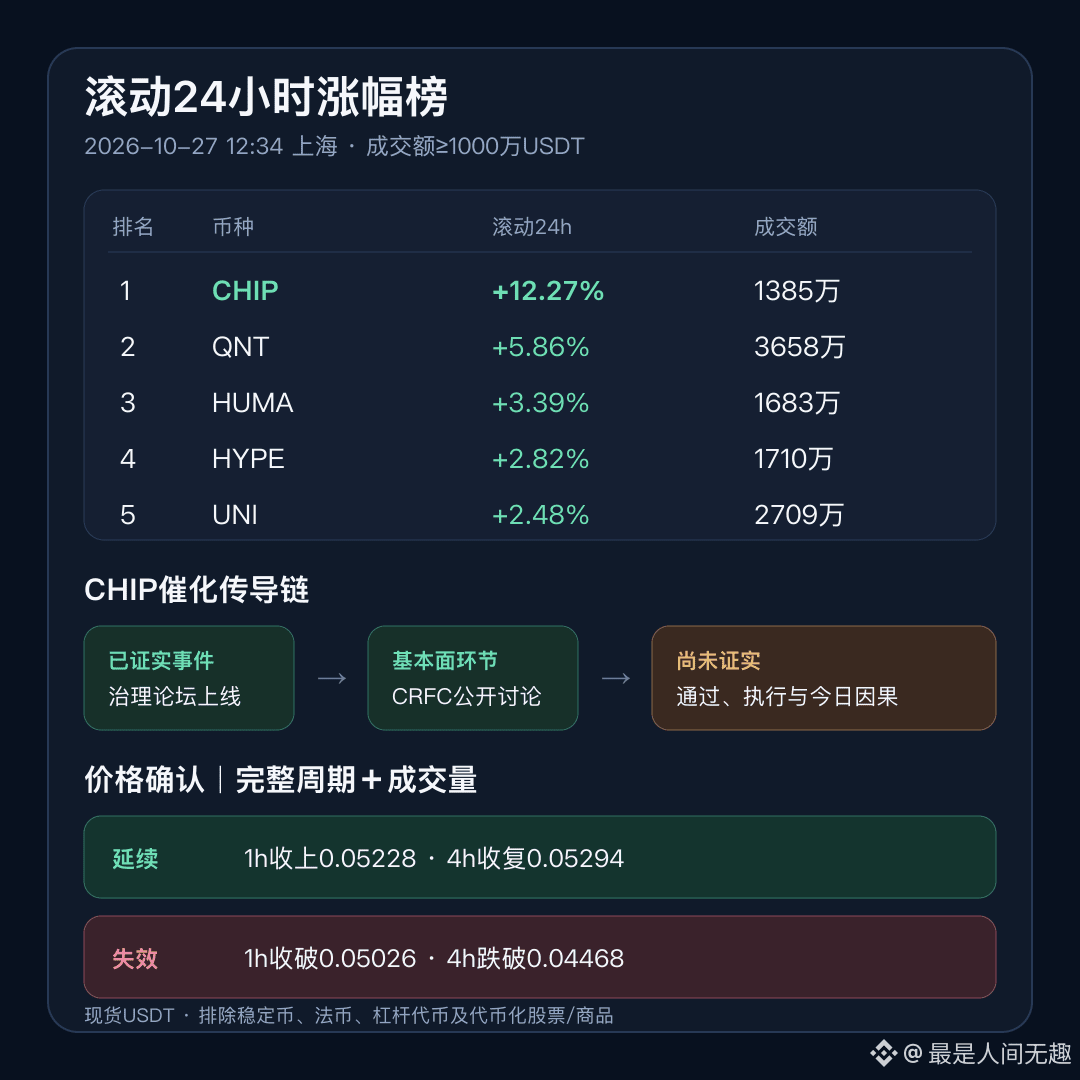
$CHIP ranked first among Binance spot assets with high liquidity, gaining +12.27%, but its current price of 0.05098 is about 11.0% below the 24-hour high of 0.05725. The top ranking and the pullback are both real. The key question is not whether the token has attracted attention, but whether the governance catalyst can continue to translate into investor acceptance and price confirmation.
Data was captured on October 27 at 12:34 Shanghai time, using a rolling 24-hour window rather than the calendar day. The screen included only assets with status=TRADING that are spot-tradable and USDT-denominated, and excluded stablecoins, fiat currencies, leveraged tokens, tokenized stocks/commodities, and obviously anomalous assets. Trading volume had to be at least 10 million USDT. The top five gainers after screening were:
1. CHIP +12.27%, trading volume: 13.85 million USDT
2. QNT +5.86%, trading volume: 36.58 million USDT
3. HUMA +3.39%, trading volume: 16.83 million USDT
4. HYPE +2.82%, trading volume: 17.10 million USDT
5. UNI +2.48%, trading volume: 27.09 million USDT
First, let’s unpack the confirmed catalyst. On October 19, USD.AI officially announced the launch of the CHIP governance forum. Public proposals follow a process of “at least four days of discussion—Snapshot vote—on-chain vote and timelock if necessary—implementation.” The governance forum shows that two CRFCs were published on October 22, covering parameters for initiating new financing and for selling GLX facilities. This moves CHIP’s governance utility from concept into a public process.
But two links in the chain of transmission are still missing: a CRFC is not the same as an approved vote, let alone completed implementation. Also, as of publication, no new official announcement dated October 27 had been found that could independently explain this rally. So “governance launch” is verifiable context, but it should not be presented as the definitive cause of today’s +12.27% gain.
The flow data shows both confirmation and a cooldown. The latest completed 4-hour candle opened at 0.05107 and closed at 0.05139, with trading volume of about $1.4 million—2.53 times the median of the previous 12 completed 4-hour candles. This indicates genuine turnover at elevated prices. However, the latest completed 1-hour candle had trading volume of only about $196,000, or 0.52 times the median of the previous 24 candles. Follow-through buying has yet to arrive. An earlier 4-hour candle reached 0.05725 but closed at 0.05294, showing that the market did not sustain acceptance of the high.
Next, watch for confirmation across three scenarios:
Catalyst continues to transmit: Only a high-volume close above 0.05228 on a completed 1-hour candle, followed by a reclaim of 0.05294 on a completed 4-hour candle, would justify another test of 0.05725. An intraday move above these levels alone should still be treated as a test of the highs.
Consolidation at elevated levels: If the price stays between 0.05026 and 0.05294 as volume declines, that suggests investors have not yet exited, but the market has not established acceptance at a new price level either.
Structure invalidation: A high-volume close below 0.05026 on a completed 1-hour candle would indicate that support at current elevated levels has failed. If the price then falls below 0.04468 on a 4-hour candle, the structure of this governance-catalyst trade is invalidated and the thesis needs to be reassessed.
Key risks include CHIP’s Seed Tag and higher volatility relative to mature assets, the possibility that governance proposals may be amended or rejected, and rapid changes in ranking as the rolling leaderboard window shifts.
Open $CHIP first and check which side of 0.05228 and 0.05026 is confirmed by volume on a completed hourly candle. Then see whether the 4-hour close can regain acceptance above 0.05294 to determine whether this catalyst chain has reached price confirmation.