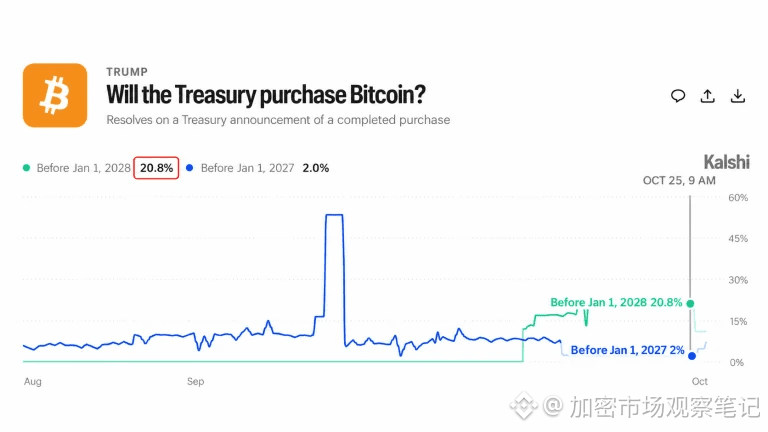
Wow! Will the U.S. Treasury buy Bitcoin before 2028? Kalshi put the odds at one point as high as 21%, but the amount wagered behind that figure was much smaller—a striking contrast. The report was published on October 27, 2026; in the same screenshot, the odds for a contract covering the rest of 2026 were just 2%.
The contract’s terms are also quite specific: it only pays out if the Treasury announces that it has completed a Bitcoin purchase for the government’s reserve. A speech, study, or executive order would not count. The report put total trading volume at about $1,617, with roughly 309 and 1,305 trades, respectively, on the contracts with the two different deadlines. The author also said that the 2028 contract’s last-traded odds fell to 11% early Monday morning, with a bid of 12 cents and an ask of 17 cents. With liquidity this thin, a small number of trades can move the quoted odds substantially.
The article notes that the executive order establishing the existing Strategic Bitcoin Reserve prohibits open-market purchases, while the BITCOIN Act, which would authorize purchases, has not passed. Defense Secretary Pete Hegseth has expressed interest in Bitcoin and the potential of crypto, but that does not mean there is already a budget or a plan to buy. The author says what happens next could depend on congressional legislation, whether the Treasury finds a budget-neutral way to make purchases, or whether nothing happens and the reserve continues to grow solely through forfeitures.
The market takeaway is fairly neutral: 21% is the price of a low-liquidity prediction contract, not evidence that the Treasury is preparing to buy Bitcoin. The report also noted that Kalshi contracts put the odds of Bitcoin falling below $77,500 at about 44%, and below $75,000 at about 16%. These, too, reflect bettors’ pricing; they do not mean those price levels will necessarily be reached. If authorization to buy emerges, policy expectations could shift; until then, institutional constraints remain key. How much do you think these low-volume policy contracts can tell us about genuine expectations?
$BTC $ETH
Source: Bitcoin.com News