
What is Anthropic’s IPO actually worth?
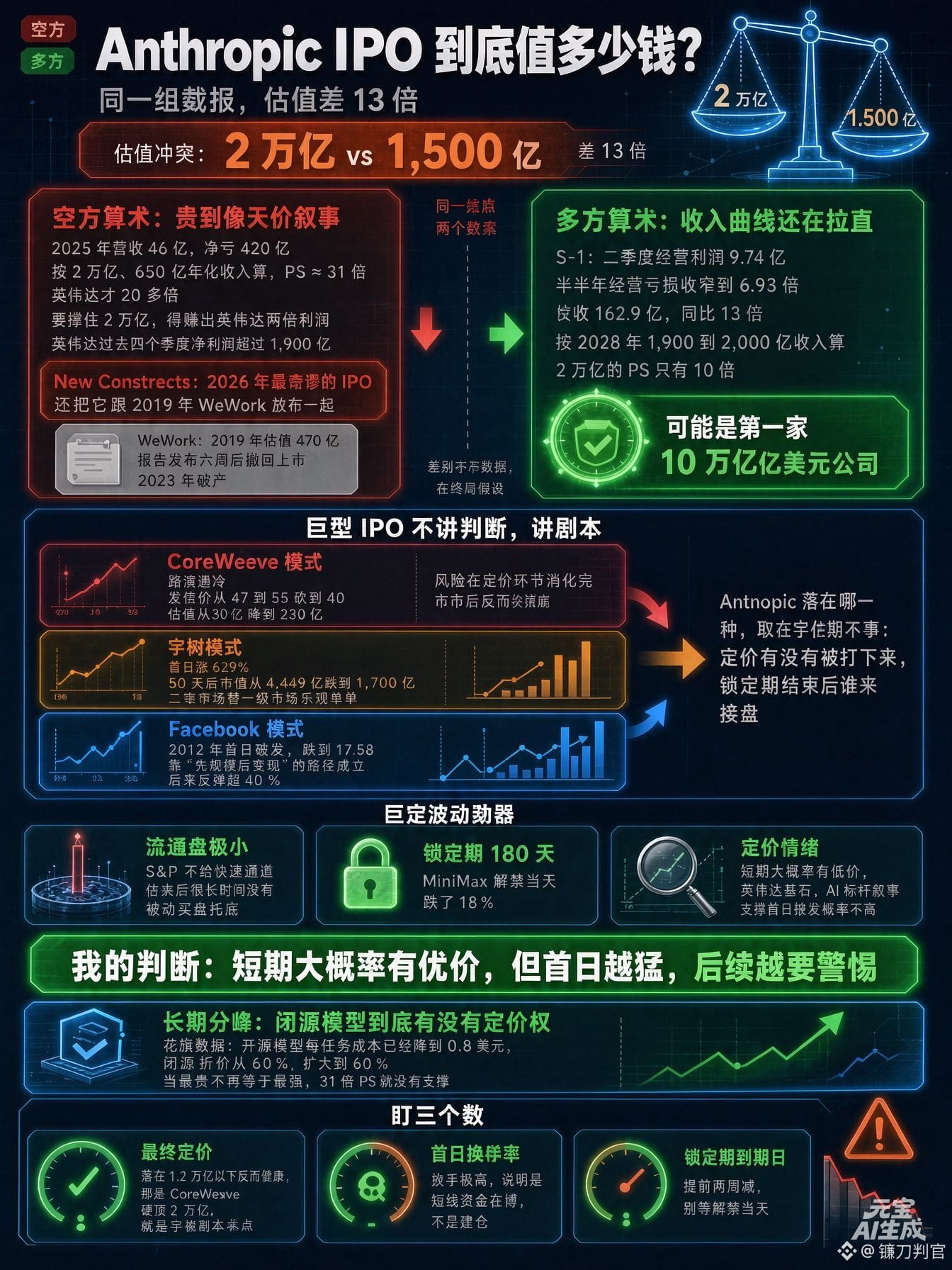
One estimate says $2 trillion. Another says $150 billion.
That’s a 13-fold difference.
The $150 billion figure comes from independent research firm New Constructs. Its words were blunt: the most ridiculous IPO of 2026.
It also compared Anthropic to WeWork in 2019.
WeWork was valued at $47 billion at the time, withdrew its IPO six weeks after the report came out, and went bankrupt in 2023.
Last night, I said it was coming to bleed investors dry. Today, let’s first calculate just how big it really is.
The bears’ math is pretty hard to argue with.
Revenue in 2025 was $4.6 billion, with a net loss of $42 billion. At a $2 trillion valuation and $65 billion in annualized revenue, its price-to-sales ratio is 31x.
Nvidia’s is only a little over 20x.
To justify $2 trillion, Anthropic would need to generate twice Nvidia’s profits.
Nvidia posted net income of more than $190 billion over the past four quarters.
So New Constructs’ conclusion is even harsher: this IPO isn’t for public-market investors. It’s a way for private shareholders and insiders to cash out.
The bulls have their own math.
The S-1 says operating profit in the second quarter was $974 million, and the operating loss for the first half of the year narrowed to $693 million. Revenue was $16.29 billion, up 13x year over year.
Based on the company’s own forecast of $190 billion to $200 billion in revenue in 2028, a $2 trillion valuation works out to a price-to-sales ratio of just 10x.
Some are already saying Anthropic could become the first $10 trillion company.
Same set of data, two conclusions.
The difference isn’t in the numbers, but in the assumptions about the endgame.
One focuses on the revenue curve three years from now; the other, on this year’s cost bill.
What I care more about is what happens after the IPO.
With a mega-IPO, it’s not about whether the stock goes up or down. It’s about the script.
The CoreWeave scenario: a cool reception on the roadshow, with the offering price cut from the $47–$55 range to $40, and the valuation falling from $32 billion to $23 billion.
The risk gets priced in during the offering, so the stock doesn’t collapse after listing.
The Unitree scenario: shares jump 629% on day one, then 50 days later the market cap falls from $444.9 billion to $170 billion. The secondary market ends up paying for the primary market’s optimism.
The Facebook scenario: shares fall below their offer price on the first day in 2012, dropping to $17.58. The “scale first, monetize later” strategy proves out, and the stock later rebounds by more than 40%.
Which scenario Anthropic follows depends on two things: whether the offering price gets cut, and who will buy after the lockup period ends.
Three mechanisms will amplify volatility.
The public float will be tiny. The S&P won’t grant fast-track inclusion, so there’ll be no passive buying to support the stock for a long time after listing. The lockup period is 180 days; MiniMax fell 18% on the day its lockup expired.
$ANTHROPIC