A company lost $80.7 billion in six months. In the same filing, it lost only $693 million. The $72.388 billion wasn’t cash burned—it was an accounting loss from a rise in valuation.
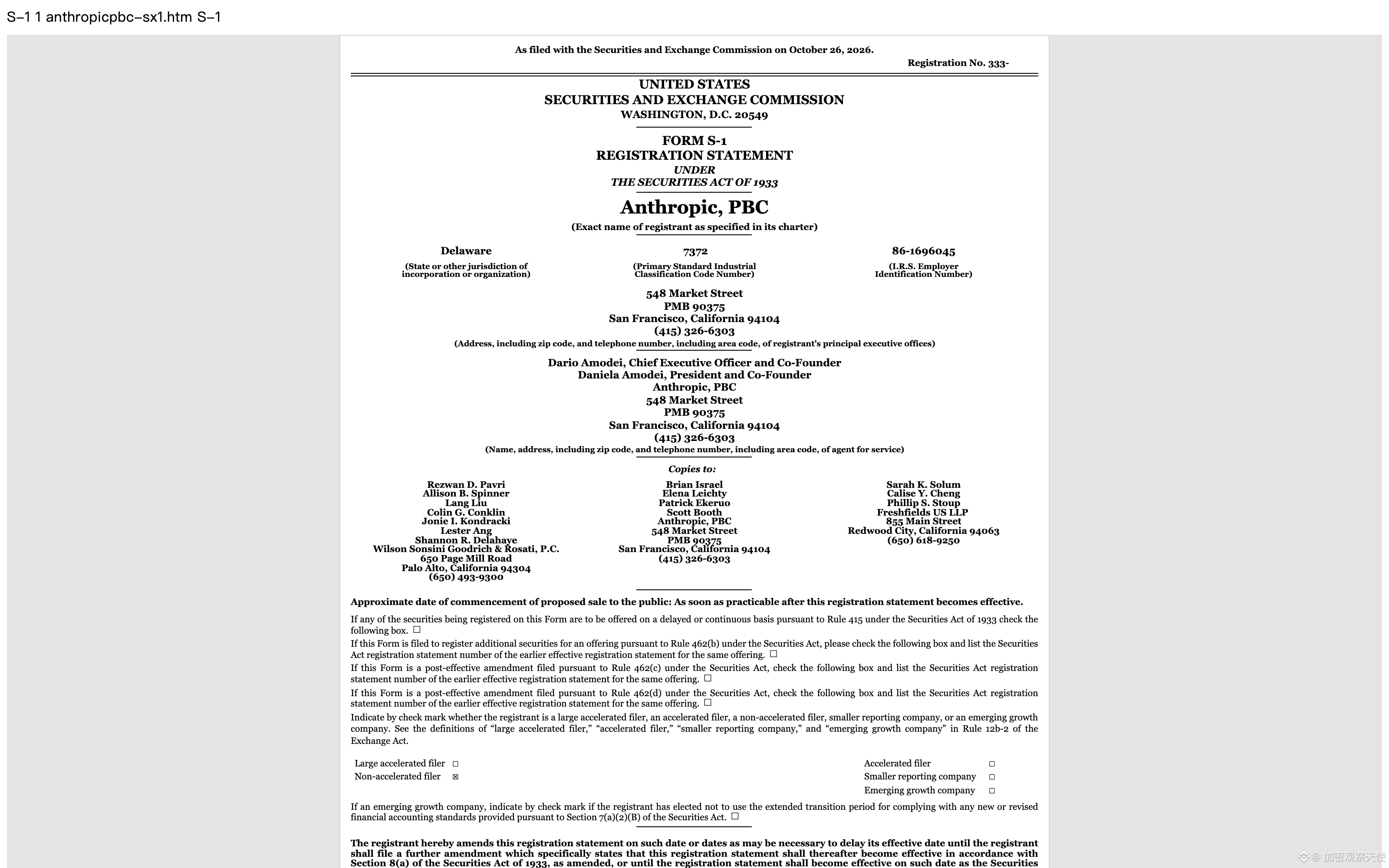
On October 26, Anthropic filed an S-1 with the SEC under the ticker ANT, proposing to list on the Nasdaq Global Select Market.
Let’s lay out the income statement.
Revenue in the first half of 2026 was $16.286 billion, up from $1.163 billion in the same period last year—14 times as much.
Operating expenses were $16.979 billion, resulting in an operating loss of $693 million.
The operating loss for the same period last year was $2.135 billion. The losses are getting smaller.
Two lines further down, the numbers change.
The line for changes in the fair value of convertible notes, derivatives, and SAFEs shows -$72.388 billion.
Net income: -$80.748 billion.
That one line accounts for 89.7% of the $80.7 billion loss.
That line does not represent a cash outflow.
Convertible notes and SAFEs are liabilities measured at fair value. When the company’s valuation rises, the fair value of these liabilities rises too, and accounting rules record that as a loss.
So the more valuable the company becomes, the worse its books look.
A rise in valuation shows up as a loss on the income statement, a liability on the balance sheet, and nothing at all on the cash flow statement.
That’s what makes this filing hard to read. It’s easy to get distracted by the loss figure at the top of a prospectus.
The slope of revenue says more about the company than its losses do.
Revenue was $41 million in 2023, $4.585 billion in 2025, and $16.286 billion in the first half of this year.
Revenue in the first half was 3.55 times last year’s full-year revenue.
The number of customers spending more than $100,000 with Anthropic rose from 20 at the end of 2023 to more than 11,900 by the end of September this year.
On a per-share basis, the loss was $39.88.
In 2025, 76% of revenue came from these customers—a substantial concentration.
The filing also shows where the money goes.
In the first half, compute costs were $8.945 billion, personnel costs were $3.152 billion, and sales costs were $3.168 billion. Compute alone accounted for more than half of operating expenses.
Compute costs of $8.945 billion were 22% higher than the $7.326 billion for all of 2025.
Real money is going out the door, and it’s going out faster than last year.
So “near break-even” is true only on an operating basis.
What I can’t pin down is how this line will move after the company goes public. If the share price falls, the same fair-value change could turn into a gain, making the books look better. That scenario makes sense, but the offering price and share count are both blank, so there’s no way to calculate it.
The takeaway from this page isn’t the loss—it’s the accounting basis.
Any company that measures its own liabilities at fair value will eventually have an income statement that moves with its valuation.
Because valuation isn’t performance. It’s just the price someone else is willing to pay.
Demand for AI is real. The shovels-selling chain has 24-hour quotes on Binance, and $NVDAB is one of them.
Would you value this company based on operating income or net income?
Data from the S-1 filed with SEC EDGAR on 2026-10-26. This is an analysis of how to read the financial statements, not investment advice.