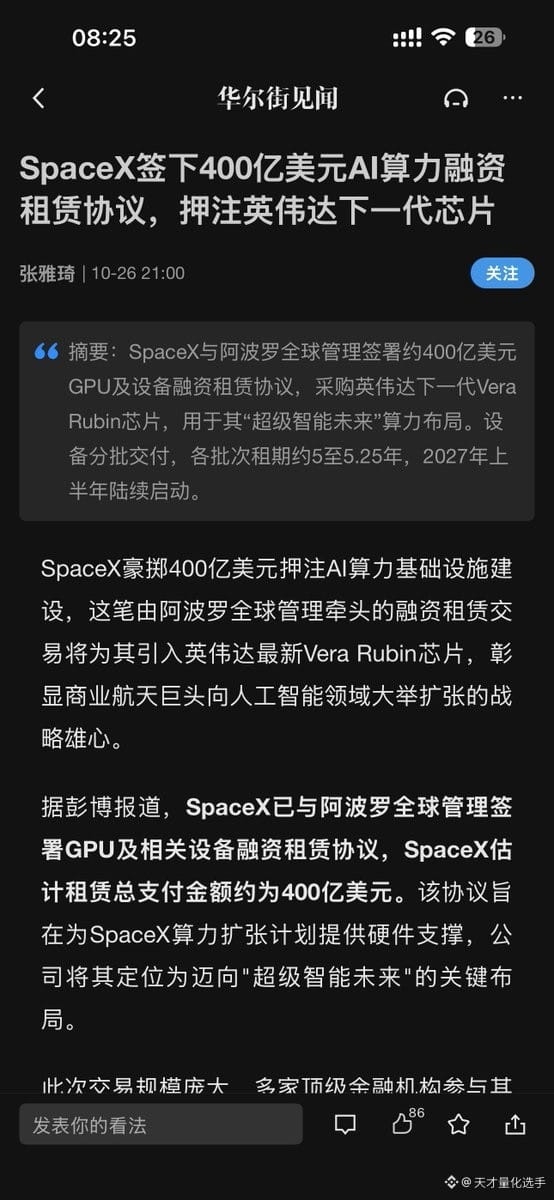
I saw a blogger pour cold water on the financing lease agreement between SpaceX and Apollo. He said some people questioned whether he understood financing leases, but that’s beside the point—the real issue is SpaceX’s own AI business.
His reasoning is that revenue from SpaceX’s large language models is almost negligible; what really keeps the show going is its cloud services. But cloud services aren’t a scarce commodity: Microsoft, Amazon, and Google are all in the game, and the competition is fundamentally about capital, not technological superiority. According to Anthropic’s latest S-1 filing, the contract between the two parties is quite flexible and can be canceled after early 2027.
The blogger therefore believes this business is fraught with uncertainty: first, it is heavily dependent on a few large customers, and Anthropic is the only profitable company in the entire industry. Even SpaceX’s own AI business is losing money, raising questions about sustainability. Second, its in-house large language models consume computing power without generating profits. Third, competition in traditional AI cloud services is intense, and rivals are larger and have more diversified customer bases.
The blogger also pointed out a key fact: AI hardware leasing revenue already exceeds the SpaceX, Starlink, and rocket-launch businesses often cited in crypto circles ($BTC ). Put simply, it’s a cloud services company—so what justifies such a high valuation? If OpenAI or Anthropic fails to meet revenue expectations, Wall Street may vote with its feet.
His conclusion is sharp: strip away the “Musk halo” narrative, and this is Musk abusing his market influence to lend credibility to a business that isn’t technologically superior.
My take: however compelling an influencer’s narrative may be, it ultimately comes down to cash flow and fundamentals. The same reminder applies to crypto: no matter how good the story sounds, a high valuation will eventually have to be justified by real revenue.
— Based on a post by @zfcbtc
#BTC #Crypto