



Earnings from U.S. tech giants are one of this week’s three major macro themes and directly affect confidence in the narrative around the U.S. AI sector. With macroeconomic pressures currently so intense, confidence has become all the more important.
There are seven earnings reports worth watching this week: #股票财报季
SK Hynix and Robinhood on October 28
Google and Microsoft on October 29
Amazon, Intel, and SanDisk on October 30
Among them, the most critical are the global AI hyperscaler giants Google, Microsoft, and Amazon. Last week, the logic for validating AI companies officially entered the cash flow validation stage: previously, the focus was on spending; now, it’s on making money. Although the Q3 earnings season has not yet been rigorous enough in assessing AI companies’ ability to generate profits, it is clear that the sector is rapidly diverging.
Why do I say these three companies are the most important? The key is that they are the three leading cloud providers globally, occupying critical positions in the AI industry value chain. They can influence orders and demand for upstream AI infrastructure, as well as downstream AI models and applications. They are also currently a litmus test of investor confidence in AI.
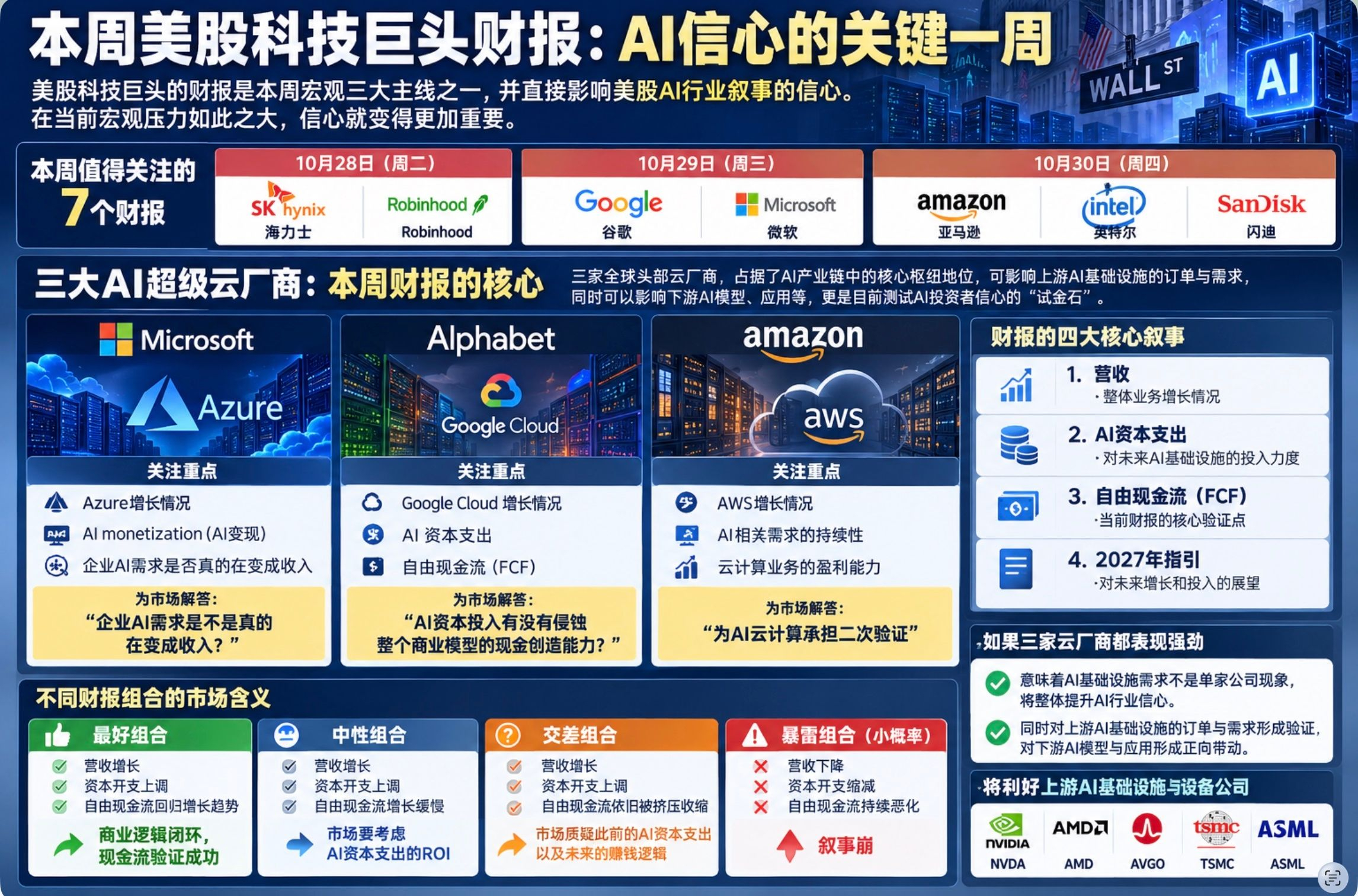
Taken together, the earnings reports from these three companies revolve around four key narratives: revenue, AI capital expenditure, free cash flow, and 2027 guidance. Cash flow is the key measure to watch in this earnings season.
Best-case combination = revenue growth + increased capital expenditure + free cash flow returning to a growth trajectory. The business logic comes full circle, and cash flow validates the thesis.
Neutral combination = revenue growth + increased capital expenditure + slow free cash flow growth. The market will need to consider the ROI on AI capital expenditure.
Bare-minimum combination = revenue growth + increased capital expenditure + free cash flow still being squeezed and contracting. The market questions both the AI capital spending so far and the future path to profitability.
Blowup scenario = declining revenue + reduced capital expenditure + free cash flow continuing to deteriorate (a low-probability outcome). The narrative falls apart.
That’s the overall framework. Looking at the specifics of each company’s earnings, the focus differs for each:
Microsoft: Watch Azure + AI monetization. The question for the market is whether enterprise AI demand is genuinely translating into revenue.
Alphabet: Watch Google Cloud + AI capital expenditure + free cash flow. The question for the market is whether AI investment is eroding the business model’s overall ability to generate cash.
Amazon: Watch AWS, which provides a second validation of demand for AI cloud computing.
If Azure at Microsoft, Google Cloud at Google, and AWS at Amazon all perform strongly in their earnings reports, it would mean demand for AI infrastructure is not isolated to a single company. That would boost confidence across the AI industry as a whole and provide a second validation of capacity at equipment companies such as NVDA / AMD / AVGO / TSMC / ASML!