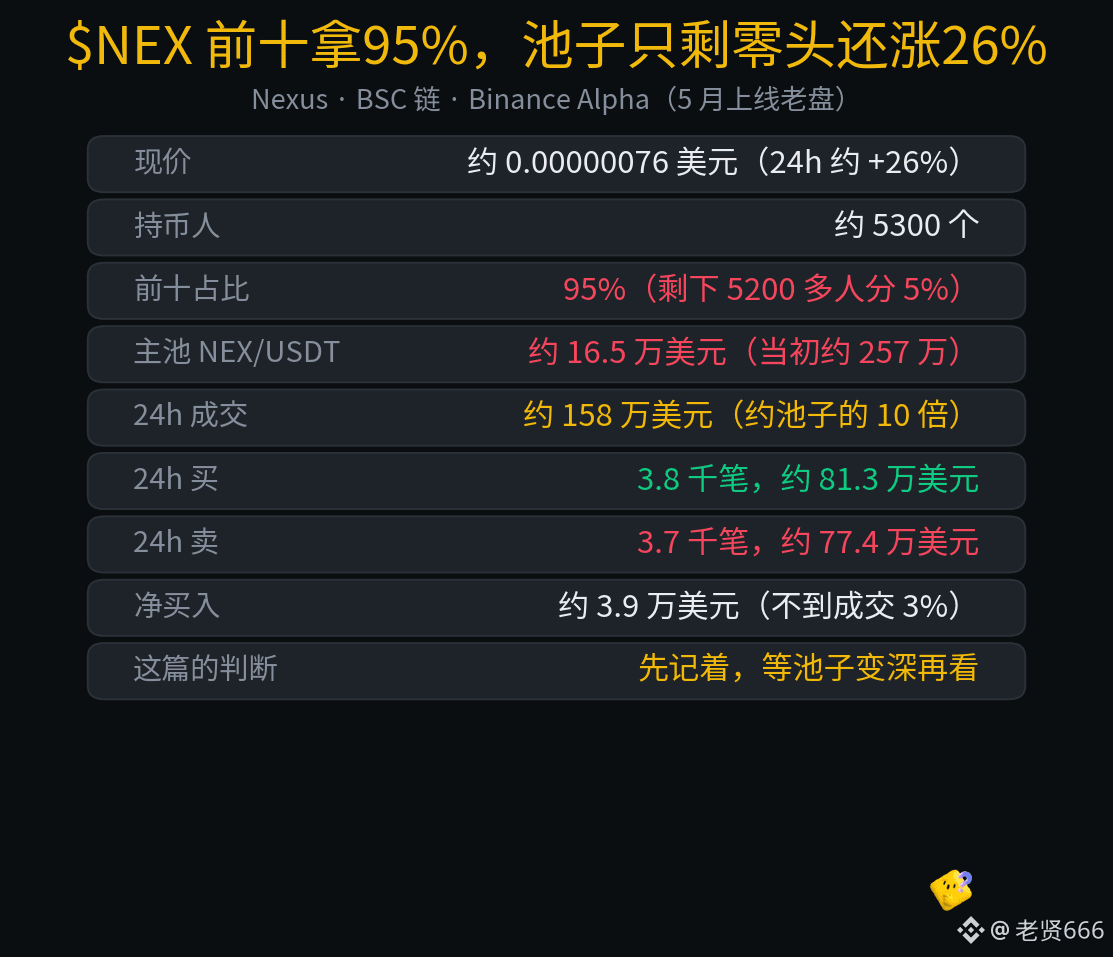
The top 10 hold 95% of the tokens, the pool is down to a fraction of what it was, yet the price rose 26% in a day—$NEX ’s numbers contradict each other in three places.
First, who holds the tokens? There are about 5,300 holders, which sounds like a lot, but the top 10 account for 95% of the supply. The remaining 5,200-plus holders share just 5%—with a market cap of over $3.4 million, that works out to a little over $30 per person on average. The team holds 0; sniper and insider wallets are also at 0; bundled addresses account for less than 0.1%; and the buy/sell tax is 0. Nothing seems wrong with the contract. The problem is that the tokens are extremely concentrated: this isn’t a retail-driven market; a handful of addresses call the shots.
Next, the pool. The main NEX/USDT pool shown on the tracker was listed at about $2.57 million initially. Now it’s down to just $165,000—a drop of more than 90%. Yet daily trading volume is $1.58 million, nearly 10 times the pool’s size. With a pool this shallow and that much volume, the price still rose 26%, to about $0.00000076. There were about 3,800 buys totaling $813,000 and 3,700 sells totaling $774,000. Net buying was around $39,000, less than 3% of volume. Buys and sells were basically even, yet the price genuinely climbed 26%. Balanced buying and selling shouldn’t push the price up like that, but a shallow pool did—that’s the biggest contradiction.
And there’s one more thing: this coin launched on May 18, so it’s an old hand approaching five months on the market, not a brand-new token that just appeared today. An older token, a shallow pool, concentrated holdings, and a rising price: it may look lively, but the fundamentals aren’t especially solid.
If you hold it, check one thing first: how large your trade would be relative to the $165,000 main pool, and whether you can tolerate the slippage. If you don’t hold it, wait for one of two signals: the top 10’s share clearly falls, or the pool deepens again and volume is no longer 10 times the pool’s size. If the top 10 still hold around 95% and the pool keeps shrinking, there’s no need to dwell on it. If the top 10 drop below 70% and the pool grows back to over a few hundred thousand dollars, then the “concentrated holdings + shallow pool” picture described above no longer applies, and I’ll revise my view.
What do you think: with the top 10 holding 95% and the pool down to a fraction of its former size, how can the price still rise 26%? Is someone propping it up, or is the pool so shallow that the slightest push moves it?
Risk disclaimer: The above is only a review of on-chain figures and does not constitute any buy or sell recommendation. Alpha coins are highly volatile; if you’re unsure, stay away. Follow me, and I’ll see you tomorrow for another look at the numbers.
#BinanceAlpha #NEX #池子观察 #链上算账