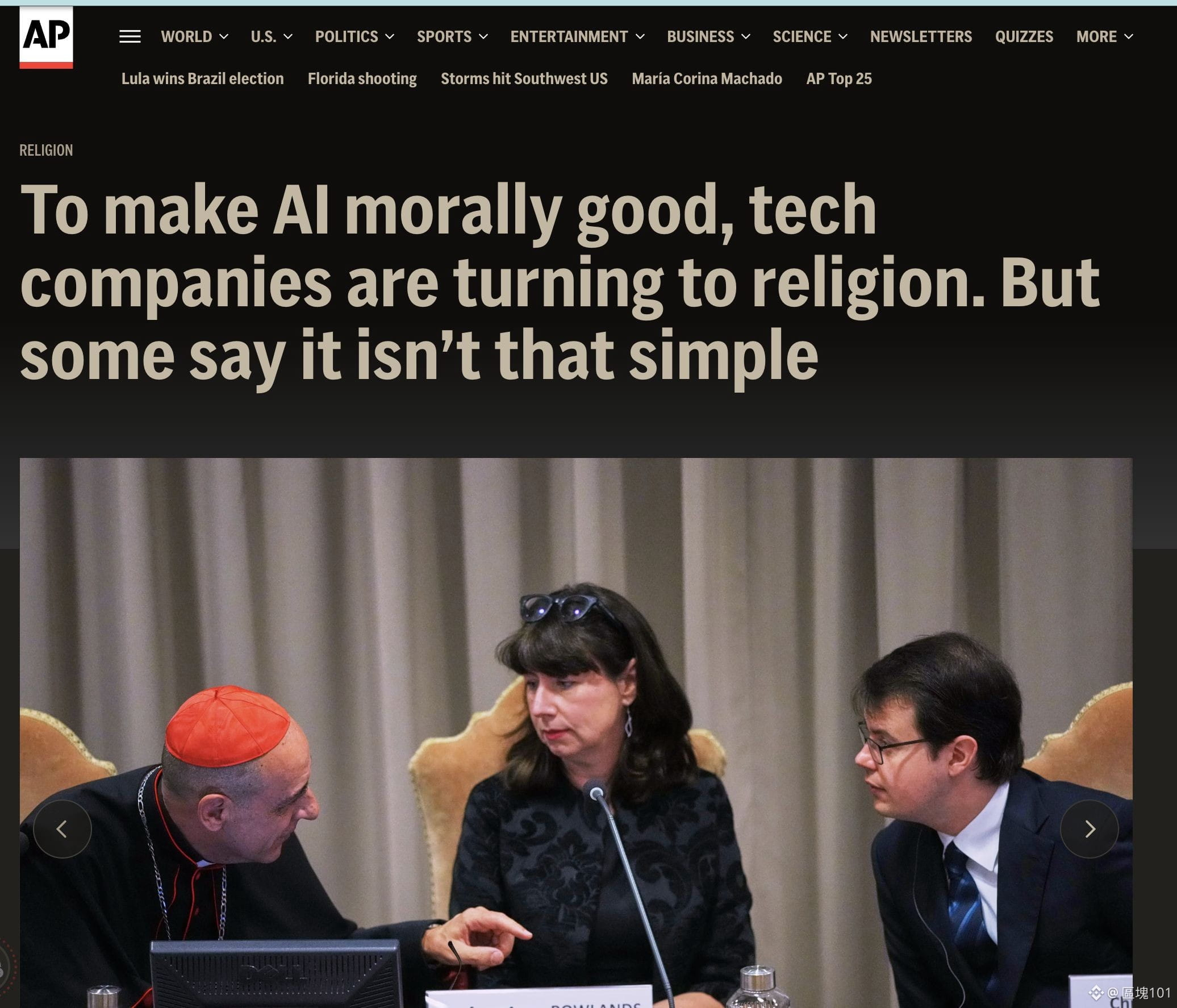
AI companies are doing something unexpected: inviting religious leaders and theologians to explore how AI can tell right from wrong.
According to a recent report by the Associated Press (AP), Anthropic has spoken with more than 15 religious and intercultural groups, hoping to find answers to AI ethics questions in thousands of years of human thought and tradition.
In May this year, Anthropic co-founder Christopher Olah even traveled to the Vatican to attend the announcement of Pope Leo XIV’s encyclical on artificial intelligence.
He believes the questions raised by AI have gone beyond the expertise of computer scientists and require input from religious groups, scholars, and society at large.
And Anthropic’s discussions with religious scholars have raised some unexpected questions.
For example:
• Do humans have souls?
• Should third-grade students use AI chatbots?
• How should AI understand morality and good and evil?
• Can the teachings of different religions help AI make better judgments?
Meghan Sullivan, a philosopher at the University of Notre Dame who took part in the discussions, said Anthropic’s approach was not simply to gather opinions. Instead, the company showed scholars how its models work, then delved into the ethical questions raised by the technology.
Anthropic is not alone. Representatives from Meta, Google, and Amazon have also spoken with the Vatican, while Microsoft has likewise been actively reaching out to religious groups.
However, this approach has also sparked new controversy.
Some scholars worry that if AI companies simply blend the values of different religions into a single set of universal rules, they could end up erasing important differences among religious traditions.
This reflects how AI development is entering a new phase.
In the past, tech companies mainly focused on making models more powerful and accurate.
Now, they must also grapple with a harder question:
When AI begins to take part in important decisions in human life, who should decide what values it holds?