

比特乔恩
881 Posts
比特乔恩
Report
Block User
7 Following
387 Followers
738 Liked
Posts
All
Live
·
--
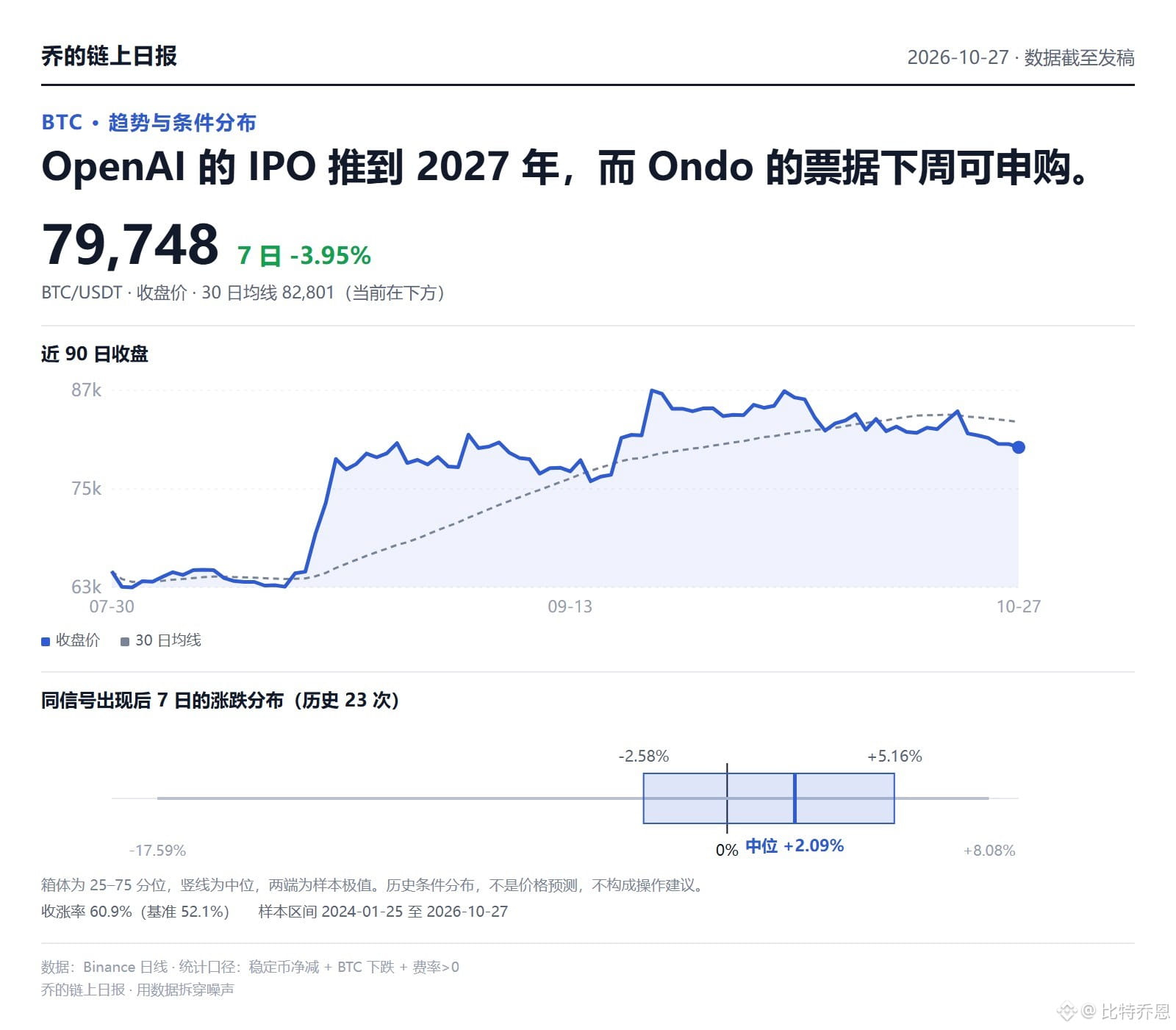
OpenAI’s IPO has been pushed to 2027, while Ondo’s note will be available for subscription next week.
[🤖 一级还没开,二级先有价,这条线进群一起盯](https://app.binance.com/uni-qr/SyhWRABY)
Under Ondo Finance’s arrangement, private clients can directly subscribe to this pre-IPO tokenized note. The product is already trading on the secondary market—the primary market hasn’t opened yet, but the secondary market already has a price. It’s like tickets going on sale before a show opens: the seats haven’t changed, but they already have a resale price.
The primary market hasn’t opened, but the secondary market has already set a price.
For regulators, the question is specific: Is this note equity, debt, or a derivative? Each classification comes with a different set of disclosure requirements and investor eligibility thresholds.
Keep an eye on 2027: if OpenAI’s IPO is pushed back further, the wait for this note will grow longer too.
#ondo下周开放openai上市前代币化票据认购
OpenAI’s IPO has been pushed to 2027, while Ondo’s note will be available for subscription next week.
🤖 一级还没开,二级先有价,这条线进群一起盯
Under Ondo Finance’s arrangement, private clients can directly subscribe to this pre-IPO tokenized note. The product is already trading on the secondary market—the primary market hasn’t opened yet, but the secondary market already has a price. It’s like tickets going on sale before a show opens: the seats haven’t changed, but they already have a resale price.
The primary market hasn’t opened, but the secondary market has already set a price.
For regulators, the question is specific: Is this note equity, debt, or a derivative? Each classification comes with a different set of disclosure requirements and investor eligibility thresholds.
Keep an eye on 2027: if OpenAI’s IPO is pushed back further, the wait for this note will grow longer too.
#ondo下周开放openai上市前代币化票据认购
4
·
--
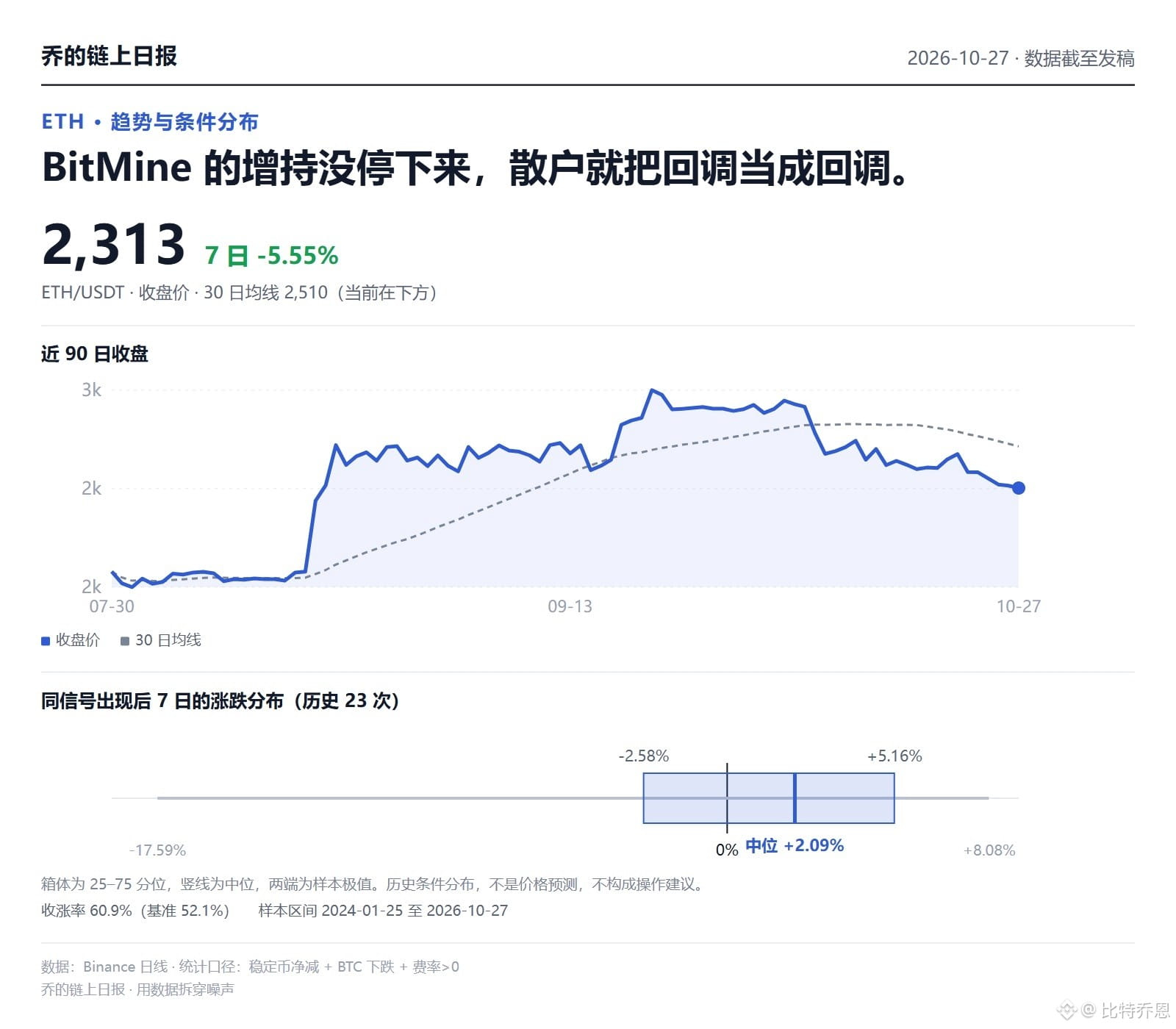
BitMine hasn't stopped adding to its holdings, and retail investors are treating the pullback as just a pullback.
[📊 嘴上说牛市,钱先回购自家股票,进群看这两笔](https://app.binance.com/uni-qr/SyhWRABY)
BitMine's latest purchase was 10,452 ETH, bringing its holdings to 4.95% of Ethereum's supply. Chairman Tom Lee said crypto has held up better than AI stocks during this downturn, and that the bull market is still underway.
In the same disclosure, it made an even bigger move: repurchasing 2.04 million of its own shares for $46 million. The company said this was the largest stock buyback among crypto treasury companies. As of October 25, its crypto, cash, marketable securities, and other investments totaled $15 billion.
It added fewer coins than the number of shares it repurchased.
If the next disclosure shows no new purchases but an even bigger buyback, or if Tom Lee stops saying the bull market is still underway, this thesis is invalidated.
#bitmine增持10452枚eth
BitMine hasn't stopped adding to its holdings, and retail investors are treating the pullback as just a pullback.
📊 嘴上说牛市,钱先回购自家股票,进群看这两笔
BitMine's latest purchase was 10,452 ETH, bringing its holdings to 4.95% of Ethereum's supply. Chairman Tom Lee said crypto has held up better than AI stocks during this downturn, and that the bull market is still underway.
In the same disclosure, it made an even bigger move: repurchasing 2.04 million of its own shares for $46 million. The company said this was the largest stock buyback among crypto treasury companies. As of October 25, its crypto, cash, marketable securities, and other investments totaled $15 billion.
It added fewer coins than the number of shares it repurchased.
If the next disclosure shows no new purchases but an even bigger buyback, or if Tom Lee stops saying the bull market is still underway, this thesis is invalidated.
#bitmine增持10452枚eth
81
·
--
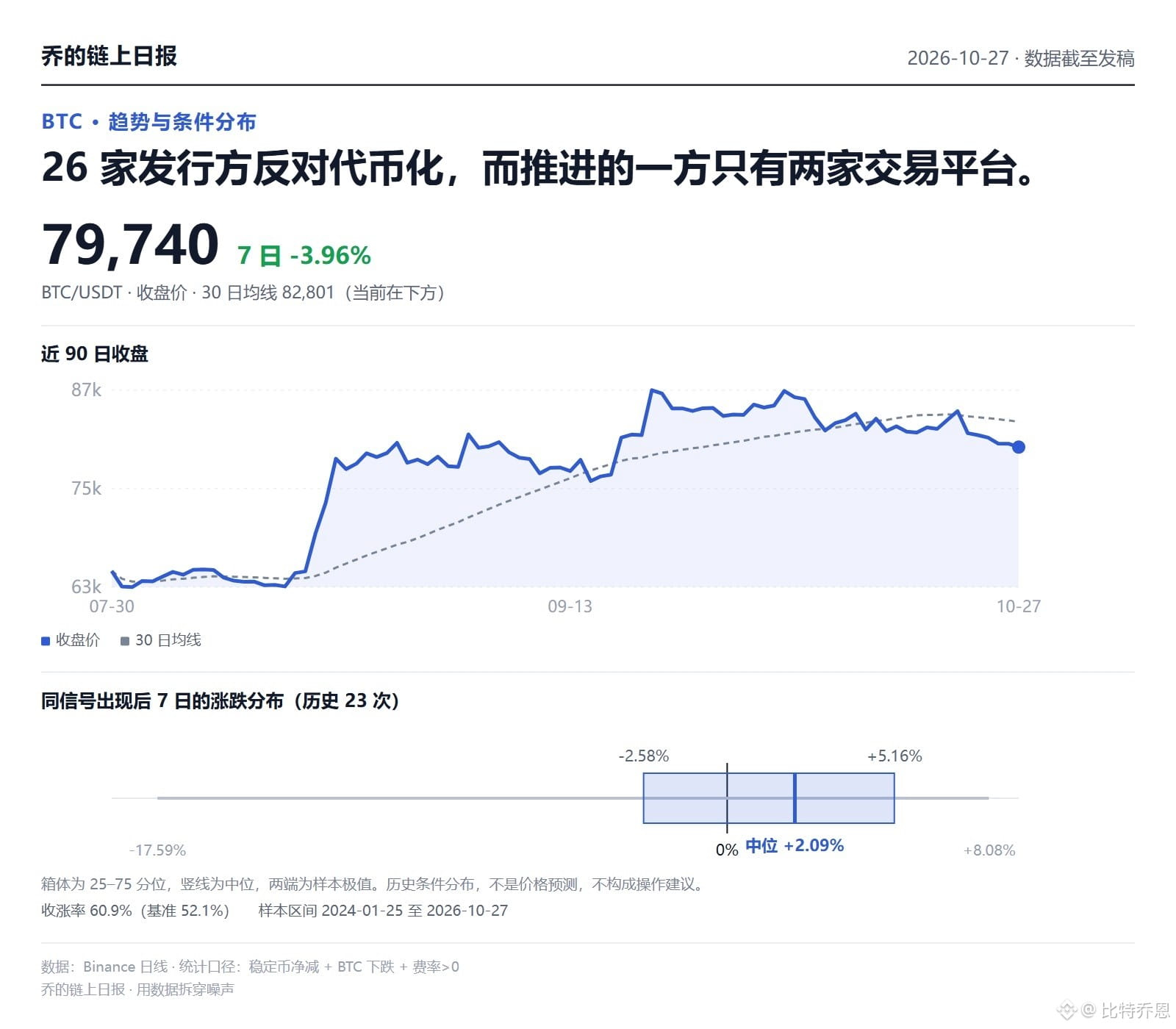
26 issuers oppose tokenization, while only two trading platforms are pushing it.
[⚖️ 26 家反对代币化,票在发行方手里,进群看名单](https://app.binance.com/uni-qr/SyhWRABY)
A Fox Business crypto reporter posted on X that four issuers—IBM, Oracle, Intel, and IonQ—oppose a leading exchange and ICE Markets tokenizing their stocks under the SEC’s innovation exemption, bringing the number of objecting issuers to 26. The exemption provides a channel for issuance, not the issuer’s consent; for institutions, the shares are theirs, and tokenization requires their sign-off. The bottleneck is authorization, not technology.
The issuers hold the cards.
If the list stays at 26 and tokenization continues to roll out as usual, this assessment will no longer hold; for now, the line of authorization is still moving upward.
26 issuers oppose tokenization, while only two trading platforms are pushing it.
⚖️ 26 家反对代币化,票在发行方手里,进群看名单
A Fox Business crypto reporter posted on X that four issuers—IBM, Oracle, Intel, and IonQ—oppose a leading exchange and ICE Markets tokenizing their stocks under the SEC’s innovation exemption, bringing the number of objecting issuers to 26. The exemption provides a channel for issuance, not the issuer’s consent; for institutions, the shares are theirs, and tokenization requires their sign-off. The bottleneck is authorization, not technology.
The issuers hold the cards.
If the list stays at 26 and tokenization continues to roll out as usual, this assessment will no longer hold; for now, the line of authorization is still moving upward.
·
--
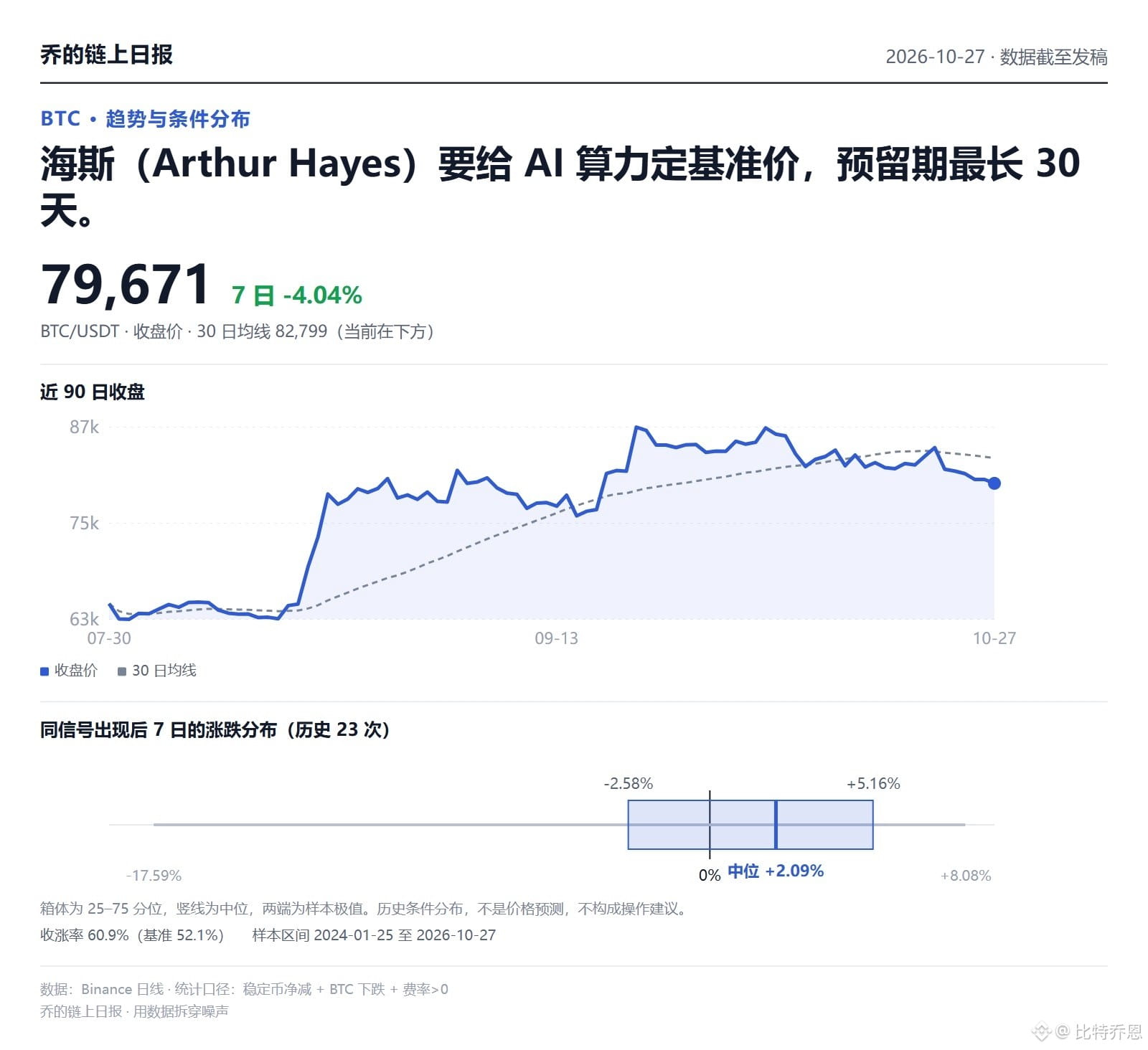
Arthur Hayes wants to set a benchmark price for AI compute, with reservation periods of up to 30 days.
[🤖 算力基准价一落地,比价就变了,进群看](https://app.binance.com/uni-qr/SyhWRABY)
His view is that compute has no globally unified price, and that chip and AI token prices are merely derivatives of compute—so compute itself should be priced.
The plan is to turn Flop Network into a ledger that produces a block every second. Block receipts would record inference-task latency, floating-point operations, and transaction fees, which would be used to calculate the exchange rate between FLOP and compute. This would then be standardized into tradable FCU, with quarterly and perpetual contracts that are USD-margined and cash-settled.
This news isn’t moving token prices; it’s changing the anchor for relative pricing. Chips and AI tokens are each priced on their own, but once compute has publicly quoted forward prices, cross-market valuations have a benchmark.
There’s only one thing to watch next: whether any over-the-counter compute rentals start quoting prices based on this exchange rate, or whether FCU sees real trades. If, after two weeks, there are still only articles and no quotes, the thesis is void.
Arthur Hayes wants to set a benchmark price for AI compute, with reservation periods of up to 30 days.
🤖 算力基准价一落地,比价就变了,进群看
His view is that compute has no globally unified price, and that chip and AI token prices are merely derivatives of compute—so compute itself should be priced.
The plan is to turn Flop Network into a ledger that produces a block every second. Block receipts would record inference-task latency, floating-point operations, and transaction fees, which would be used to calculate the exchange rate between FLOP and compute. This would then be standardized into tradable FCU, with quarterly and perpetual contracts that are USD-margined and cash-settled.
This news isn’t moving token prices; it’s changing the anchor for relative pricing. Chips and AI tokens are each priced on their own, but once compute has publicly quoted forward prices, cross-market valuations have a benchmark.
There’s only one thing to watch next: whether any over-the-counter compute rentals start quoting prices based on this exchange rate, or whether FCU sees real trades. If, after two weeks, there are still only articles and no quotes, the thesis is void.
26
·
--
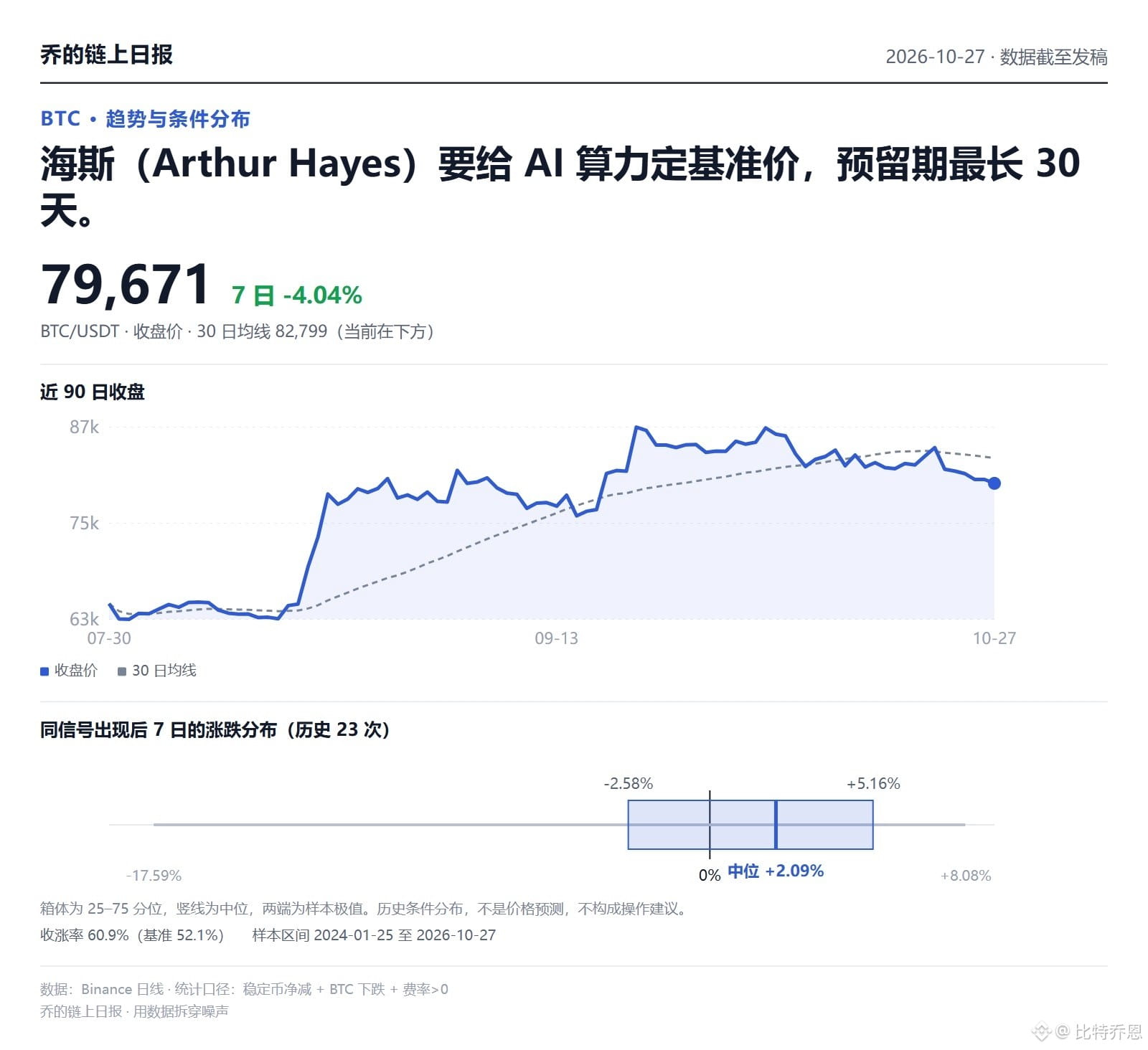
Arthur Hayes wants to set a benchmark price for AI compute, with reservation periods of up to 30 days.
[🤖 算力基准价一落地,比价就变了,进群看](https://app.binance.com/uni-qr/SyhWRABY)
His view is that compute has no globally unified price: chip prices and AI token prices are merely derivatives of compute, so compute itself should be priced.
The plan is to turn Flop Network into a ledger that produces a block every second. Block receipts record the latency, floating-point operations, and transaction fees of inference tasks. These are used to calculate the exchange rate between FLOP and compute, then standardize it into tradable FCU, with quarterly and perpetual contracts that are USD-margined and cash-settled.
This doesn’t move token prices; it changes the benchmark for comparing them. Chips and AI tokens are each priced on their own. Once compute has publicly quoted forward prices, cross-market valuations will have a reference point.
For now, there’s just one thing to watch: whether any over-the-counter compute rentals start quoting prices based on this exchange rate, or whether FCU sees actual trades. If, after two weeks, there are still only articles and no quotes, the thesis is invalidated.
Arthur Hayes wants to set a benchmark price for AI compute, with reservation periods of up to 30 days.
🤖 算力基准价一落地,比价就变了,进群看
His view is that compute has no globally unified price: chip prices and AI token prices are merely derivatives of compute, so compute itself should be priced.
The plan is to turn Flop Network into a ledger that produces a block every second. Block receipts record the latency, floating-point operations, and transaction fees of inference tasks. These are used to calculate the exchange rate between FLOP and compute, then standardize it into tradable FCU, with quarterly and perpetual contracts that are USD-margined and cash-settled.
This doesn’t move token prices; it changes the benchmark for comparing them. Chips and AI tokens are each priced on their own. Once compute has publicly quoted forward prices, cross-market valuations will have a reference point.
For now, there’s just one thing to watch: whether any over-the-counter compute rentals start quoting prices based on this exchange rate, or whether FCU sees actual trades. If, after two weeks, there are still only articles and no quotes, the thesis is invalidated.
24
·
--
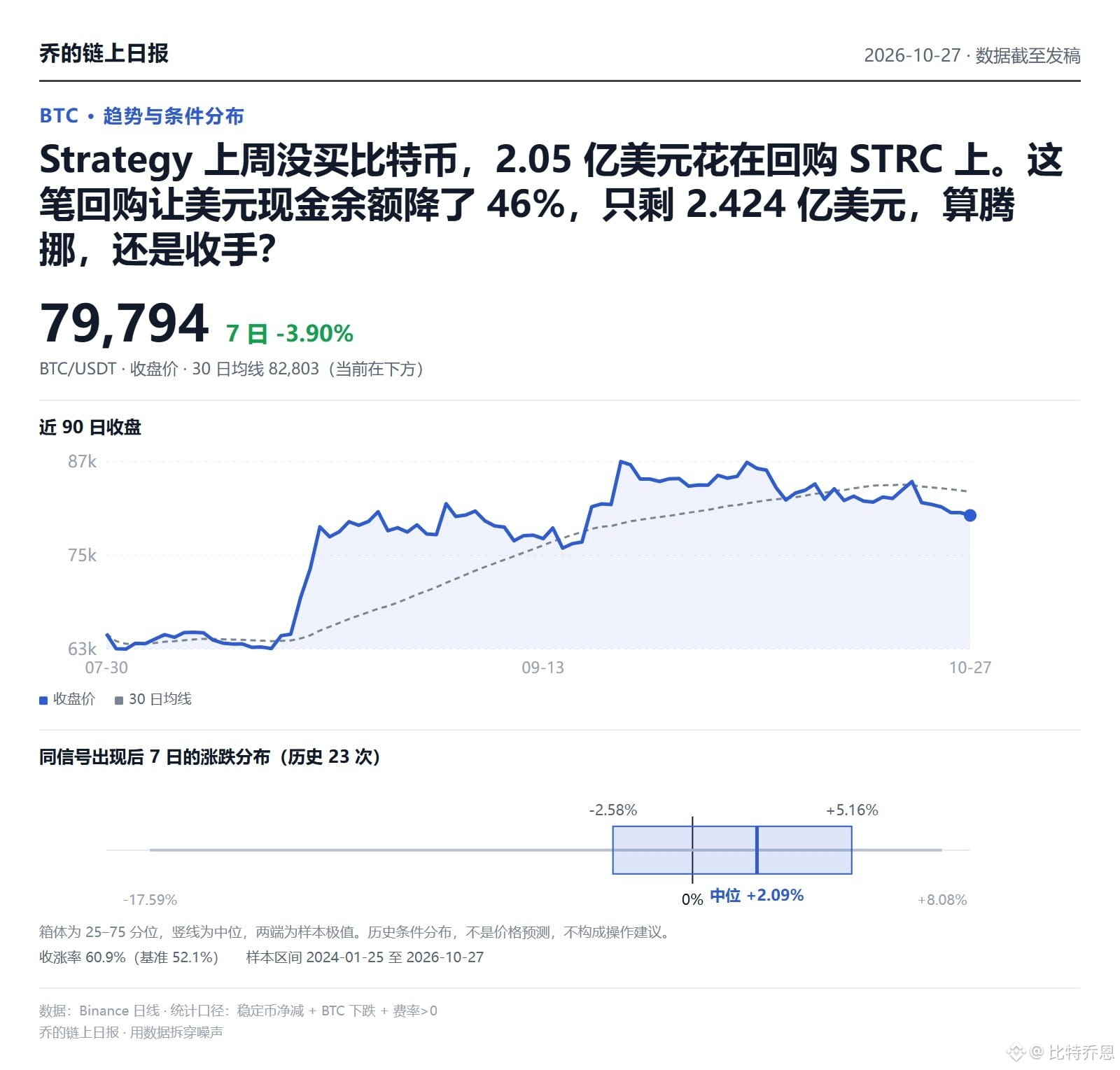
Strategy didn’t buy Bitcoin last week. It spent $205 million buying back STRC. The buyback reduced its cash balance by 46%, leaving just $242.4 million. Is this a reshuffle—or a retreat?
[💬 一个在回购优先股,一个在发新债买币,进群看站位](https://app.binance.com/uni-qr/SyhWRABY)
As of October 25, Strategy held 848,517 bitcoins and $5.1 billion in dollar assets. In the same week, Strive signed at-the-market offering agreements with seven institutions, proposing to sell up to $1 billion in 15% dividend-paying SATS preferred stock, with some of the proceeds earmarked for buying Bitcoin. One is returning cash to preferred shareholders, while the other is borrowing money at a 15% cost—two Bitcoin-hoarding companies, on the same metric, have ended up on opposite sides.
One is paying out. The other is borrowing.
#strategy未购比特币斥资2.05亿美元回购strc
Strategy didn’t buy Bitcoin last week. It spent $205 million buying back STRC. The buyback reduced its cash balance by 46%, leaving just $242.4 million. Is this a reshuffle—or a retreat?
💬 一个在回购优先股,一个在发新债买币,进群看站位
As of October 25, Strategy held 848,517 bitcoins and $5.1 billion in dollar assets. In the same week, Strive signed at-the-market offering agreements with seven institutions, proposing to sell up to $1 billion in 15% dividend-paying SATS preferred stock, with some of the proceeds earmarked for buying Bitcoin. One is returning cash to preferred shareholders, while the other is borrowing money at a 15% cost—two Bitcoin-hoarding companies, on the same metric, have ended up on opposite sides.
One is paying out. The other is borrowing.
#strategy未购比特币斥资2.05亿美元回购strc
1.1k
·
--
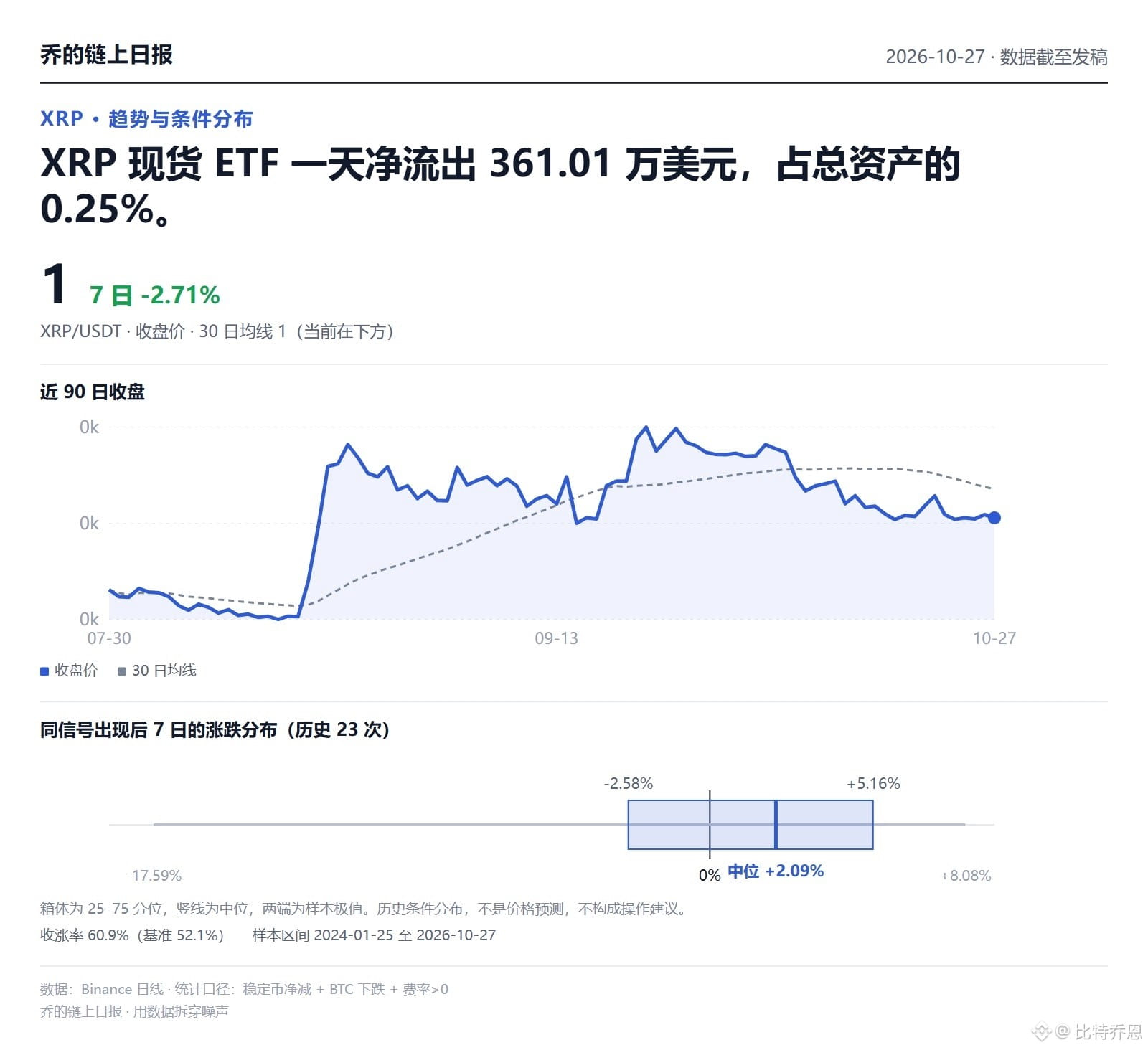
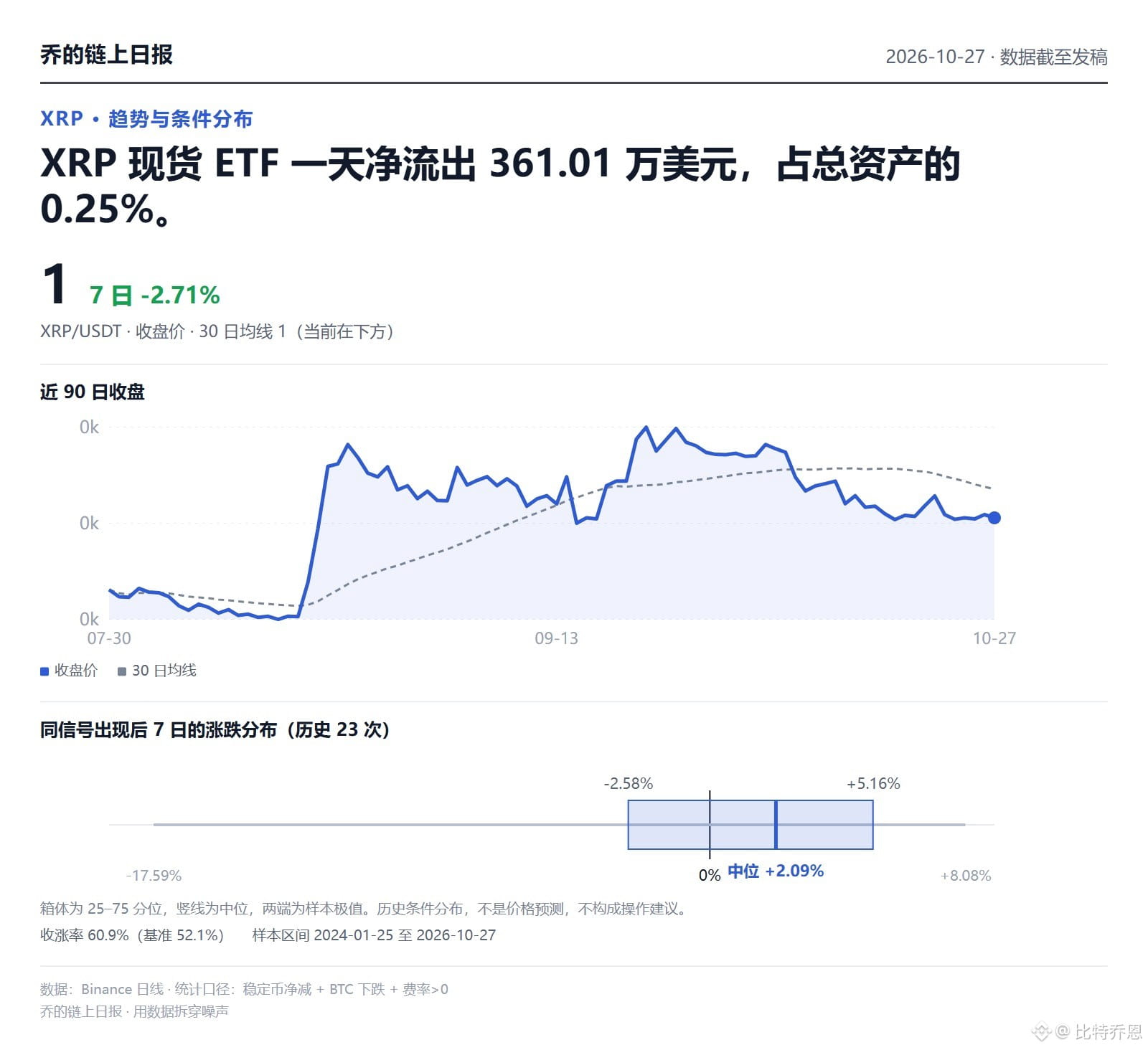
XRP spot ETFs saw net outflows of $3.6101 million in one day, equal to 0.25% of total assets.
[💰 0.25% 的流出算噪音吗,进群看申赎往哪走](https://app.binance.com/uni-qr/SyhWRABY)
Against a total asset base of $1.469 billion, this amount isn’t even enough to represent a single redemption by holders. On October 26, U.S. Eastern Time, only Bitwise’s XRP ETF recorded outflows, amounting to $3.6101 million for the day.
XRP spot ETFs have seen cumulative historical net inflows of $1.801 billion. Bitwise’s fund alone has recorded historical net inflows of $680 million, so today’s $3.6101 million outflow represents just 0.5% of its own total.
The key thing to watch is whether the outflows spread from one fund to several. Today, only Bitwise saw outflows. If two or more funds record simultaneous net outflows over the next two trading days, that would indicate a shift in the direction of creations and redemptions.
A single-day outflow of 0.25% isn’t enough to establish a trend.
#比特币重回8.4万美元
XRP spot ETFs saw net outflows of $3.6101 million in one day, equal to 0.25% of total assets.
💰 0.25% 的流出算噪音吗,进群看申赎往哪走
Against a total asset base of $1.469 billion, this amount isn’t even enough to represent a single redemption by holders. On October 26, U.S. Eastern Time, only Bitwise’s XRP ETF recorded outflows, amounting to $3.6101 million for the day.
XRP spot ETFs have seen cumulative historical net inflows of $1.801 billion. Bitwise’s fund alone has recorded historical net inflows of $680 million, so today’s $3.6101 million outflow represents just 0.5% of its own total.
The key thing to watch is whether the outflows spread from one fund to several. Today, only Bitwise saw outflows. If two or more funds record simultaneous net outflows over the next two trading days, that would indicate a shift in the direction of creations and redemptions.
A single-day outflow of 0.25% isn’t enough to establish a trend.
#比特币重回8.4万美元
61
·
--
XRP spot ETFs saw a net outflow of $3.6101 million in one day, equal to 0.25% of total assets.
[💰 0.25% 的流出算噪音吗,进群看申赎往哪走](https://app.binance.com/uni-qr/SyhWRABY)
Against a total of $1.469 billion, that amount isn’t even enough for holders to make a single redemption. On October 26, Eastern Time, only Bitwise’s XRP ETF saw outflows, totaling $3.6101 million for the day.
Cumulative historical net inflows into XRP spot ETFs stand at $1.801 billion. Bitwise’s ETF has seen historical net inflows of $680 million, so today’s $3.6101 million outflow represents just 0.5% of its own inflows.
The key thing to watch is whether outflows spread from one fund to several. Bitwise was the only one today; if two or more funds see simultaneous net outflows over the next two trading days, that would indicate a shift in the direction of creations and redemptions.
A single-day outflow of 0.25% isn’t enough to establish a trend.
#比特币重回8.4万美元
XRP spot ETFs saw a net outflow of $3.6101 million in one day, equal to 0.25% of total assets.
💰 0.25% 的流出算噪音吗,进群看申赎往哪走
Against a total of $1.469 billion, that amount isn’t even enough for holders to make a single redemption. On October 26, Eastern Time, only Bitwise’s XRP ETF saw outflows, totaling $3.6101 million for the day.
Cumulative historical net inflows into XRP spot ETFs stand at $1.801 billion. Bitwise’s ETF has seen historical net inflows of $680 million, so today’s $3.6101 million outflow represents just 0.5% of its own inflows.
The key thing to watch is whether outflows spread from one fund to several. Bitwise was the only one today; if two or more funds see simultaneous net outflows over the next two trading days, that would indicate a shift in the direction of creations and redemptions.
A single-day outflow of 0.25% isn’t enough to establish a trend.
#比特币重回8.4万美元
65
·
--
Reading this as the UK regulating algorithms is a misinterpretation; it regulates who takes that step on behalf of users.
[👉 门槛不在算法在决策权,细则落地先进群对着看](https://app.binance.com/uni-qr/SyhWRABY)
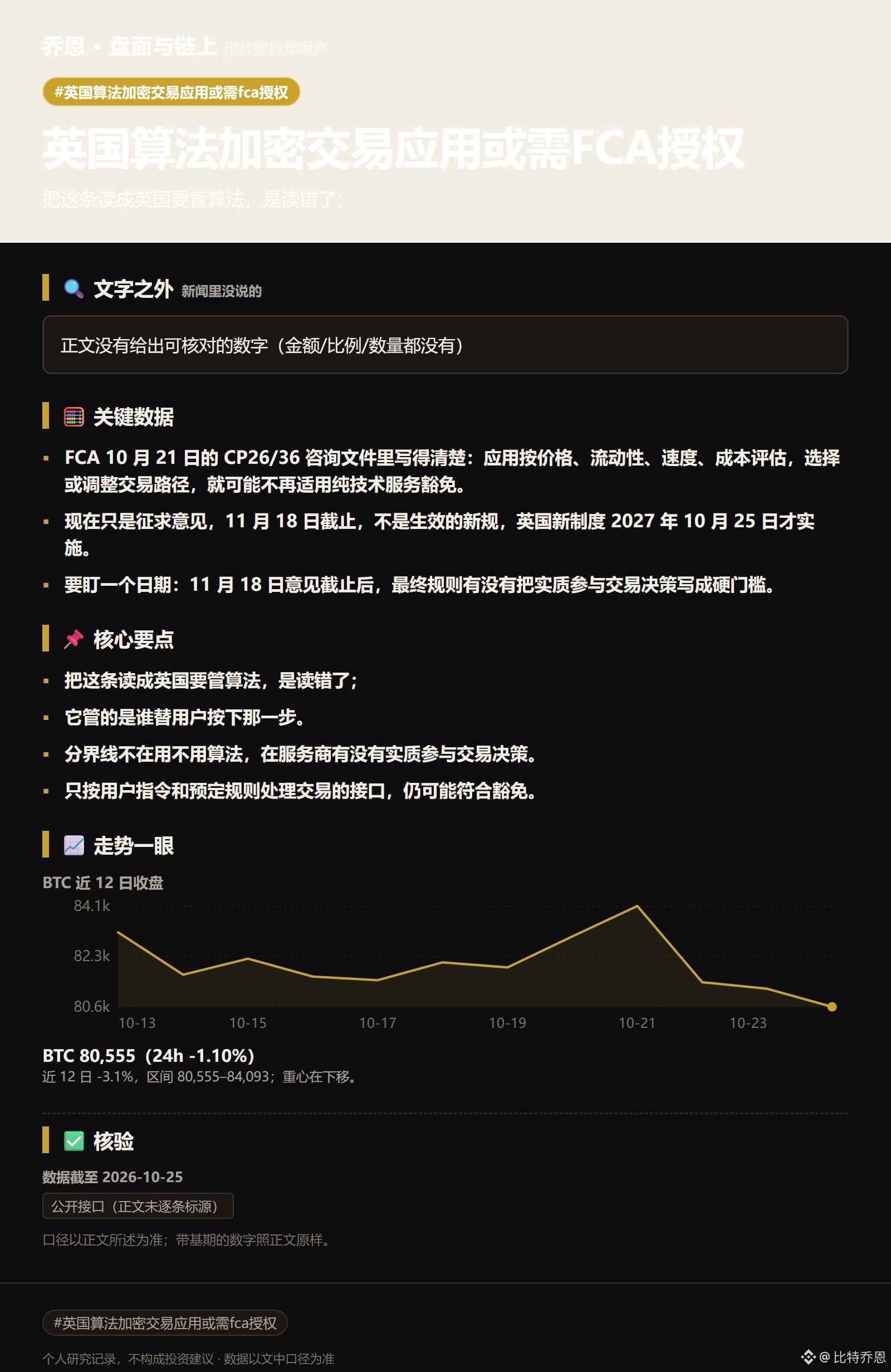
The FCA’s consultation paper CP26/36, published on 21 October, is clear: an app that assesses price, liquidity, speed and cost, and selects or adjusts a trading route, may no longer qualify for the exemption for purely technical services.
The dividing line is not whether an algorithm is used, but whether the service provider is substantively involved in trading decisions.
An interface that processes transactions only according to user instructions and predefined rules may still qualify for the exemption.
Here’s the crux: if a service is deemed purely technical, it does not need authorisation; if it is deemed to participate in decision-making, it does. This is only a consultation, with responses due by 18 November—not a new rule in force. The UK’s new regime will not take effect until 25 October 2027.
One date to watch: after the consultation closes on 18 November, will the final rules make substantive involvement in trading decisions a hard threshold?
#英国算法加密交易应用或需fca授权
Reading this as the UK regulating algorithms is a misinterpretation; it regulates who takes that step on behalf of users.
👉 门槛不在算法在决策权,细则落地先进群对着看
The FCA’s consultation paper CP26/36, published on 21 October, is clear: an app that assesses price, liquidity, speed and cost, and selects or adjusts a trading route, may no longer qualify for the exemption for purely technical services.
The dividing line is not whether an algorithm is used, but whether the service provider is substantively involved in trading decisions.
An interface that processes transactions only according to user instructions and predefined rules may still qualify for the exemption.
Here’s the crux: if a service is deemed purely technical, it does not need authorisation; if it is deemed to participate in decision-making, it does. This is only a consultation, with responses due by 18 November—not a new rule in force. The UK’s new regime will not take effect until 25 October 2027.
One date to watch: after the consultation closes on 18 November, will the final rules make substantive involvement in trading decisions a hard threshold?
#英国算法加密交易应用或需fca授权
1.2k
·
--
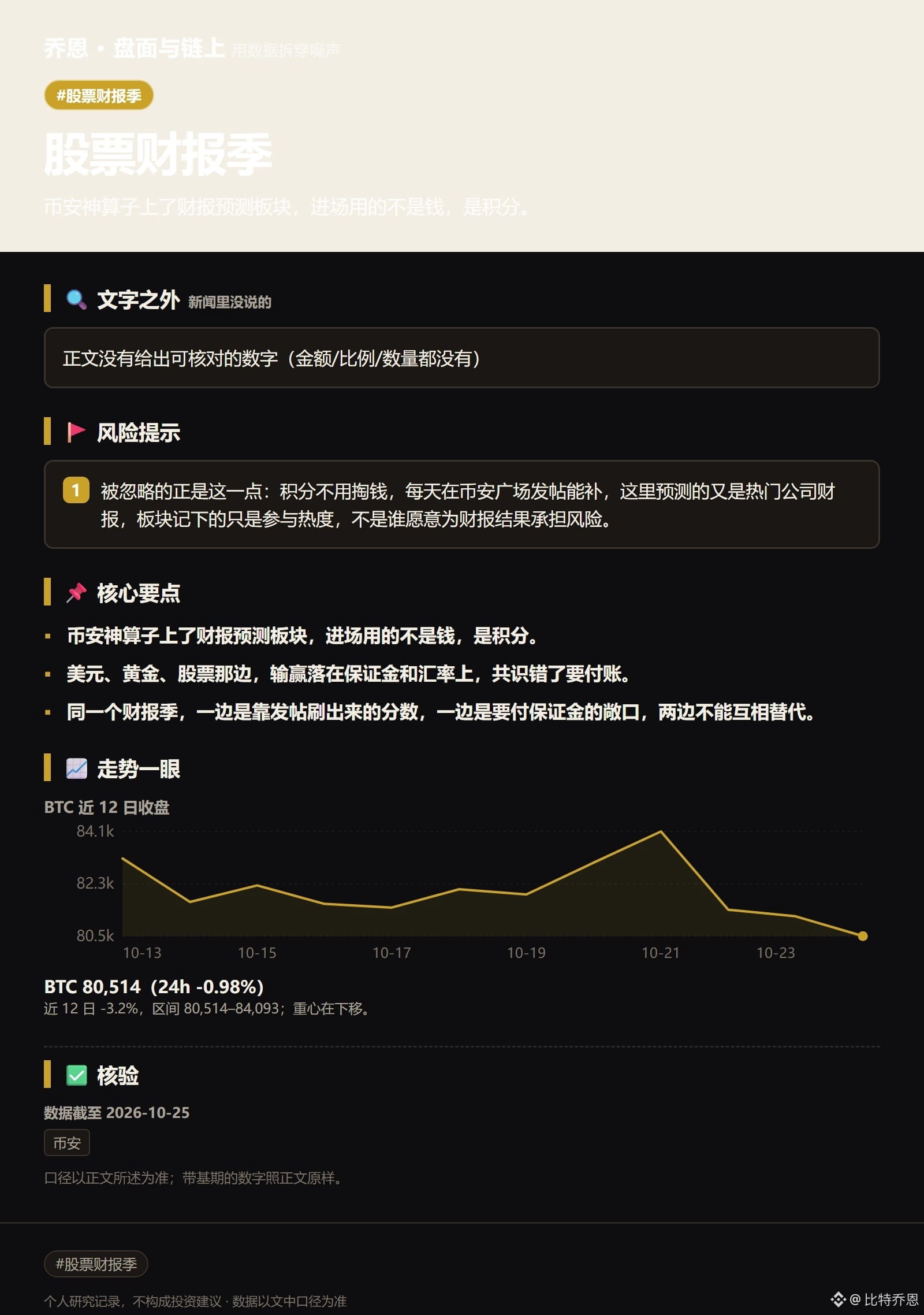
Binance Oracle has added an earnings prediction section, where you enter with points, not money.
[📈 积分刷得出热度,刷不出仓位,财报季的账进群一起算](https://app.binance.com/uni-qr/SyhWRABY)
The key point is being overlooked: points don’t cost anything—you can earn them by posting on Binance Square every day. And the predictions here are about popular companies’ earnings, so the section records how much people participate, not who’s willing to take on risk over the results. With the dollar, gold, and stocks, gains and losses come down to margin and exchange rates; if the consensus is wrong, you pay for it. In the same earnings season, one side is points earned by posting, while the other is exposure backed by margin. The two aren’t interchangeable.
If, over time, the distribution of points in this earnings prediction section consistently moves in the same direction as the dollar and gold in response to the same earnings reports, then it’s more than just a measure of interest—it’s pricing in expectations ahead of time, and this assessment would need to change.
#股票财报季
Binance Oracle has added an earnings prediction section, where you enter with points, not money.
📈 积分刷得出热度,刷不出仓位,财报季的账进群一起算
The key point is being overlooked: points don’t cost anything—you can earn them by posting on Binance Square every day. And the predictions here are about popular companies’ earnings, so the section records how much people participate, not who’s willing to take on risk over the results. With the dollar, gold, and stocks, gains and losses come down to margin and exchange rates; if the consensus is wrong, you pay for it. In the same earnings season, one side is points earned by posting, while the other is exposure backed by margin. The two aren’t interchangeable.
If, over time, the distribution of points in this earnings prediction section consistently moves in the same direction as the dollar and gold in response to the same earnings reports, then it’s more than just a measure of interest—it’s pricing in expectations ahead of time, and this assessment would need to change.
#股票财报季
2
5.1k
·
--
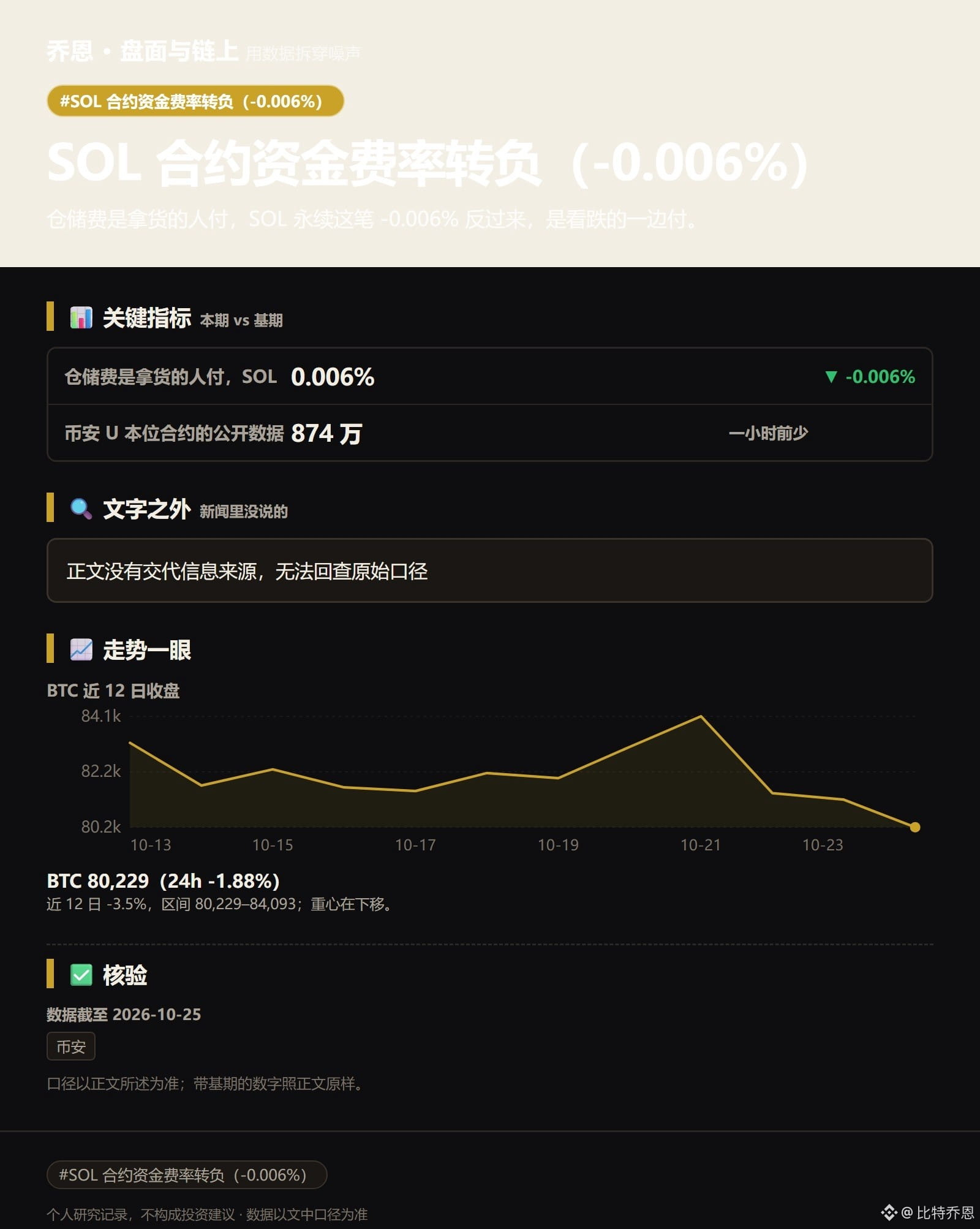
In commodities, the people holding the goods pay the storage costs. With this SOL perpetual, the -0.006% works in reverse: the bearish side pays.
[🔄 负费率配缩仓,掏钱的是旧空头,进群对着数据看](https://app.binance.com/uni-qr/SyhWRABY)
In commodity markets, whoever puts goods in a warehouse bears the cost of holding them. In perpetuals, when the funding rate is negative, shorts pay longs to keep holding their short positions. This payment only tells you who is willing to pay; it doesn’t tell you where prices are headed.
The difference is in open interest. Public data for Binance USDⓈ-M futures shows 8.74 million SOL in open interest, down 0.3% from an hour ago, with a mark price of 100.37. The rate has flipped, but positions haven’t grown along with it—they’ve actually shrunk.
In the altcoin space, RWA is about bringing off-chain assets onto the blockchain. The money coming in is slow-moving money that can stay put; the money moving in perpetuals over this past hour is fast money.
If open interest rises along with the funding rate in the next data update, that would show new shorts are truly entering the market. If the rate merely turns negative without open interest rising, it’s still the same group paying.
#市场定价美联储下周加息概率仅10%
In commodities, the people holding the goods pay the storage costs. With this SOL perpetual, the -0.006% works in reverse: the bearish side pays.
🔄 负费率配缩仓,掏钱的是旧空头,进群对着数据看
In commodity markets, whoever puts goods in a warehouse bears the cost of holding them. In perpetuals, when the funding rate is negative, shorts pay longs to keep holding their short positions. This payment only tells you who is willing to pay; it doesn’t tell you where prices are headed.
The difference is in open interest. Public data for Binance USDⓈ-M futures shows 8.74 million SOL in open interest, down 0.3% from an hour ago, with a mark price of 100.37. The rate has flipped, but positions haven’t grown along with it—they’ve actually shrunk.
In the altcoin space, RWA is about bringing off-chain assets onto the blockchain. The money coming in is slow-moving money that can stay put; the money moving in perpetuals over this past hour is fast money.
If open interest rises along with the funding rate in the next data update, that would show new shorts are truly entering the market. If the rate merely turns negative without open interest rising, it’s still the same group paying.
#市场定价美联储下周加息概率仅10%
15
·
--
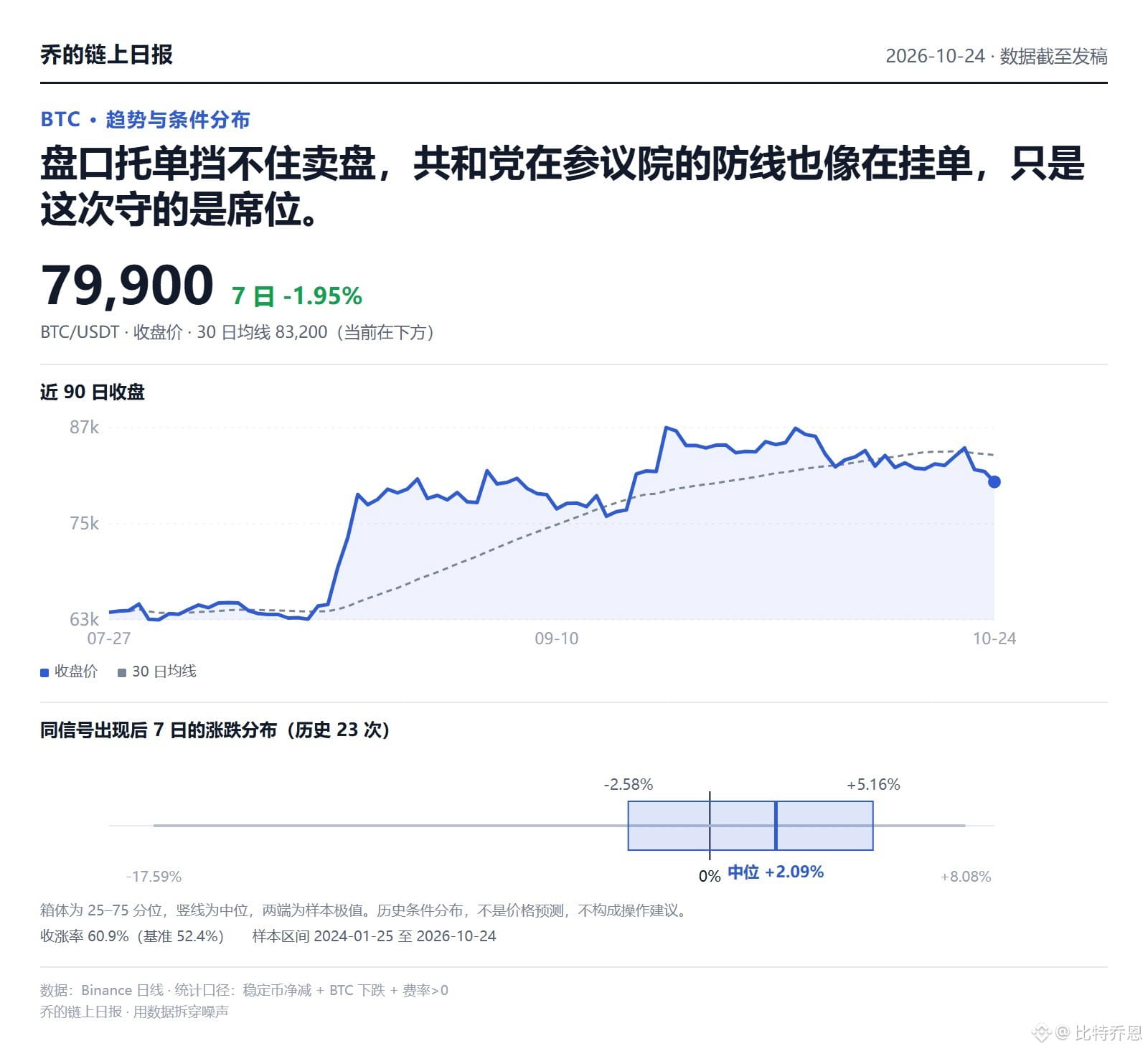
Buy orders can’t hold back selling pressure, and the Republicans’ Senate defenses look like resting orders—only this time, they’re defending seats.
[🔥 托单能堆,席位不能,点进群看最后两周](https://app.binance.com/uni-qr/SyhWRABY)
On October 24, Bloomberg reported that with fewer than two weeks until the November 3 vote, Democrats were expanding their Senate map while Republicans shored up their traditional strongholds. Trump was campaigning in states such as South Carolina and Mississippi, where he has a strong base of support; Republicans were relying on hundreds of millions of dollars from Musk and Trump’s super PAC to maintain their defenses.
The difference is that buy orders defend a price level, while Republicans have to hold three red-wall states: Iowa, Ohio and Alaska. On the Democratic side, the early-2025 target list included only North Carolina and Maine, but Texas, Iowa and Kansas were later added.
Money can be placed as a resting order, but seats can’t. Democrats need a net gain of four seats to retake the Senate. Republican advisers say their chances of holding on are still better than even, but acknowledge that campaign spending is delivering diminishing returns.
The buy orders keep piling up, and the defense has grown from holding one price level to holding a string of states. That’s where this defensive effort and the market analogy stop lining up.
Buy orders can’t hold back selling pressure, and the Republicans’ Senate defenses look like resting orders—only this time, they’re defending seats.
🔥 托单能堆,席位不能,点进群看最后两周
On October 24, Bloomberg reported that with fewer than two weeks until the November 3 vote, Democrats were expanding their Senate map while Republicans shored up their traditional strongholds. Trump was campaigning in states such as South Carolina and Mississippi, where he has a strong base of support; Republicans were relying on hundreds of millions of dollars from Musk and Trump’s super PAC to maintain their defenses.
The difference is that buy orders defend a price level, while Republicans have to hold three red-wall states: Iowa, Ohio and Alaska. On the Democratic side, the early-2025 target list included only North Carolina and Maine, but Texas, Iowa and Kansas were later added.
Money can be placed as a resting order, but seats can’t. Democrats need a net gain of four seats to retake the Senate. Republican advisers say their chances of holding on are still better than even, but acknowledge that campaign spending is delivering diminishing returns.
The buy orders keep piling up, and the defense has grown from holding one price level to holding a string of states. That’s where this defensive effort and the market analogy stop lining up.
46
·
--
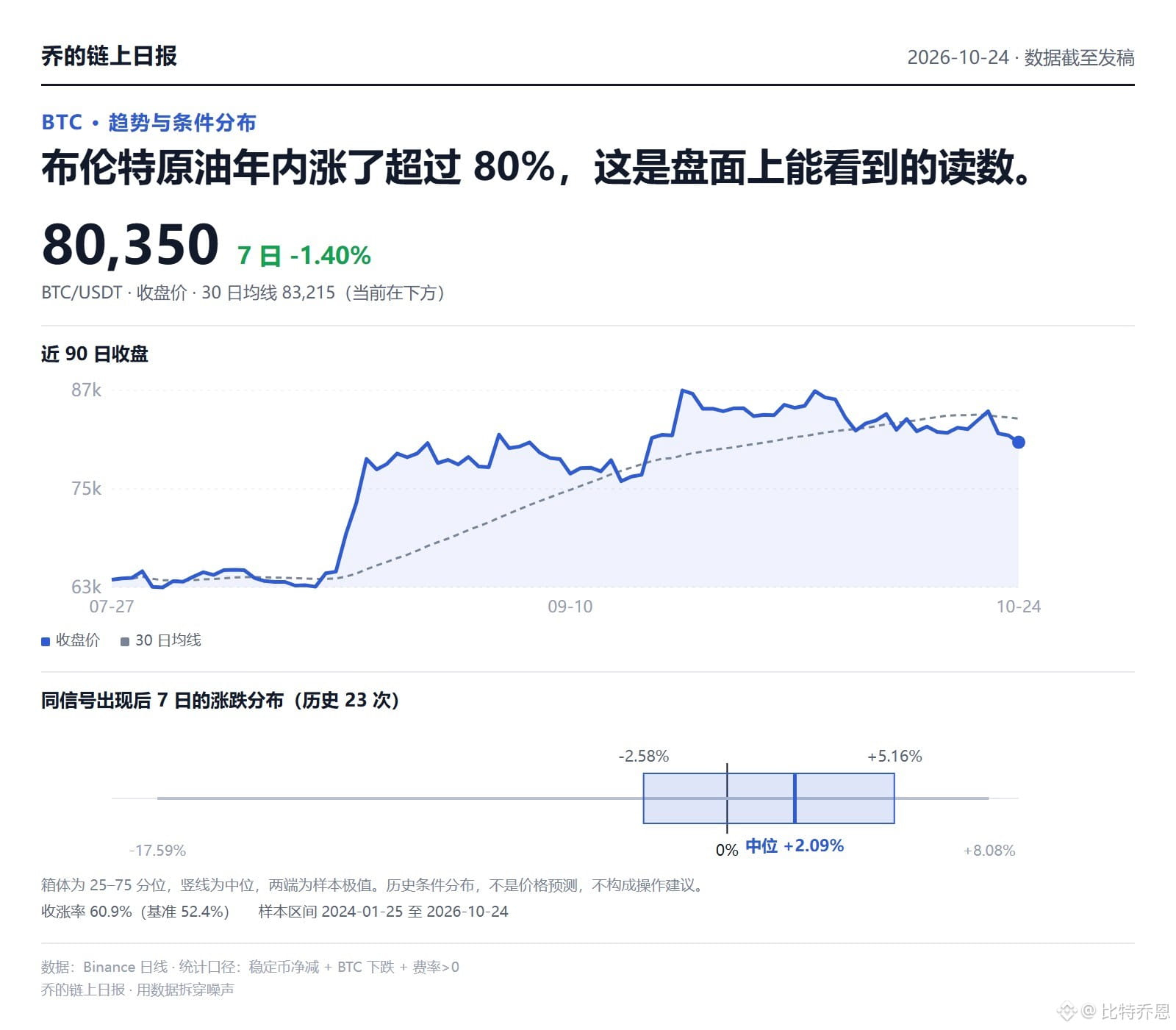
Brent crude is up more than 80% year to date—that’s what the market is showing.
[🚀 80% 之后还认不认,点进群盯下次部署](https://app.binance.com/uni-qr/SyhWRABY)
On October 24, Bloomberg reported that the U.S. was stepping up deployments in preparation for resuming military strikes on Iran. A third carrier strike group and 10,000 sailors and Marines are being sent to the Persian Gulf, though the exact timing remains uncertain. Trump hinted that strikes could resume after the November 3 midterm elections.
The news and the market reading point in the same direction. The report said concerns about military escalation had pushed oil prices higher again. After Houthi militants attacked Saudi airports and energy facilities, the U.S. State Department ordered some diplomatic staff and their families to leave Saudi Arabia. Iran is preparing for a new round of bombing around the midterms and planning retaliation against Israel and the UAE.
The two signals line up; there’s no divergence in direction. What matters is whether oil prices respond to this news the next time around: if deployments continue to increase but prices don’t rise, it means the market has already priced in the escalation. If prices follow the new deployments higher for a while, the reading is still the same.
Brent crude is up more than 80% year to date—that’s what the market is showing.
🚀 80% 之后还认不认,点进群盯下次部署
On October 24, Bloomberg reported that the U.S. was stepping up deployments in preparation for resuming military strikes on Iran. A third carrier strike group and 10,000 sailors and Marines are being sent to the Persian Gulf, though the exact timing remains uncertain. Trump hinted that strikes could resume after the November 3 midterm elections.
The news and the market reading point in the same direction. The report said concerns about military escalation had pushed oil prices higher again. After Houthi militants attacked Saudi airports and energy facilities, the U.S. State Department ordered some diplomatic staff and their families to leave Saudi Arabia. Iran is preparing for a new round of bombing around the midterms and planning retaliation against Israel and the UAE.
The two signals line up; there’s no divergence in direction. What matters is whether oil prices respond to this news the next time around: if deployments continue to increase but prices don’t rise, it means the market has already priced in the escalation. If prices follow the new deployments higher for a while, the reading is still the same.
32
·
--
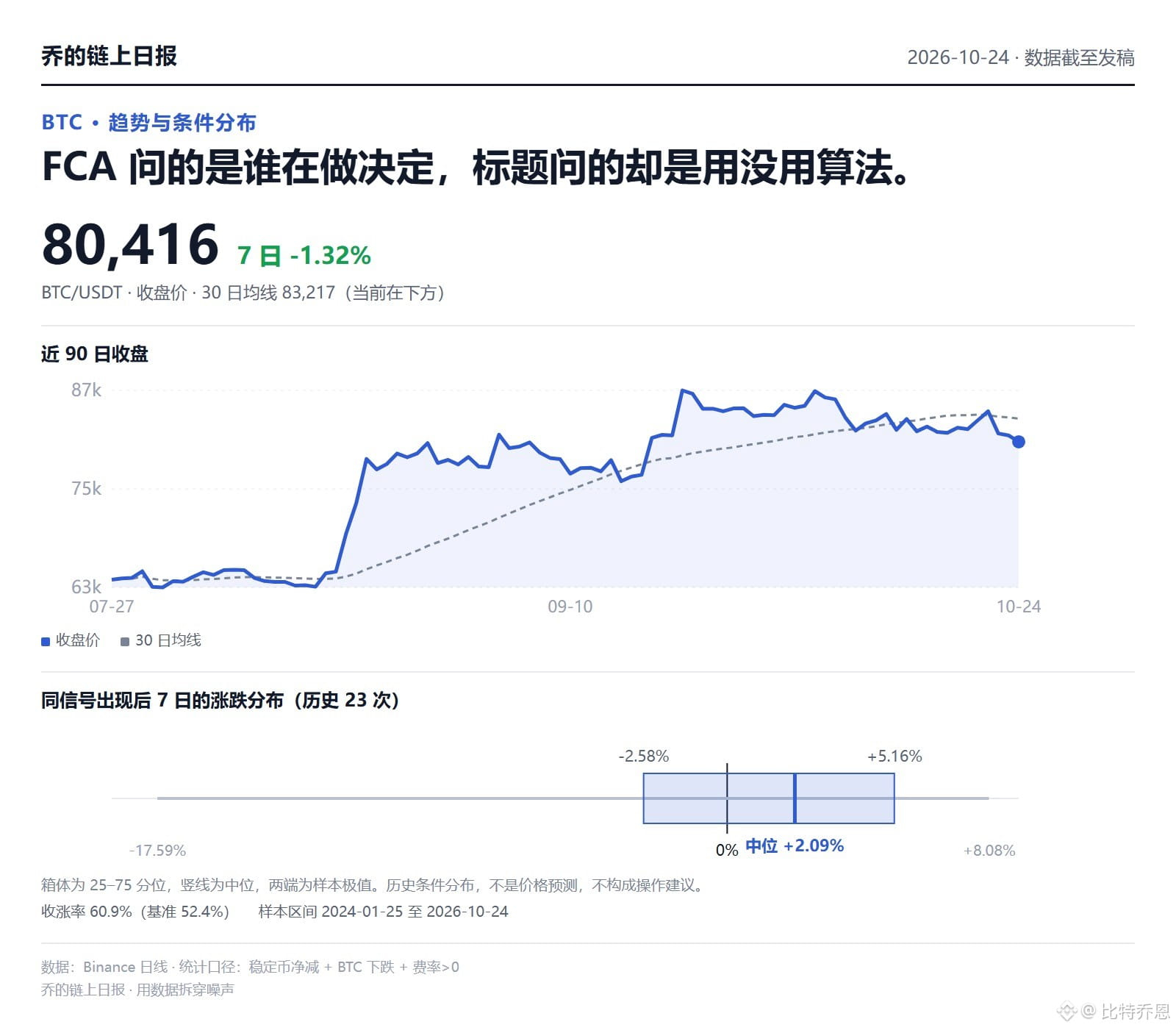
The FCA asks who is making the decision; the headline asks whether an algorithm is being used.
[⚖️ 分界线在谁做决定,这条我跟着咨询走,进群看](https://app.binance.com/uni-qr/SyhWRABY)
The FCA’s CP26/36 consultation paper, published on October 21, asks just one thing: if an app selects or adjusts trading routes based on price, liquidity, speed or cost, does it still count as a “purely technical service”? The key issue isn’t the algorithm, but whether the provider has substantive involvement in trading decisions. An interface that processes trades solely according to user instructions and predetermined objective rules may still qualify for the exemption.
This is still just a consultation. The deadline is November 18.
For apps under the new regime, the options are clear: leave routing decisions in the hands of users and objective rules, or obtain authorisation. The UK’s new crypto regulatory regime takes effect on October 25, 2027.
First, look at who pressed the button.
#英国算法加密交易应用或需fca授权
The FCA asks who is making the decision; the headline asks whether an algorithm is being used.
⚖️ 分界线在谁做决定,这条我跟着咨询走,进群看
The FCA’s CP26/36 consultation paper, published on October 21, asks just one thing: if an app selects or adjusts trading routes based on price, liquidity, speed or cost, does it still count as a “purely technical service”? The key issue isn’t the algorithm, but whether the provider has substantive involvement in trading decisions. An interface that processes trades solely according to user instructions and predetermined objective rules may still qualify for the exemption.
This is still just a consultation. The deadline is November 18.
For apps under the new regime, the options are clear: leave routing decisions in the hands of users and objective rules, or obtain authorisation. The UK’s new crypto regulatory regime takes effect on October 25, 2027.
First, look at who pressed the button.
#英国算法加密交易应用或需fca授权
1.1k
·
--
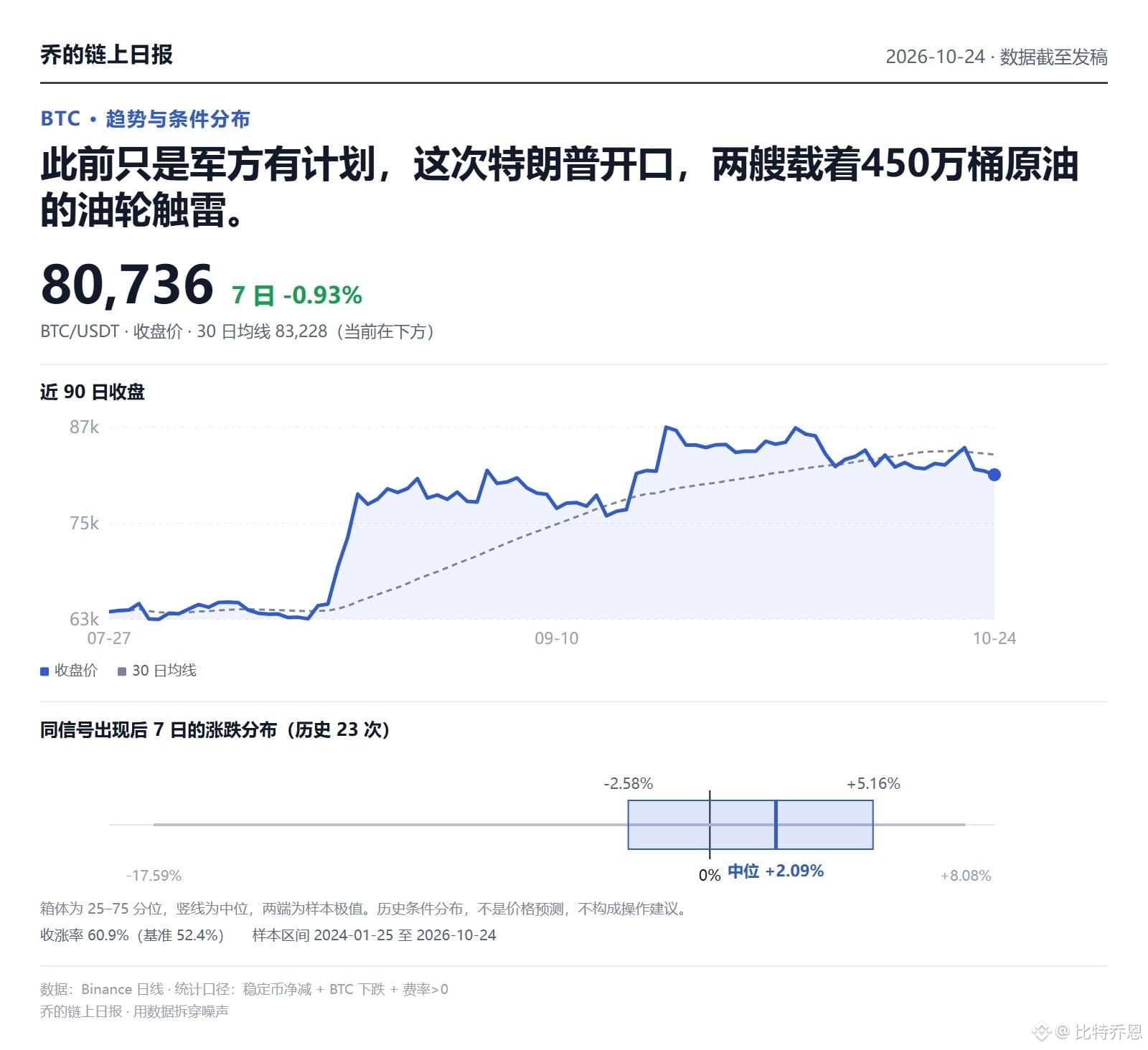
Until now, this had only been a military plan. This time, Trump spoke out—and two oil tankers carrying 4.5 million barrels of crude hit mines.
[💬 450万桶卡在航道上,点进群等核实和停航消息](https://app.binance.com/uni-qr/SyhWRABY)
On October 24, Trump said the U.S. might launch another limited “Operation Epic Fury,” and that the war could end soon. The key question is whether it will end completely or simply die down.
The Revolutionary Guard Navy said two supertankers attempting to pass through the southern part of the Strait of Hormuz were carrying a combined total of more than 4.5 million barrels of crude. Their crews abandoned ship after the vessels hit mines on Friday, though the claims have yet to be verified. Reuters, citing two senior Iranian security officials, reported that Iran plans to target undersea communications cables in the Gulf if it is attacked again, and may expand its target list to include covert military bases.
What markets need to reassess is the risk to physical assets. With 4.5 million barrels of crude stranded in the shipping lane and undersea cables added to the target list, both energy and communications are now within the scope of potential strikes. That is where the added risk premium comes from.
Watch for independent verification of the mine-strike claims, and for any new suspensions or diversions of shipping south of the Strait of Hormuz.
Until now, this had only been a military plan. This time, Trump spoke out—and two oil tankers carrying 4.5 million barrels of crude hit mines.
💬 450万桶卡在航道上,点进群等核实和停航消息
On October 24, Trump said the U.S. might launch another limited “Operation Epic Fury,” and that the war could end soon. The key question is whether it will end completely or simply die down.
The Revolutionary Guard Navy said two supertankers attempting to pass through the southern part of the Strait of Hormuz were carrying a combined total of more than 4.5 million barrels of crude. Their crews abandoned ship after the vessels hit mines on Friday, though the claims have yet to be verified. Reuters, citing two senior Iranian security officials, reported that Iran plans to target undersea communications cables in the Gulf if it is attacked again, and may expand its target list to include covert military bases.
What markets need to reassess is the risk to physical assets. With 4.5 million barrels of crude stranded in the shipping lane and undersea cables added to the target list, both energy and communications are now within the scope of potential strikes. That is where the added risk premium comes from.
Watch for independent verification of the mine-strike claims, and for any new suspensions or diversions of shipping south of the Strait of Hormuz.
51
·
--
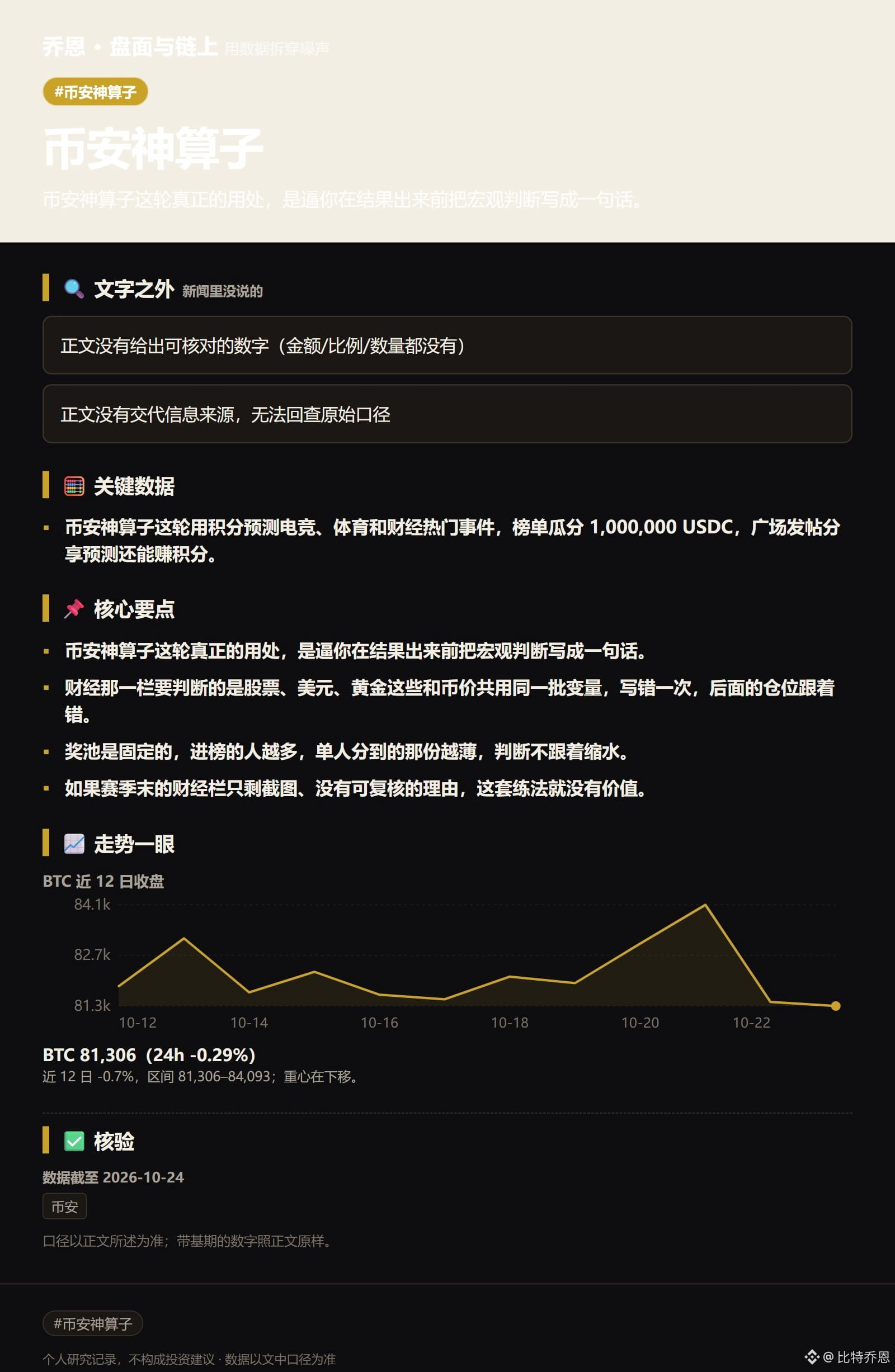
The real value of this round of Binance Predictor is that it forces you to put your macro view into one sentence before the results come in.
[🏛️ 财经栏每条判断我都记着,进群看怎么验](https://app.binance.com/uni-qr/SyhWRABY)
This round, Binance Predictor lets you use points to predict trending events in esports, sports, and finance. The leaderboard shares 1,000,000 USDC, and you can also earn points by posting your predictions in the community. The finance section asks you to make calls on stocks, the dollar, gold, and other assets that share many of the same underlying variables as crypto prices. Get one call wrong, and your positions down the line can go wrong too. The prize pool is fixed, so the more people who make the leaderboard, the smaller each person’s share—but that doesn’t make your judgment any less important. If, at the end of the season, the finance section is all screenshots and no verifiable reasoning, then this practice has no value.
The prize money is zero-sum. Judgment isn’t.
#币安神算子
The real value of this round of Binance Predictor is that it forces you to put your macro view into one sentence before the results come in.
🏛️ 财经栏每条判断我都记着,进群看怎么验
This round, Binance Predictor lets you use points to predict trending events in esports, sports, and finance. The leaderboard shares 1,000,000 USDC, and you can also earn points by posting your predictions in the community. The finance section asks you to make calls on stocks, the dollar, gold, and other assets that share many of the same underlying variables as crypto prices. Get one call wrong, and your positions down the line can go wrong too. The prize pool is fixed, so the more people who make the leaderboard, the smaller each person’s share—but that doesn’t make your judgment any less important. If, at the end of the season, the finance section is all screenshots and no verifiable reasoning, then this practice has no value.
The prize money is zero-sum. Judgment isn’t.
#币安神算子
1k
·
--
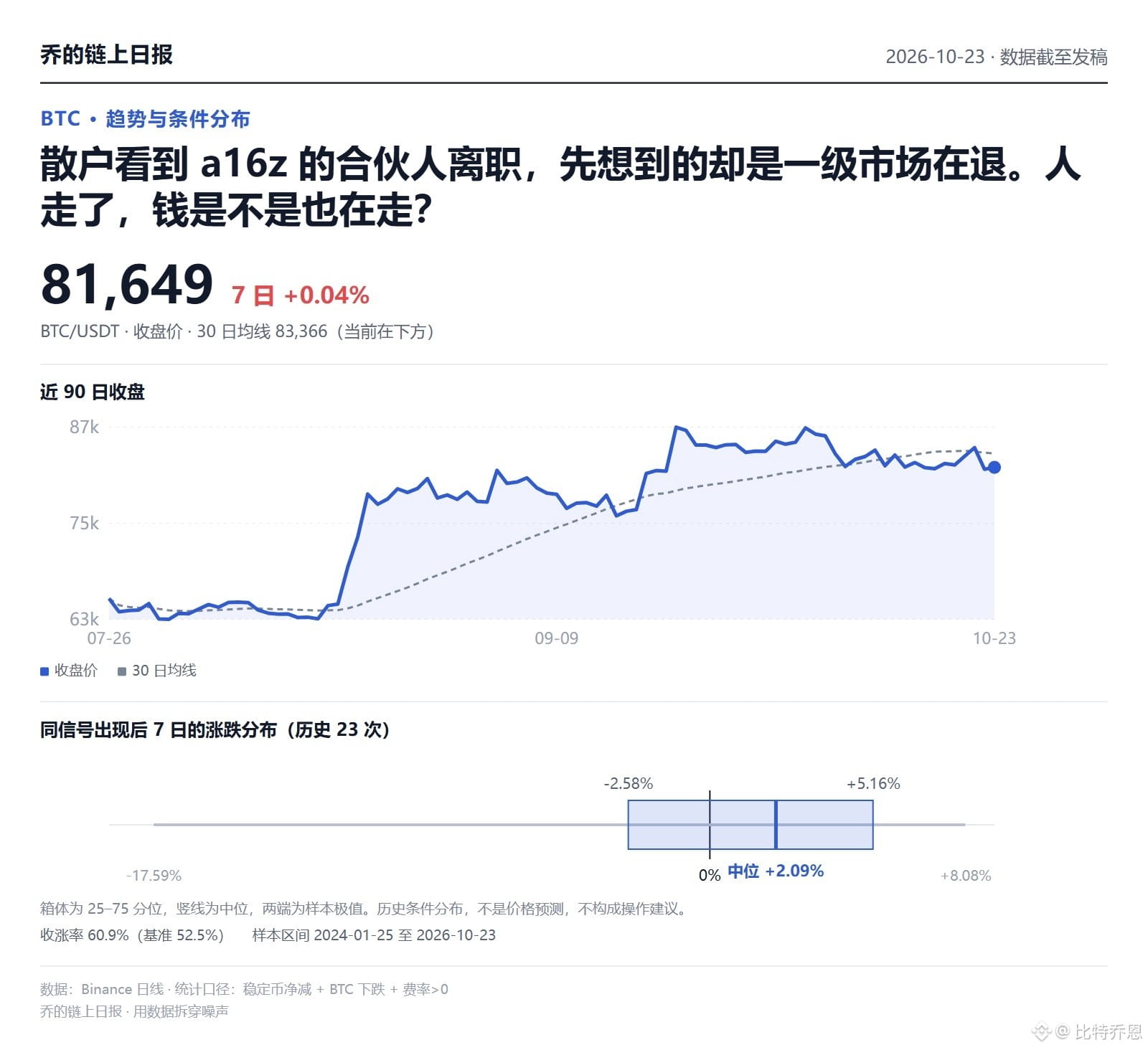
Retail investors see an a16z partner leave and immediately think private markets are pulling back. One person leaves—but is the money leaving too?
[⚖️ 走的人去了哪,基金往哪挪,进群一起看](https://app.binance.com/uni-qr/SyhWRABY)
On October 23, a16z Crypto general partner Ali Yahya announced that he was leaving and moving to San Francisco to start a company focused on infrastructure for “open software ecosystems.” The company is still at an early stage. Yahya had spent nearly 10 years at a16z. When he met Chris Dixon in 2017, a16z’s crypto team consisted of Dixon alone. Earlier, a16z Crypto had been renamed a16z Frontier, with its investment focus expanding to frontier startups.
There wasn’t a single mention of regulation in the announcement.
What’s worth watching is a16z Frontier’s next investment: the sector and the amount will say more about where the boundaries have shifted than the departure of someone who spent nearly 10 years there.
#a16z合伙人aliyahya将离职创业
Retail investors see an a16z partner leave and immediately think private markets are pulling back. One person leaves—but is the money leaving too?
⚖️ 走的人去了哪,基金往哪挪,进群一起看
On October 23, a16z Crypto general partner Ali Yahya announced that he was leaving and moving to San Francisco to start a company focused on infrastructure for “open software ecosystems.” The company is still at an early stage. Yahya had spent nearly 10 years at a16z. When he met Chris Dixon in 2017, a16z’s crypto team consisted of Dixon alone. Earlier, a16z Crypto had been renamed a16z Frontier, with its investment focus expanding to frontier startups.
There wasn’t a single mention of regulation in the announcement.
What’s worth watching is a16z Frontier’s next investment: the sector and the amount will say more about where the boundaries have shifted than the departure of someone who spent nearly 10 years there.
#a16z合伙人aliyahya将离职创业
1
3.9k
Log in to explore more content
Join global crypto users on Binance Square
⚡️ Get latest and useful information about crypto.
💬 Trusted by the world’s largest crypto exchange.
👍 Discover real insights from verified creators.
Email / Phone number
Trending Topics
BinancePick
3.4M views
164,520 Discussing
Join #EarningsSeason: Predict Earnings on Binance Pick, Share Your Take on Binance Square!
Binance Square Official
·419 Likes
·345.4k views
EarningsSeason
5.5M views
26,872 Discussing
StrategySkipsBitcoinPurchasesSpends$205MOnSTRCBuybacks
823 views
24 Discussing