

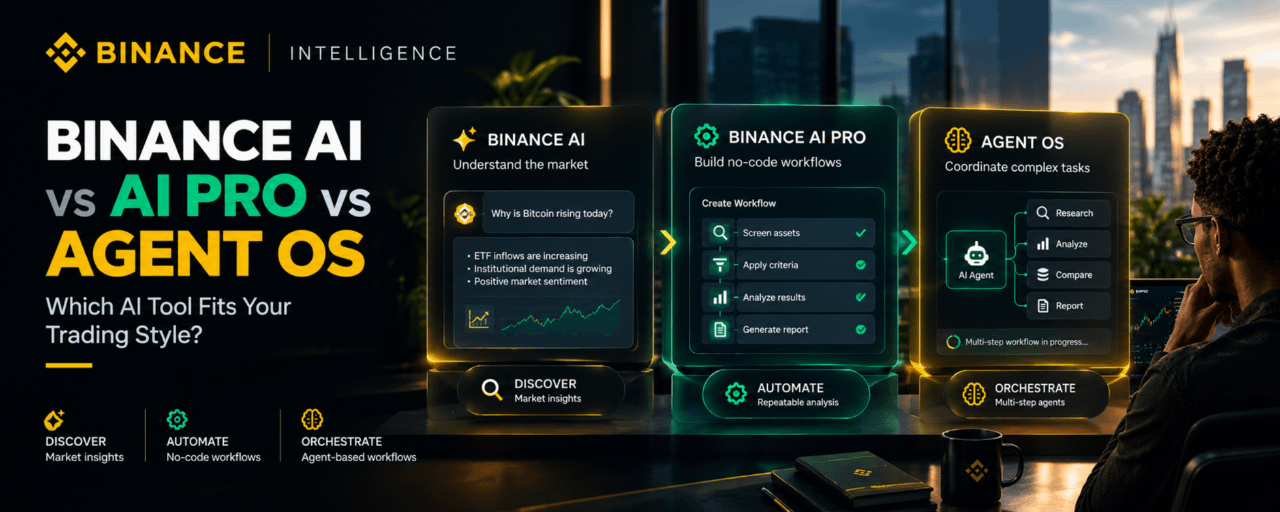

Artificial intelligence is changing how crypto users discover opportunities, analyze markets, and manage repetitive tasks.
But not every trader needs the same level of AI.
Some users simply want to understand why Bitcoin is moving. Others want a more systematic way to screen opportunities and organize their research. More advanced users may be interested in AI systems capable of coordinating multiple steps within a defined workflow.
This is where the distinction between Binance AI, Binance AI Pro, and Agent OS becomes important.
Rather than viewing them as three competing products, it is more useful to understand them as three different approaches to working with intelligence, automation, and execution.
The real question is not which AI tool is the most powerful. It is which one fits the way you work with crypto.
1. Binance AI: For Everyday Market Discovery
Every trading decision begins with information.
A token gains momentum. Bitcoin breaks an important price level. A new project announces a partnership. A protocol introduces a major update.
The challenge is understanding what matters without spending hours searching through different sources.
Binance AI is positioned around everyday market discovery and understanding. It represents the natural starting point for users who want AI assistance while exploring the crypto market.
Imagine a beginner who notices that Ethereum is gaining attention but does not understand the reasons behind the movement.
Instead of jumping between multiple articles and social media discussions, the user could ask AI to explain the relevant concepts, summarize available information, and identify factors worth investigating.
An experienced trader could use a similar approach to organize research before conducting a deeper analysis.
Typical use cases include:
Understanding market developments and crypto terminology.
Exploring blockchain projects and emerging narratives.
Summarizing information to support further research.
Asking questions about market trends and digital assets.
Best suited for: beginners, casual investors, and traders who want faster access to useful market information.
The important limitation is that understanding a market event does not automatically create a profitable trading opportunity. AI-generated explanations still need to be checked against reliable data, and market decisions remain the user's responsibility.
2. Binance AI Pro: For Traders Who Want Repeatable Workflows
Finding information is one thing. Applying the same analytical process consistently is another.
Many traders repeat similar tasks every day. They monitor selected assets, compare market conditions, review indicators, check liquidity, and organize potential opportunities.
Doing this manually can become time-consuming, especially when the same process must be repeated across dozens of assets.
This is where no-code workflows become valuable.
Binance AI Pro is positioned around more structured AI-assisted work, including the ability to build workflows without writing code. Instead of asking a separate question every time, users can define a process for screening opportunities or organizing recurring research tasks.
Consider a trader who wants to identify assets that meet a specific set of conditions.
A workflow might be designed to:
Screen a selected list of assets.
Apply predefined criteria using available data.
Organize the results into a shortlist.
Summarize the factors that deserve further investigation.
Produce a consistent report for review.
The trader can then investigate the shortlist instead of starting from scratch every morning.
Other potential applications include monitoring a watchlist, comparing selected projects, preparing recurring market summaries, and organizing research into a repeatable format.
The main advantage is consistency.
A well-designed workflow makes it easier to apply the same process repeatedly, while reducing the amount of manual coordination required.
Best suited for: active traders, systematic researchers, and users who frequently repeat the same analytical tasks.
However, automation does not guarantee better results. Poor screening criteria can produce poor opportunities more efficiently. A workflow is only as useful as its inputs, assumptions, and evaluation process.
3. Agent OS: For Advanced, Multi-Step AI Workflows
What happens when a workflow becomes more complex than a single screening task?
Imagine that a user wants to research a new DeFi ecosystem. The process involves reviewing documentation, comparing protocols, examining available market data, identifying risks, and preparing a structured report.
These tasks are connected, but each requires a different type of analysis.
An agent-based approach aims to coordinate multiple steps toward a broader objective.
This is the direction represented by Agent OS: infrastructure for more advanced, agent-based experiences, where AI can potentially work across connected tasks rather than simply answering individual questions.
The distinction is important.
A chatbot may explain a protocol. A no-code workflow may apply a predefined screening process. An agent-based system aims to coordinate a broader sequence of tasks, potentially adapting its next steps to intermediate results within its permitted boundaries.
For example, an advanced research workflow could be structured to:
Gather information from permitted sources.
Analyze a project's stated objectives and tokenomics.
Compare the project with selected alternatives.
Flag missing information and potential risk factors.
Assemble the findings into a research report for human review.
This is a more ambitious form of AI assistance because the focus shifts from individual operations to coordination across an entire process.
Potentially, the same principle could extend to operational reporting, portfolio monitoring, and other complex digital-asset workflows.
These examples illustrate possible applications, not a guarantee that every capability is currently available through Agent OS.
Best suited for: advanced users, researchers, developers, and people interested in orchestrating complex, multi-step workflows.
The more autonomy a system receives, the more important permissions, transparency, monitoring, and human approval become. In crypto, agents should never be given unrestricted access to funds or sensitive credentials simply because they can automate tasks.
4. The Three Approaches Compared
Here is the practical difference between the three.
DimensionBinance AIBinance AI ProAgent OSPrimary focusMarket discovery and understandingNo-code workflowsAdvanced agent-based workflowsTypical interactionAsk and exploreDefine and repeat a processCoordinate multiple tasksMain valueFaster access to informationMore consistent analysisBroader workflow orchestrationExampleExplain a market eventScreen a watchlistCoordinate a research processIdeal starting pointEveryday usersActive, process-driven tradersAdvanced workflow users
The key distinction is the level of workflow complexity.
Binance AI helps users work with information. AI Pro adds a more structured approach to recurring tasks. Agent OS points toward infrastructure for coordinating more complex, agent-based processes.
These categories describe their intended roles and should not be interpreted as a definitive list of currently available features or a guarantee that the products share every capability.
5. Which One Fits Your Trading Style?
The easiest way to choose is to start with the problem you want to solve.
If you are a beginner
Start with everyday market discovery.
Your priority should be understanding market movements, learning how crypto projects work, and developing the ability to distinguish useful information from speculation.
You probably do not need an elaborate automated workflow before you understand the fundamentals.
If you trade actively
Focus on repeatability.
If you repeatedly monitor the same assets, apply the same criteria, and prepare similar reports, no-code workflows may help you organize your process.
The goal is not to trade more frequently. It is to spend less time on repetitive analysis while maintaining consistent standards.
If you manage complex research
Think in terms of coordination.
If your work involves several information sources, multiple analytical stages, and recurring dependencies between tasks, agent-based infrastructure may be the more relevant direction to explore.
The objective is to coordinate a process that would otherwise require substantial manual effort.
If you are building crypto products
Consider the infrastructure layer.
Developers and businesses may be interested in how agents interact with tools, manage context, respect permissions, and operate within defined boundaries.
For them, the opportunity extends beyond trading. It concerns how AI could become part of the underlying infrastructure of financial services.
6. What Early Users Should Evaluate
When exploring new AI tools, impressive demonstrations are not enough. Practical performance matters more.
Rather than assuming that a tool will improve trading results, early users should evaluate it against real tasks and measurable criteria.
For example:
Time saved: Does the workflow genuinely reduce the time required to complete a task?
Consistency: Does it apply the same criteria reliably across repeated runs?
Accuracy: Can its findings be verified against trustworthy sources and relevant market data?
Transparency: Can the user understand why a result was produced and which information supports it?
Failure handling: Does the system clearly identify missing information, incomplete results, or unsuccessful steps?
Control: Can users review sensitive actions and restrict what the system is allowed to do?
A practical test is to select one repetitive research task, establish a manual baseline, and compare the results with the AI-assisted process over several sessions