

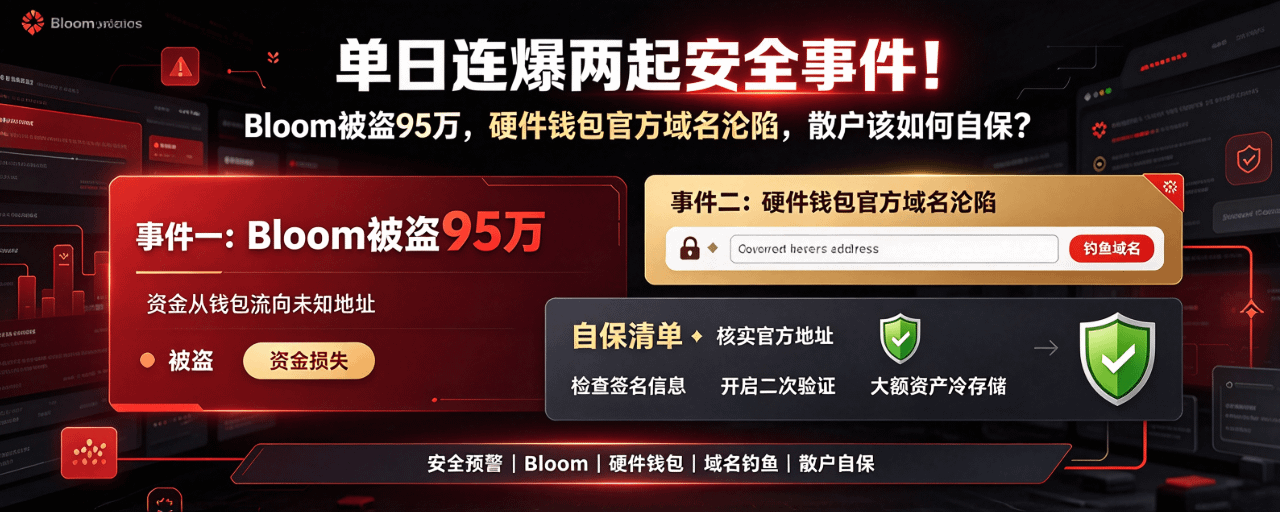

As if the sluggish macro market weren’t frustrating enough, hackers are also going all out to “hit their targets”! On October 26, two serious security incidents broke out at the same time, once again sounding the alarm over asset security.
First: A cross-chain platform was hacked, and nearly a million dollars vanished. Bloom Trading was attacked, with 49 users losing a total of 9,408 SOL (worth approximately $954,000). The largest single loss was as high as $166,000. The good news is that the team has promised full reimbursement. But this also exposes the serious risks involved in fund transfers on today’s cross-chain and DeFi platforms: once a code vulnerability is targeted, users’ wallets can instantly become ATMs.
The second incident: A hardware wallet’s official domain was hijacked—no one is safe! Hardware wallet manufacturer Foundation confirmed that its official domain was compromised and used by hackers to send phishing spam. The breach stemmed from a leaked Cloudflare API key. Although the company quickly reassured users that funds on Passport devices and the hardware itself remained safe, control of the official domain meant hackers could impersonate the company and send fake links to trick users into entering their seed phrases. In a separate incident, hackers also breached hardware wallet maker Keystone’s Shopify store on October 20, exposing customer information. Fortunately, no private keys or payment card details were stolen.
An expert’s perspective: Why are these two incidents extremely dangerous? The market is highly fragile right now, and people have already lost money using leverage. If a single mistaken click on a phishing link wipes out your entire principal, you’re truly out of the game. The hackers’ tactics are clear: if smart contracts are hard to break into, go after the “people” and the “front end” instead. A leaked Web2 API key could easily become the first domino in the destruction of Web3 assets.
Essential rules for retail investors to stay safe:
Never click links in emails. If you receive an email about an “official upgrade” or “airdrop,” verify it through the official X account or website. Never click the email link directly!
Secure your API keys and permissions. If you’re running quantitative strategies or interacting with protocols, check immediately whether your Cloudflare or other cloud service API keys have expired or been leaked, and replace them promptly.
Move large holdings back into deep cold storage. In these turbulent times, keeping substantial assets in a completely offline cold wallet—and even writing down your seed phrase by hand—is more reliable than any promise.
Your information is wealth in a hacker’s eyes. Amid this string of security incidents, have you received phishing emails like these? What good habits do you follow to avoid phishing? Share them in the comments and help everyone steer clear of trouble!👇
$SOL $BTC #网络安全 #Bloom被盗 #钱包安全 #Web3防骗指南

