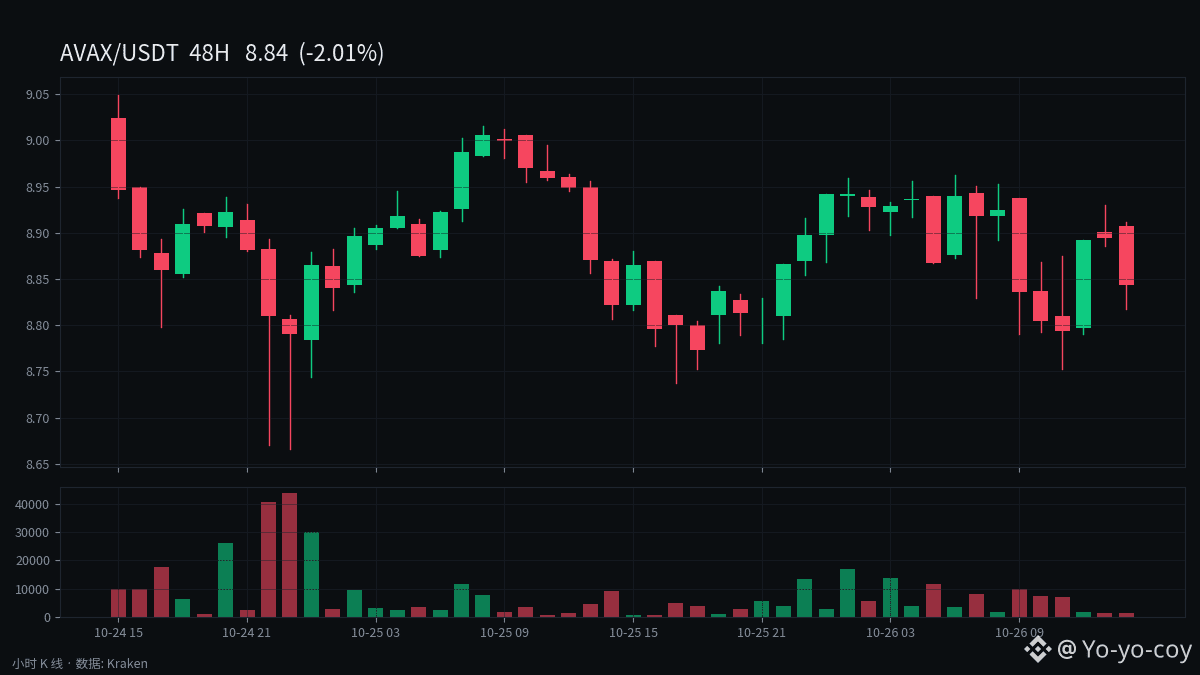
Avalanche presents a case of fundamentals diverging from price action on October 26: network metrics are improving, while the price remains close to key support.
1. Network speed hit a record. Data shows that Avalanche’s average block time reached 911 milliseconds, falling below one second for the first time and marking the fastest rate in the network’s history.
2. Price and technical levels are both in a sensitive zone. CoinStats data on October 26 showed $AVAX at approximately $8.82, down about 1.99% over 24 hours and 8.65% over seven days, with a market cap of about $3.92 billion and 24-hour trading volume of about $142.56 million. Key support is around $8.295, with resistance between approximately $9.99 and $10.00. Analysts’ upside reference levels are around $10, $11.432, and $14.934; if support breaks, the downside reference level is around $7. These are analyst views, not a predetermined price path. The relative strength index is around 35.44, close to the edge of oversold territory; MACD is around -0.2666, and momentum remains weak.
3. Fund flows and supply are also subdued. As of October 21, Avalanche-related funds had cumulative net inflows of about $31.6 million and net assets of about $55.5 million, with no new inflows since October 8. Starting October 21, related funds began accepting in-kind subscriptions, with a minimum threshold of about $235,800. On the supply side, 1.67 million tokens, worth about $14.81 million, will be unlocked on November 8. This represents about 0.35% of total supply, a relatively small amount.
What we can observe is that the divergence is not about the direction of the outlook, but about timing: the network’s efficiency has improved first, while capital and price have yet to catch up. Whether support holds is the first thing to watch in determining whether this divergence is narrowing.
Personal opinion only; this does not constitute investment advice.
#AVAX $AVAX