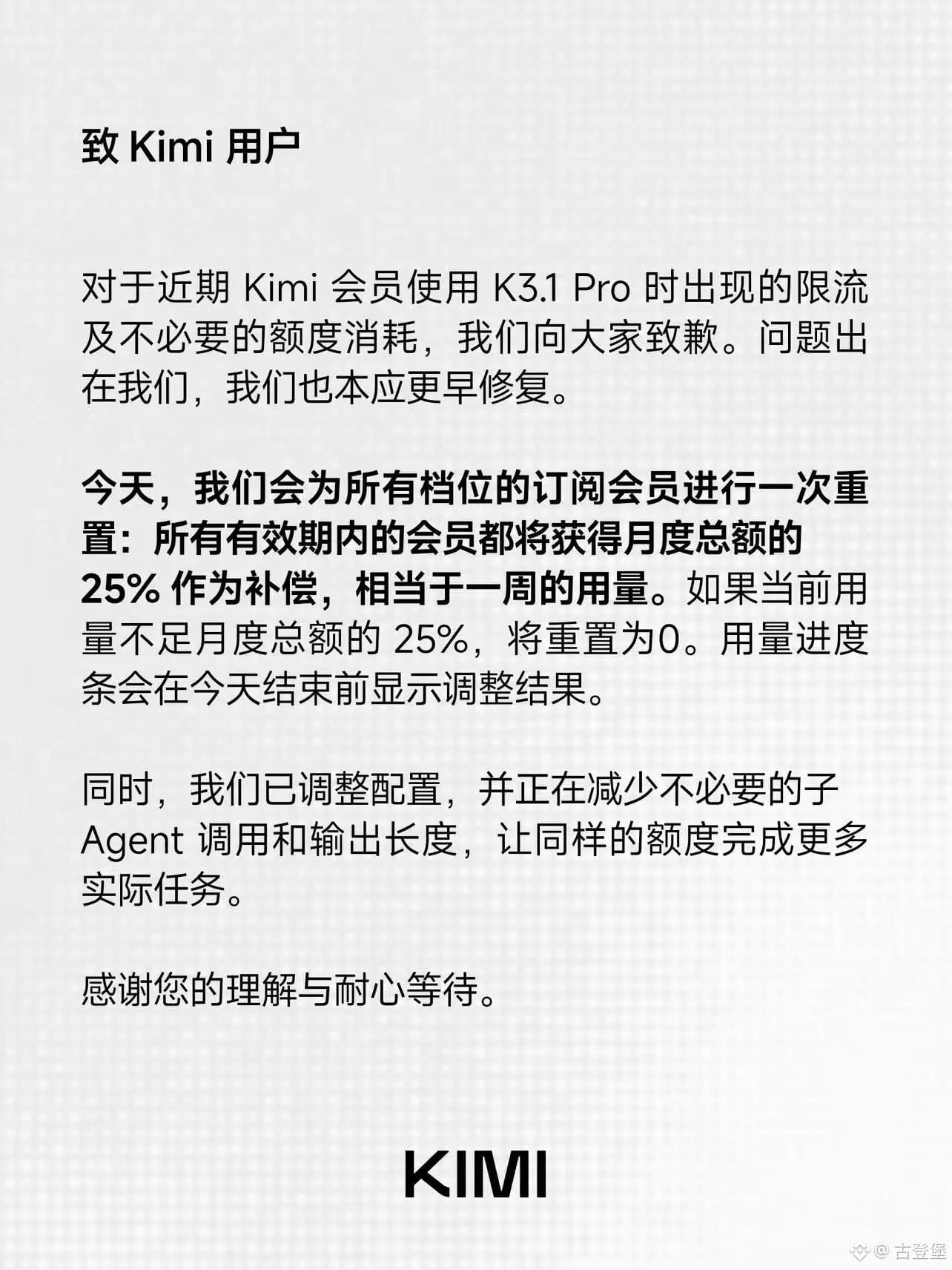
Moonshot AI’s Kimi apologized.
Haha, after reading it, I was left a little speechless—and amused.
It all started on October 24. In the early hours of that day, Moonshot AI rolled out its latest large model, K3.1 Pro:
3 trillion parameters and a context window of 1 million tokens. According to third-party evaluations, its capabilities are already hot on the heels of Claude Opus 5.5.
Honestly, it’s very powerful. But the smarter the model gets, the less users can afford to use it.
One user had just topped up their account with 199, then spent a few dozen minutes running a complex task—and had nearly used up their entire quota.
Then the company started throttling usage too, because it didn’t have enough compute to support the influx of users.
What’s the problem? Agents.
In the past, you asked a question, it gave you an answer, and the conversation was over.
Now, you give it a task, and an Agent might run for dozens of minutes, call tools hundreds of times, and burn through millions of tokens—with a whole chain of sub-agents making calls like crazy in the background.
Kimi itself admitted that it was reducing unnecessary sub-agent calls and shortening outputs.
At the end of the day, there just isn’t enough compute.
Of course, Kimi’s marketing this time had its problems too, and its quota pricing wasn’t very transparent.
A 25% compensation offer can’t fix these problems.
It’s just a band-aid, not a cure.
Moonshot AI’s real challenge isn’t that it can’t build a good model—it’s that it can’t afford to support the demand for one.
Its technical success has turned into a commercial burden.
So China’s homegrown compute industry needs to step up.
#月之暗面IPO