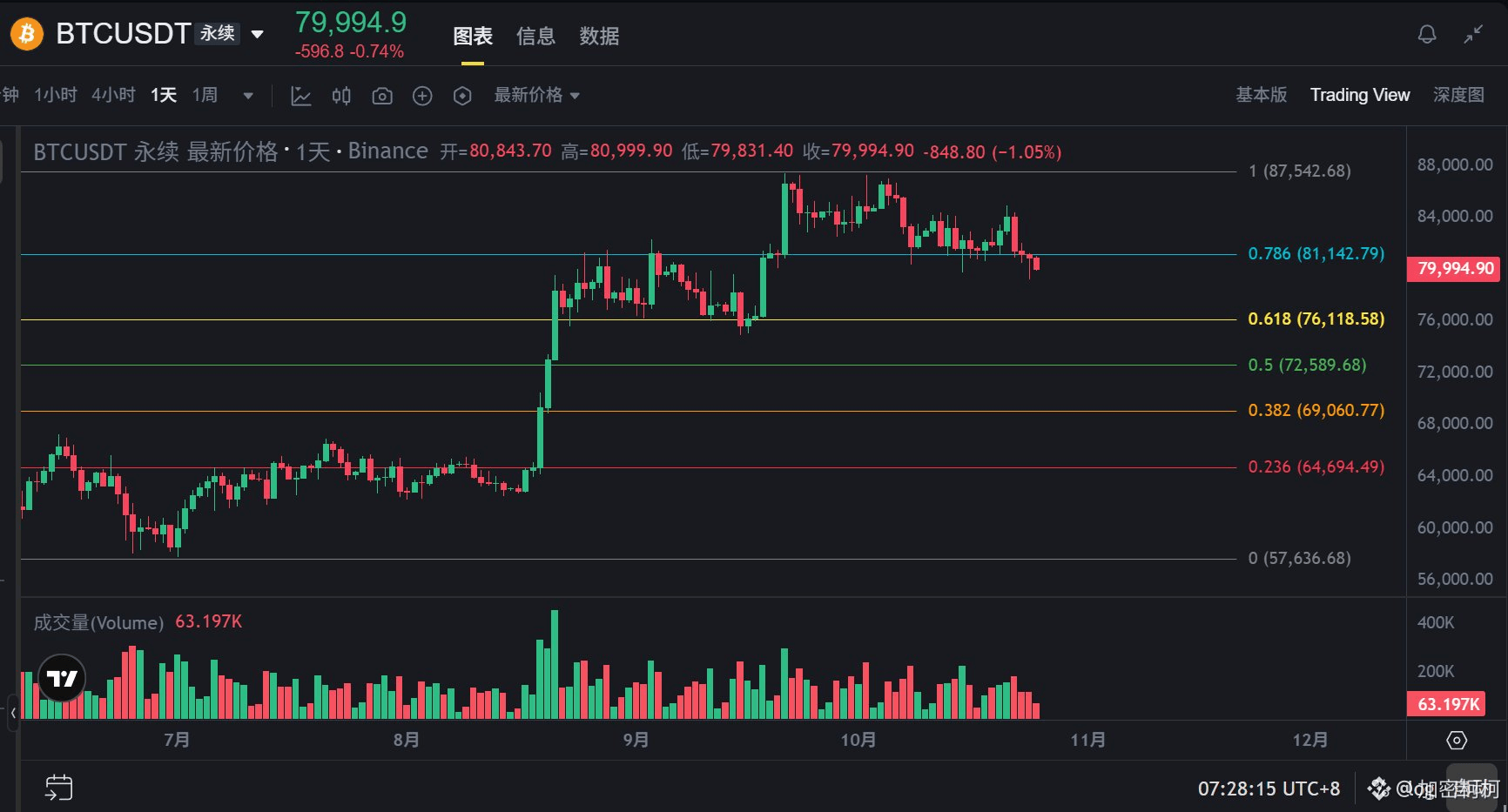
For now, don’t rush to buy the dip on $BTC and $ETH .
Two major headwinds are still weighing heavily on these two assets, with no sign of easing.
First, the cost of capital keeps rising, and that trend is still in place.
The market still puts the probability of a rate hike in December above 76%. Treasury yields have edged down slightly in the short term, but if inflation data rebounds, risk-free returns above 5% could quickly become entrenched again.
Bitcoin and Ethereum don’t generate interest, so holding them in this environment means paying an opportunity cost every single day.
Second, ETF money continues to flow out, and investors are exiting decisively.
On October 22, U.S. spot Bitcoin ETFs saw net outflows of $635 million in a single day, the largest daily outflow since late June.
Ethereum fared even worse: ETFs saw cumulative outflows of $1.08 billion in October, the highest monthly outflow on record this year.
Third, top traders have already chosen to step aside and wait.
On October 24, Arthur Hayes said publicly that his family office had closed all directional positions.
He sold ETH, ENA, and UNI, citing rising economic and geopolitical uncertainty. He isn’t simply bearish; he’s temporarily sitting out the market.
Fourth, technical signals are also weak, and the 80K support level has already been broken once.
BTC fell as low as 79146. Although it quickly bounced back after a sharp wick down, the daily trend is still moving lower.
77K is a key support level where multiple indicators converge, but the odds of holding it are only around 50%–55%. If 77K breaks, the next target is 73K.
So jumping in now is not really buying the dip.
It’s just trying to catch a falling knife.
If you’re considering entering the spot market, you could wait for two key dates:
1. After the midterm elections on November 3, and see whether there is a subsequent strike on Iran;
2. After the rate decision on December 10.
Until these two milestones arrive, keep your hands off and don’t make rash moves.