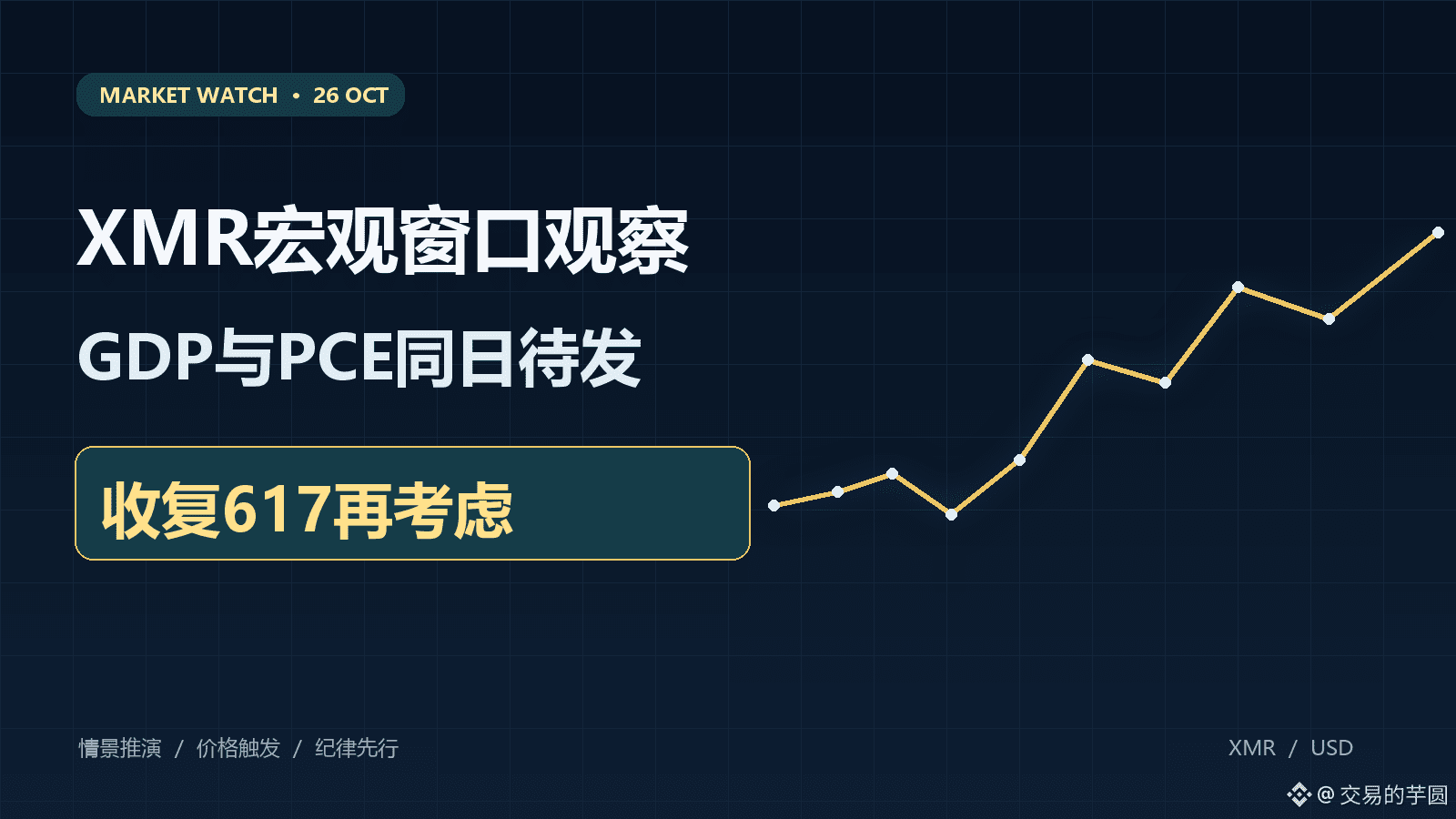
U.S. GDP and PCE due the same day|Check liquidity pressure first for XMR|Only consider an entry after reclaiming $617
My stance is defensive. I’m not betting on an XMR rebound in advance just because “inflation might ease.” A trending topic on Binance Square is that U.S. third-quarter GDP and September PCE will be released next week. I first checked the primary-source schedule: the U.S. Bureau of Economic Analysis (BEA) lists the advance estimate of third-quarter GDP and the September Personal Income and Outlays report—which includes the PCE price index—as being released simultaneously at 8:30 a.m. Eastern Time on October 29. The Federal Reserve calendar also shows an FOMC meeting on October 27–28. The policy decision comes first, followed by GDP and PCE; that order matters. Neither report has been officially released yet, and market speculation about interest rates should not be mistaken for a decision by the central bank.
Why could XMR be affected too? The macroeconomic data won’t change the functionality of Monero’s privacy protocol, but it could shift expectations for U.S. interest rates and positioning in risk assets. If inflation is higher than expected, traders may reprice the cost of capital. If GDP is weak while inflation remains sticky, a flight to safety doesn’t necessarily mean all crypto assets will rise. XMR also differs from BTC in trading depth, accessibility across exchanges, and order-book width, so the same capital outflow could cause greater short-term slippage. That’s why I care more about actual spreads and trading volume around the releases than treating “lower PCE means a sure rise, higher GDP means a sure rise” as a formula. Even if the figures seem favorable, I won’t chase the first sharp spike if BTC doesn’t confirm and XMR’s order book thins out.
The market’s current performance can be verified: Kraken’s XMR/USD is around $599.68, with a UTC daily open of $614.94, an intraday high of $616.82, and a low of $593.40. It’s currently below the daily open, so short-term support still needs to be proven. This drop happened before the data release and cannot be attributed to GDP or PCE figures that have not yet been published. Monero’s recent official release was the 0.18.5.4 client maintenance update. Technical progress on-chain and macroeconomic price shocks are two different things; the version update itself is no proof that the coin price will strengthen this time. For now, $616–$617 is the intraday ceiling, and around $593 is the short-term risk line. These levels are more actionable than guessing the exact data figures.
If I were trading this myself, I’d sit out for now, keep my position at 0%, and avoid leveraged short positions. I’d only try a long with no more than 5% of my total capital if XMR spot moves back above $617, holds $610 on a retest, and the bid-ask spread hasn’t widened significantly. The first target is $642, where I’d sell half; the second is $670, where I’d gradually close the rest. If it falls below $592 after entry, I’d stop out immediately. If it drops back below $610 and fails to reclaim it on a rebound, I’d close the position even if the hard stop hasn’t been reached. If the entry conditions never trigger, I’ll stay flat; I won’t describe the plan as an executed trade. If, after the official data release on the 29th, inflation comes in persistently above expectations, U.S. interest rates rise, and XMR breaks below $593.40, my conditions for trying a long are invalidated, and I’ll wait for a new trading range to form.
Sources: BEA 2026 release schedule, Federal Reserve FOMC meeting calendar, Monero project announcements, Kraken XMR/USD quote. #USQ3GDPAndSeptemberPCEDueNextWeek #XMR
This is solely my personal market observation and does not constitute investment advice.