


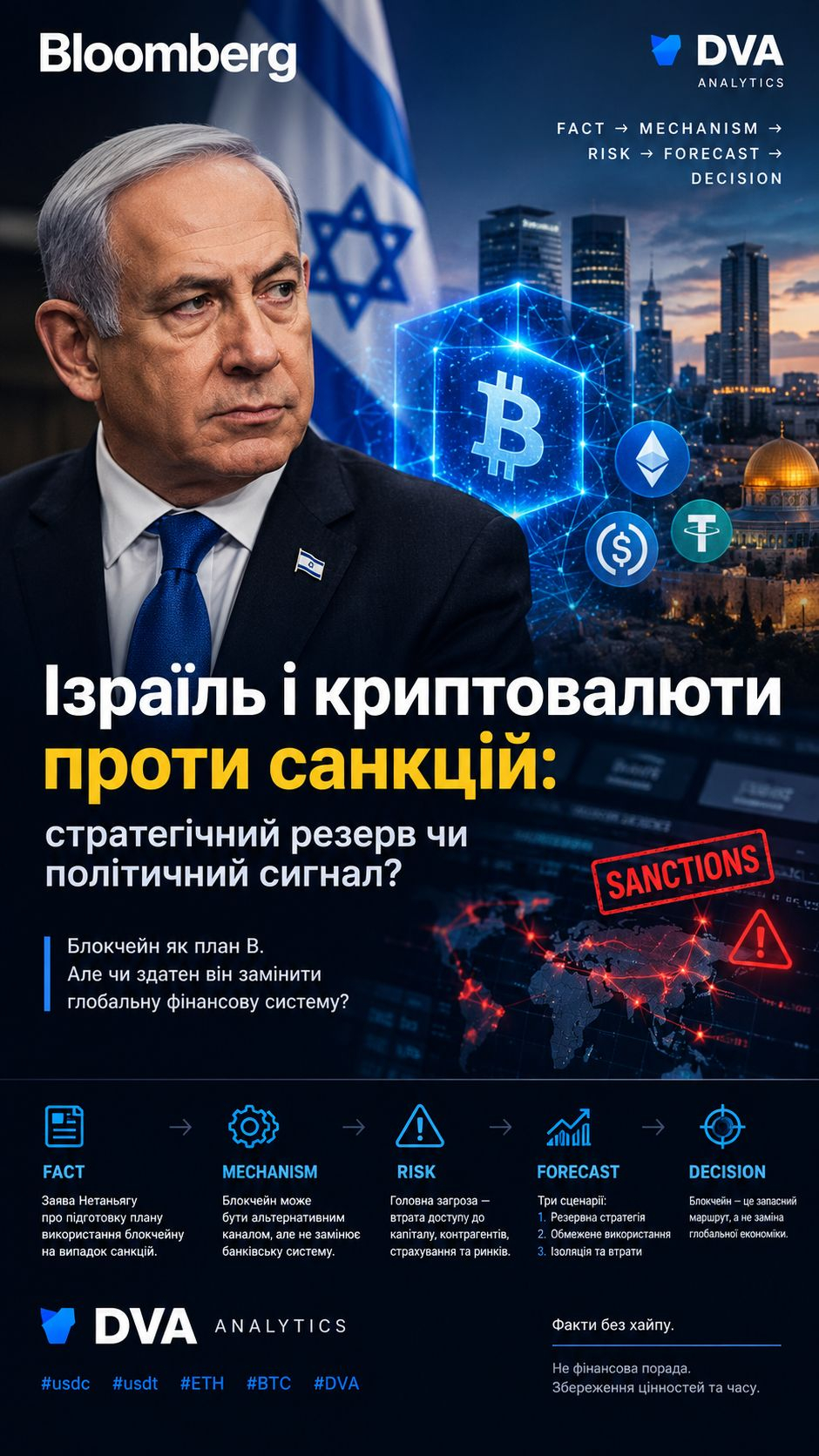
Israel and cryptocurrencies to counter sanctions: strategic reserve or political signal?
DVA ANALYTICS • FACT -> MECHANISM -> RISK -> FORECAST -> DECISION
FACT — the state is preparing for financial isolation
On October 23, 2026, Israeli Prime Minister Benjamin Netanyahu said he had instructed officials to prepare a plan for using blockchain and alternative financial mechanisms in the event of international sanctions, including restrictions against Israeli banks.
In an interview with Israeli TV channel Channel 10, he named blockchain as one possible response tool. No specific system architecture, list of digital assets, settlement mechanism, or implementation timeline was presented.
The statement came amid rising international pressure over Israel’s policies in the occupied Palestinian territories. The previous day, a number of Western countries had announced restrictions related to trade in products from Israeli settlements in the West Bank.
Netanyahu also raised the question of future U.S. military aid, emphasizing that Israel should not count on it remaining unchanged over the long term.
This is therefore part of a broader concept of strategic autonomy: from military production to financial infrastructure.
However, it is important to distinguish between two facts: preparing a backup plan does not mean sanctions have already been imposed on the entire Israeli banking system, and blockchain is not a ready-made replacement for that system.
Sources: The Block, October 23; Reuters, October 25, 2026.
MECHANISM — what blockchain can and cannot do
Traditional international trade depends on correspondent banks, foreign currency accounts, credit lines, insurance, payment systems, and trust between counterparties.
If a bank loses access to certain international transactions, the problem is not limited to transferring money. A business may be unable to obtain a loan, settle with a supplier, insure a shipment, or attract a foreign investor.
Blockchain offers an alternative way to transfer digital value. But there is a significant gap between the ability to make a transaction and the ability to sustain a national economy.
1. Bitcoin — protocol independence, but not economic independence.
The Bitcoin network has no single central operator capable of arbitrarily stopping all transactions. This makes it possible to transfer BTC without necessarily using a traditional bank transfer.
At the same time, the price of BTC fluctuates, and its acceptance depends on the counterparty. Being able to receive bitcoin does not guarantee that a supplier will agree to accept it as payment for equipment, energy supplies, or industrial components.
1. Stablecoins — convenient settlements, but new points of dependence.
Tokens pegged to the U.S. dollar can enable the rapid transfer of digital dollar equivalents.
However, such a system depends on the issuer, reserves, redemption mechanisms, exchanges, and payment intermediaries. A centralized issuer can freeze assets, while an intermediary can restrict service to a customer.
A digital dollar in token form is not the same as independence from the entire dollar-based financial system.
1. Tokenized assets — modernizing settlements, not eliminating obligations.
Bonds, deposits, and other financial claims can be represented as digital tokens. This could simplify record-keeping and settlements, but it does not eliminate credit risk, legal restrictions, or the need for a reliable debtor.
1. Alternative payment channels — a backup, not a full replacement.
A state can explore direct settlements with partners, digital payment systems, and backup mechanisms for exchanging assets. Some of these solutions may be useful even without cryptocurrencies.
The key criterion is not whether a digital asset can be transferred, but whether the mechanism can lawfully and reliably support a real economic transaction at sufficient scale.
RISK — why technology does not eliminate sanctions
On October 24, the Bank of Israel publicly rejected the idea that cryptocurrencies could be a way to evade sanctions. The central bank urged maintaining economic ties with major trading partners and focusing on preventing sanctions.
This is a fundamental difference between two approaches.
The political approach looks for ways to continue operations even under adverse external conditions.
The central bank assesses systemic consequences: financial stability, market access, investor confidence, and the economy’s ability to meet its obligations.
Risk 1. The bottleneck is not the blockchain, but access to the real economy
Imagine an Israeli manufacturer receiving payment in cryptocurrency. It needs to purchase imported components and pay wages, taxes, logistics costs, and insurance.
If a supplier does not accept digital assets, a bank does not process the conversion, and an insurer refuses to handle the transaction, simply receiving cryptocurrency does not solve the problem.
Blockchain can change the channel through which value is transferred, but it does not automatically create demand, liquidity, or trust.
Risk 2. A public blockchain does not guarantee anonymity
Many networks maintain a public record of transactions. Analytics firms and law enforcement agencies can investigate the movement of funds, while exchanges and stablecoin issuers can enforce sanctions restrictions.
Therefore, crypto assets do not create a universal, invisible financial space.
Risk 3. Losing access to investment can cost more than saving on transfers
Israel’s high-tech sector depends on international investment, export markets, banking services, and access to global supply chains.
If foreign investors begin to view Israeli companies as excessively risky partners, the consequences could affect startup funding, hiring, research, and industrial production.
Even an efficient digital channel cannot automatically compensate for the loss of lending, insurance, and investment.
Risk 4. A technological possibility does not mean it is legally permissible
Sanctions regimes vary by country, entity, sector, and transaction type. Using digital assets does not exempt participants from applicable legal requirements.
Therefore, a responsible backup system must include legal oversight, counterparty screening, and transparent risk management—not rely on the assumption that a decentralized network automatically removes external restrictions.
POLITICAL SIGNAL — why the timing of the statement matters
At the time of the statement, Israel’s parliamentary elections were just days away. On October 27, the country was due to vote amid intense political competition.
This context matters, but it should not be treated as definitive proof of the prime minister’s motives.
The statement could serve three functions at once:
· Domestic politics: demonstrating to supporters the government’s readiness to act under external pressure.
· Foreign policy: signaling to partners and critics that Israel is considering various scenarios for economic resilience.
· Strategic: initiating practical work on backup financial mechanisms.
These functions are not mutually exclusive. A political signal can accompany practical planning, and the pre-election context alone does not prove the absence of serious intent.
At the same time, the central bank’s response showed that political leaders and financial stability institutions assess the trade-off between a technological reserve and the threat of international isolation differently.
On October 25, Reuters reported that more than 100 economists, business representatives, and former officials had expressed concern about the proposal. They warned of possible consequences for investment, employment, and Israel’s international economic standing.
This is no longer just a debate about cryptocurrencies. It is a debate about the cost of political decisions to economic trust.
FORECAST — three possible scenarios
Scenario A. Prudent financial preparedness.
Israel develops backup payment channels, upgrades its digital infrastructure, and tests technologies for lawful international settlements.
In that case, blockchain could become one component of a broader resilience system—alongside traditional banks, foreign currency reserves, and trade agreements.
Scenario B. Limited use of crypto assets.
Some companies use digital assets for certain payments, where legally permitted and agreed to by counterparties.
This could help with individual transactions, but would not provide a full replacement for the international financial system.
Scenario C. Political escalation and financial isolation.
If international restrictions expand, alternative channels may preserve the ability to conduct some transactions. However, the costs of trade, access to capital, insurance, and imports could rise significantly.
In this scenario, a technological reserve would have limited effect unless accompanied by political and economic measures to preserve international ties.
There is currently insufficient evidence to say that Israel has already chosen one of these scenarios. What is publicly known is that a plan has been commissioned, not that a system with defined operating mechanisms has been approved.
DECISION — a lesson for Ukraine and everyday users
Israel’s case should be viewed not as proof that cryptocurrency can save a country from sanctions, but as a test of our understanding of financial resilience.
Practical priorities for Ukraine could include:
1. Payment infrastructure redundancy. Maintain alternative lawful channels for international settlements in case of technical failures or restrictions.
2. Technological interoperability. Develop digital payment solutions that can interact with the banking system rather than simply duplicate it.
3. Legal certainty. Ensure clear rules for working with digital assets, screening counterparties, and protecting users.
4. Preserving external ties. Maintain access to international markets, investment, insurance, and trade finance.
5. Diversification without illusions. Do not depend on a single channel, issuer, or type of asset, but do not consider any of them risk-free either.
The same principle applies to individuals. A non-custodial wallet can reduce dependence on a particular financial institution, but it does not eliminate asset volatility, the risk of losing keys, conversion restrictions, or legal obligations.
DVA SUMMARY
FACT: Netanyahu commissioned a plan for using blockchain in the event of possible international sanctions. The Bank of Israel publicly questioned cryptocurrency as a tool for evading sanctions.
MECHANISM: blockchain can provide an alternative channel for transferring digital value, but it does not replace the full range of banking and international economic relationships.
RISK: the greatest threat is not the technical inability to make a transaction, but losing access to counterparties, capital, insurance, imports, and trust.
POLITICAL SIGNAL: the pre-election timing makes the statement politically significant, but does not justify automatically dismissing it as mere election rhetoric.
DECISION: blockchain makes sense as one of several backup tools for financial resilience, not as a replacement for the global economy.
The central point: financial independence is determined not only by the ability to transfer an asset without an intermediary, but also by the ability to legally exchange it for real goods, services, and resources.
Technology can create a backup route. But it cannot by itself restore trust, replace international markets, or offset the consequences of political isolation.
DVA — facts without hype.
Not financial advice. Preserve value and time.
#USDC #usdt #ETH #BTC #DVAnews