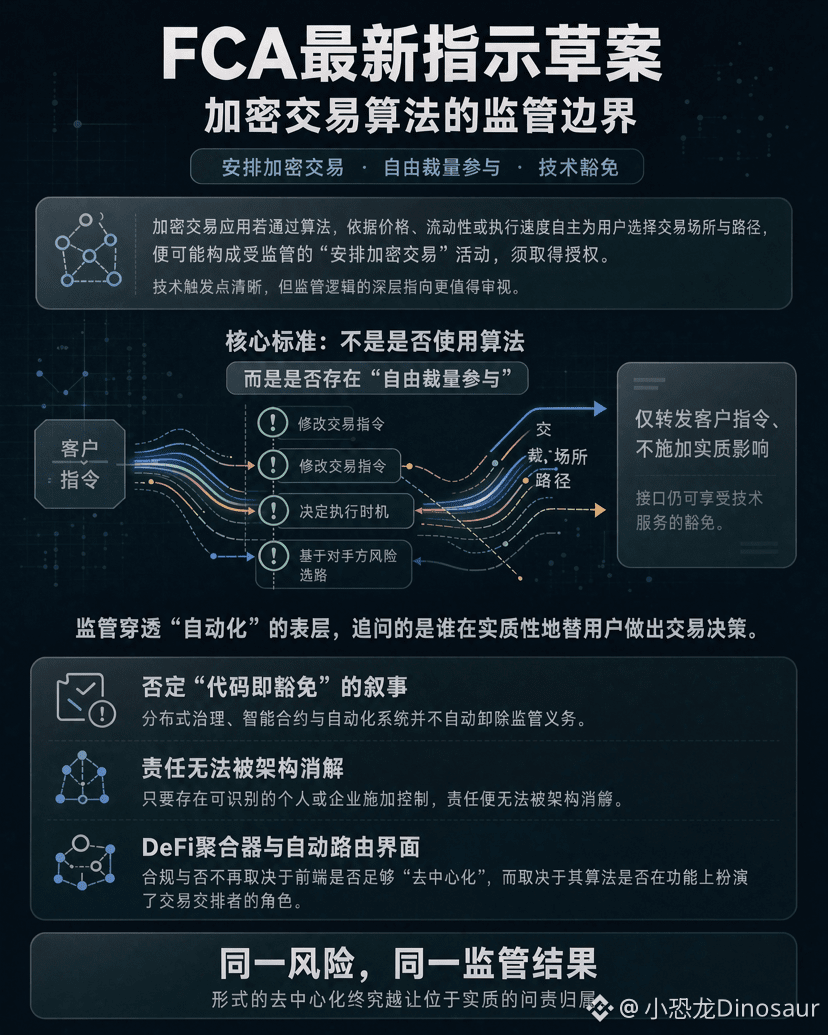

The UK Financial Conduct Authority’s (FCA) latest draft guidance targets a seemingly technical aspect: if a crypto trading app uses an algorithm to independently select trading venues and routes for users based on price, liquidity or execution speed, it may constitute the regulated activity of “arranging cryptoasset transactions” and require authorisation. The technical trigger for this rule is clear, but the deeper regulatory logic behind it merits closer scrutiny.#英国算法加密交易应用或需FCA授权
The FCA’s key criterion for drawing the line is not “whether an algorithm is used,” but whether there is “discretionary involvement.” Modifying trading instructions, deciding when to execute them, and routing orders based on counterparty risk are all listed as indicators. By contrast, interfaces that merely forward client instructions without materially influencing them may still qualify for the exemption for technical services. In other words, regulation looks beyond the surface of “automation” to ask who is actually making trading decisions on the user’s behalf.
The force of this logic lies in its rejection of the notion that “code means exemption.” The FCA makes clear that distributed governance, smart contracts and automated systems do not automatically remove regulatory obligations: whenever an identifiable person or business exercises control, responsibility cannot be designed away through architecture. For DeFi aggregators and automated routing interfaces, compliance no longer depends on whether the front end is sufficiently “decentralised,” but on whether the algorithm functionally acts as an arranger of transactions. Under the principle of “same risk, same regulatory outcome,” formal decentralisation must ultimately give way to substantive accountability.