The ceasefire takes effect on October 27, but negotiations will have to wait until after November 4. There will be no negotiating table during those eight days in between. That date wasn’t chosen casually; it sits at the intersection of three calendars.
The speaker was Ushakov, an aide to the Russian president. He said Russia was willing to resume trilateral negotiations after November 4, describing them as an initial contact and cautioning against high expectations.
The three calendars all point to the same date.
First, November 3: Election Day in the U.S. midterms.
Second, November 4: Russia’s National Unity Day, a nationwide public holiday since 2005.
The third comes from the U.S.: on October 23, it said a meeting would take place within two weeks, putting it around November 7.
All three explanations are plausible: waiting for the election results, waiting for the long holiday to end, or simply being more cautious than “within two weeks.” The Russian side offered no explanation.
The Paris Accords were signed on January 27, 1973; Saigon did not fall until April 30, 1975.
Minsk II was signed on February 12, 2015. The fighting in Debaltseve continued, and Ukrainian forces withdrew on February 18.
The Istanbul talks took place on March 29, 2022. No leader-level talks have taken place since.
In all three cases, the fighting continued after the documents were signed. A signature is a milestone, not an endpoint.
A ceasefire, then, is a period—not an event.
Brent settled at $116.70 last Friday, up 4% for the week. Some of that was an insurance premium for this period.
The ceasefire takes effect on the 27th; talks won’t begin until after the 4th. The insurance premium may shrink, but it won’t fall to zero.
At 6 a.m. on October 26, CME crude trading opens. This is the first window in which the market can price this in.
The discount-rate side moves more slowly. On September 17, the Fed had already raised rates to a range of 3.75% to 4.00%. If oil prices don’t come down, there’s no room for this path to ease.
BTC open interest fell from $7.606 billion at noon to $7.484 billion. The coin count went from 94,099 to 93,263—barely changed. The dollar value is shrinking; the positions themselves have hardly shrunk.
The funding rate is still positive, at +0.0077%.
What I can’t determine is whether “after November 4” means after the election or after the holiday. Both interpretations are plausible, but there’s no way to verify which one is meant.
What’s really worth remembering is the structure.
Any strategy that trades a ceasefire as a single event will end up paying again when the next date arrives.
Because a calendar postpones a dispute; it doesn’t resolve it.
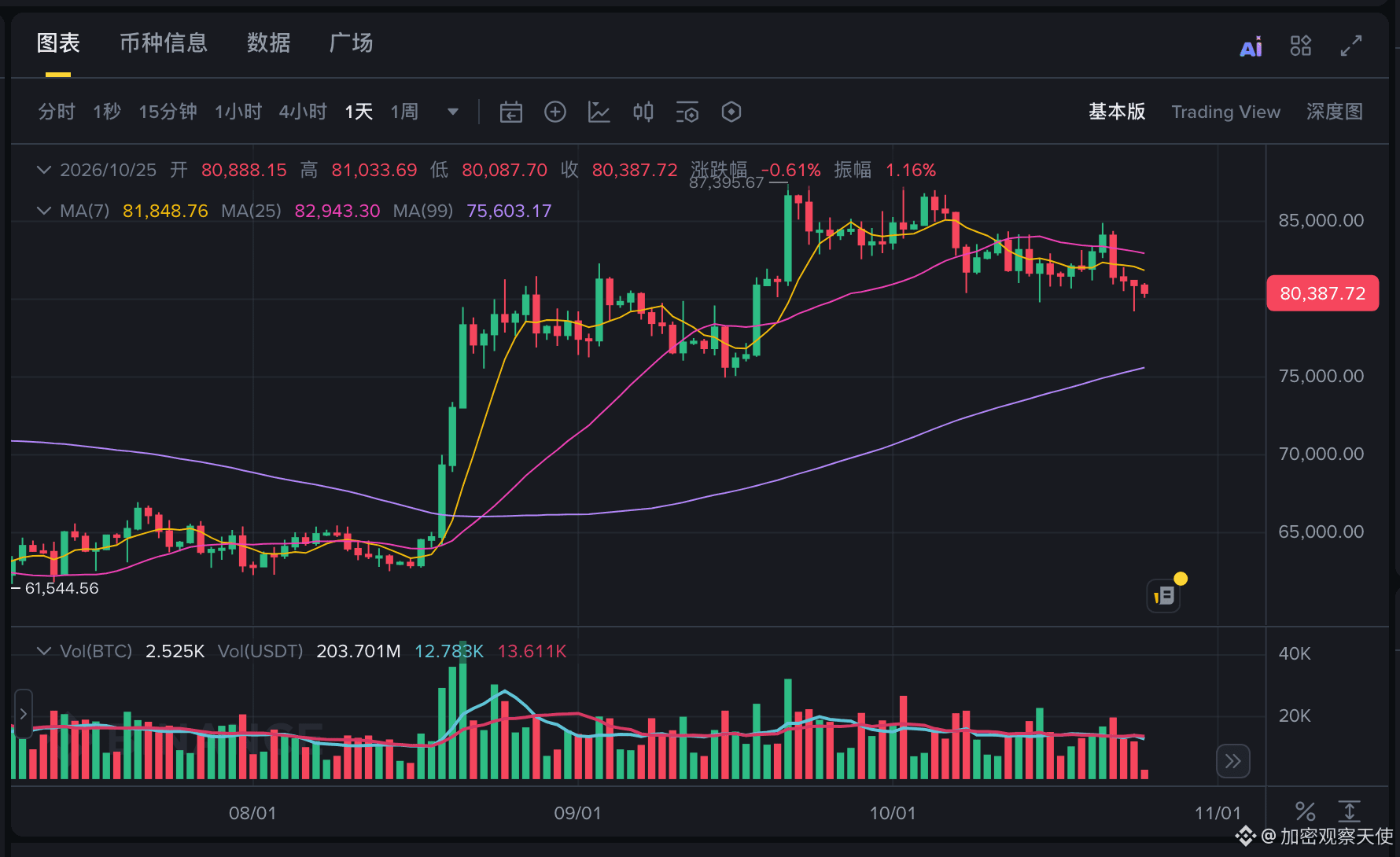
$BTC 19, at 58 minutes past the hour, was quoted at $80,362.
Over 24 hours, it ranged from $79,178 to $80,999, a swing of 2.3%.
After November 4, what comes first: the negotiating table or the next round of strikes?
Data: Ushakov’s remarks are from the CCTV News report published at 18:07 on October 25; information on the National Unity Day holiday is from the Kremlin’s official website.
The ceasefire’s effective date was separately confirmed by Russia and Ukraine on October 23. Brent prices are for the October 23 settlement; the two sources list $116.70 and $116.72, respectively, and the former is used here.
BTC and open-interest data are from the Binance Futures API, collected at 19:58.
The above is research commentary and does not constitute investment advice. #地缘 #油价 #Ceasefire