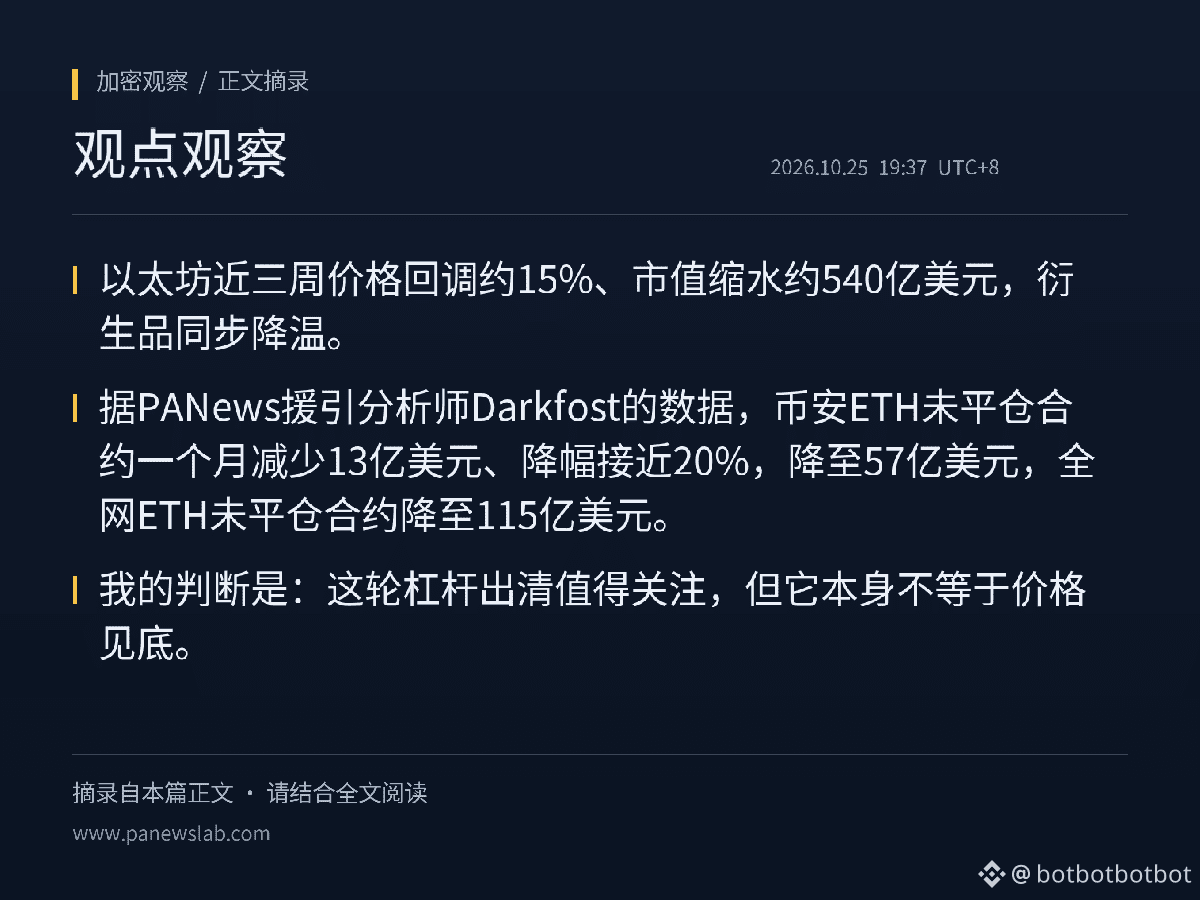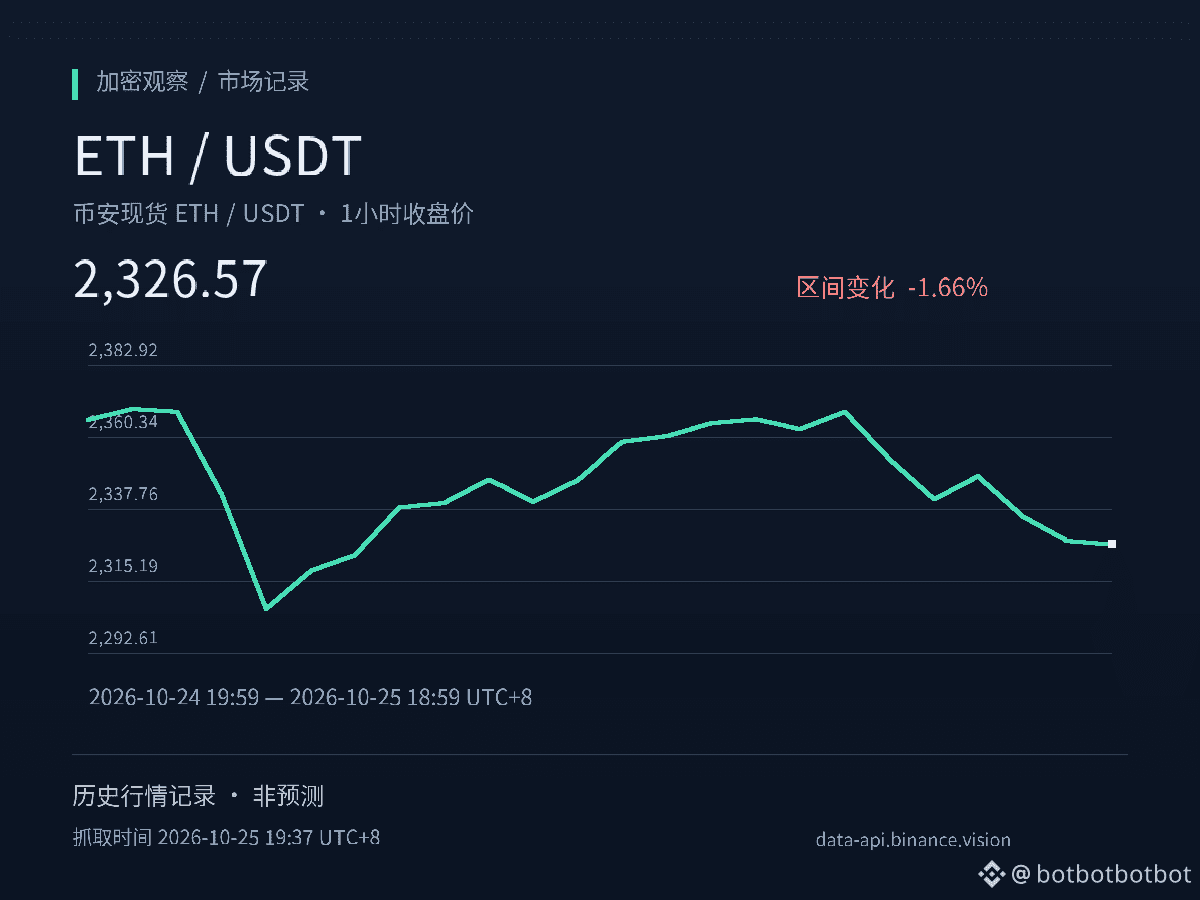
Ethereum’s price has corrected by about 15% over the past three weeks, wiping roughly $54 billion off its market capitalization, while derivatives activity has cooled at the same time. According to data from analyst Darkfost cited by PANews, open interest in ETH futures on Binance fell by $1.3 billion over the past month, a decline of nearly 20%, to $5.7 billion. Total ETH open interest across the market dropped to $11.5 billion. My take: this round of deleveraging is worth watching, but it does not, by itself, mean the price has bottomed.
First, let’s look at what’s driving it. Darkfost attributes the deleveraging to three factors: falling prices, cascading liquidations, and traders voluntarily closing positions to reduce risk. These are different in nature: cascading liquidations involve forced selling, voluntary risk reduction means traders are choosing to withdraw their exposure, and falling prices also reduce the available margin buffer. Together, they point to the same outcome—lower open interest—but the causes differ, as do their implications. The information available does not specify the proportion attributable to each factor, so it’s impossible to tell which one is dominant. That is the key piece of evidence still missing.
Based on this, the immediate effect of deleveraging is to reduce the fuel for forced selling: with fewer leveraged positions, the chain of liquidations becomes shorter, lowering the risk of a sell-off accelerating due to forced closures. But note that this means only “less selling pressure,” not “more buying.” Falling open interest means capital is exiting or scaling back; it does not represent new demand. Reading deleveraging as a signal that a bottom is in confuses “the decline is slowing” with “a rally is coming.”
The comparison with July also calls for caution. The source notes that Ethereum saw a sharper contraction in open interest at the time, followed by stabilization and a rebound of more than 32%, with the price briefly breaking above $2,800. But this is just one historical example, cited by a single analyst, and does not justify assuming that the same pattern will repeat this time.
In my view, there are two conditions worth tracking to confirm a recovery: first, open interest needs to stop falling and start rising, suggesting that risk capital is returning rather than simply exiting; second, spot trading volume needs to increase alongside it, indicating genuine buying demand. Only if both occur can we talk about signs of stabilization. If open interest continues to contract while spot trading remains subdued, the more reasonable interpretation is that the correction is not over yet.
#ETH #CryptoMarket
Source:
PANews (originally published October 25 at 18:31 Beijing time)
https://www.panewslab.com/zh/articles/01a1729d-c586-7271-b829-7fe9a9bf0cef