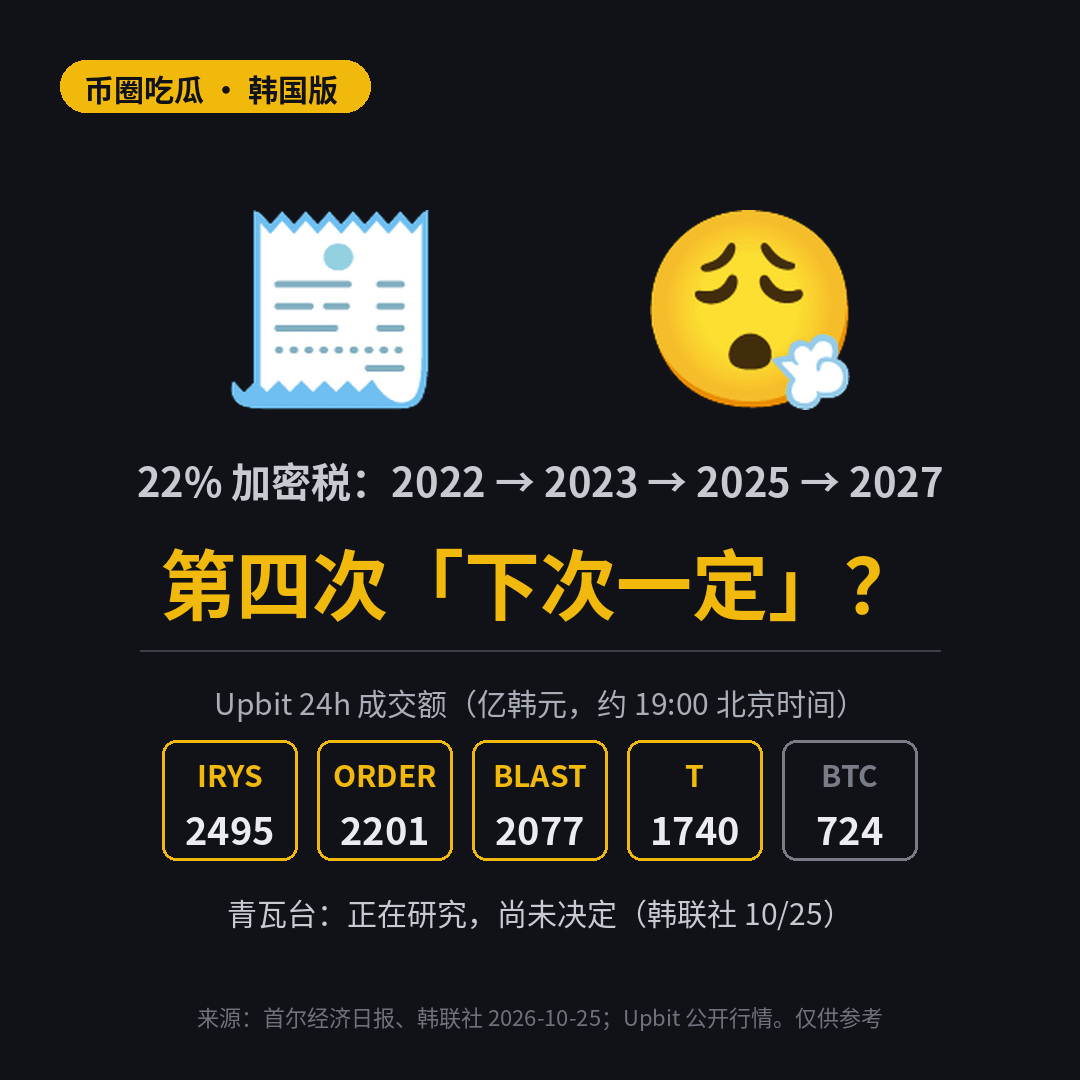
South Korea’s 22% crypto tax will probably be pushed back again. If it is, that’ll be the fourth time.
The Seoul Economic Daily reported today (10/25), citing Blue House officials, that discussions have shifted toward delaying the tax, originally set to take effect on January 1, 2027. An amendment by ruling-party lawmakers sets 2029 as the start year. Yonhap’s afternoon report was more cautious: the Blue House said it was “under review, with no decision yet.” Unless the law is changed, it still takes effect on January 1. Watch for the National Assembly’s review in November.
The reason is practical: the U.S. won’t join the OECD’s crypto-asset transaction data exchange framework (CARF) until 2029. Start collecting tax now, and South Korea would effectively be taxing only users of domestic exchanges.
Where is South Korea’s retail money going? The top six coins by 24-hour trading volume on Upbit are all small caps: IRYS at about 249.5 billion won, ORDER at 220.1 billion, BLAST at 207.7 billion, T at 174 billion… BTC is only at 72.4 billion. Upbit’s BTC price works out to about 80,310 USDT, versus around 80,390 on Binance spot—the kimchi premium is basically zero.
This news didn’t move BTC today; Korean capital is still rotating rapidly through altcoins. If the delay goes through, traders can keep playing this way for another two years without having to account for the tax.
One coin still rising—and also listed on Binance—is $T : spot is up 41% over 24 hours, while perpetual futures volume is about $220 million, more than 15 times spot volume. Korean spot trading is bringing the volume, and Binance futures are following suit. Next, it comes down to whether Upbit’s volume can hold up.
#韩国加密税 #Upbit $T $BTC