
In the trading knowledge series, I’ve covered “When You’re Allowed to Increase Position Size Based on Data.”
In this section, I’ll show you how to turn your journal into a practical tool for fixing mistakes: choose just one error to fix each week.
A review isn’t just counting wins and losses.
A review is about finding the most recurring error, then turning it into a specific action for next week.
Follow this approach, and the series—from candlesticks → checklist → capital → psychology—will gradually become a habit, not just theory.
Why fix only one error per week
Many traders open their journal, see 5–6 errors at once, and end up fixing none of them.
Your brain gets overloaded. As a result, you repeat all the same mistakes the following week.
A more effective approach:
Choose just one error each week that has occurred at least 3 times.
That week, focus only on reducing that error. Leave the other errors alone for now.
After 4–6 weeks, you’ll have clearly addressed 4–6 errors instead of leaving 20 unresolved.
Note: A weekly review has 3 steps: review each trade → find error patterns → apply what you learned next week. It doesn’t need to be complicated.

Weekly review process — 5 steps (30–45 minutes)
Do this at the end of the week, once all trades are closed.
Step 1: Filter the week’s trades
Include only trades with complete journal entries. Mark trades with missing fields as “missing data” and don’t use them for analysis.
Step 2: Count errors by category
Group the main errors into categories covered in the series:
Missing price zone / entering in the middle of a move
No confirmation candle or an invalid candle
Entered despite DXY acting as resistance
R:R below 1:2
Broke stop-loss rules or increased position size after a loss
Entered to try to win back losses
Record how many times each category occurred.
Step 3: Choose one priority error
Choose the error that occurred most often (at least 3 times).
If two errors occur equally often, choose the one that’s easier to fix or has a greater impact on your capital.
Step 4: Write a specific action for next week
Don’t write something vague like “I’ll be more careful.”
Be specific:
Error: “Entered in the middle of the range 4 times”
Action: “Before placing an order, I must take a screenshot of the price zone and clearly note the support/resistance levels. If I can’t take a screenshot, I won’t enter.”
Step 5: Set a measurable goal
Example: “Next week, the ‘entering in the middle of a move’ error will occur no more than once.”
At the end of next week, check whether you met the goal.
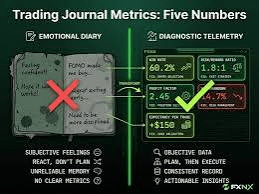
Note: Shift from subjective feelings (“I was a bit impatient”) to specific data. A journal helps you see the real errors, not just the ones you think you made.
Example of a real weekly review
Suppose you had 8 demo/live trades on XAU and BTC 4H last week:
STATISTICS ERROR
Missing price zone (entered in the middle of the range): 3 times
R:R below 1:2: 2 times
DXY was acting as resistance: 1 time
Broke stop-loss rules: 0 times
→ Priority error: Missing price zone.
Action for next week:
Before each trade, I must clearly write: “Price is touching 4H support/resistance at level X. It has reacted here Y times before.” If I can’t write this sentence → the decision is “Skip.”
Goal: This error occurs no more than once next week.
This is how you turn the lessons “Read One 4H Chart” and “Confluence” into action, rather than leaving them as mere knowledge.
Weekly review table template (copy into your journal)
WEEK: 20–26/10
Number of trades: 8
Most frequent error: Missing price zone
Number of times: 3
Action for next week: Clearly mark the zone before entering
Goal: ≤1 time
Next week’s result:
WEEK: 27/10–2/11
Number of trades:
Most frequent error:
Number of times:
Action for next week:
Goal:
Next week’s result:
Fill in the “Next week’s result” column at the end of the following week.
If you don’t meet the goal, keep working on the same error for another week instead of moving on to a different one.
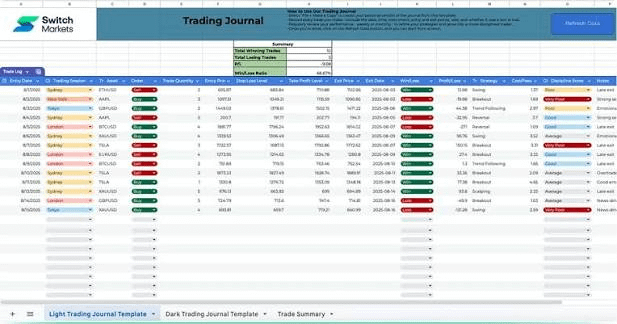
Note: A journal with note and discipline-score columns makes it easier to filter for recurring errors. You don’t need complicated software.
4 common review mistakes
Reviewing without choosing one specific error → next week is still chaotic.
Choosing an error but writing a vague action (“be more careful”) → you can’t measure it.
Meeting this week’s goal and immediately moving on to a new error without reinforcing the improvement.
Reviewing only after a losing week, while ignoring breakeven or winning weeks (errors can still be hiding there).
Consistent reviews are more important than reviewing only after a major loss.
Connect it to the whole series
“Missing price zone” error → revisit the lesson “Read One 4H Chart.”
“DXY acting as resistance” error → revisit the Confluence lesson.
“Increasing position size after a loss” error → revisit the lesson on Psychology After a Losing Streak.
“Poor R:R” error → revisit the Risk Management lesson.
Fixing one error each week is a way to review the relevant lesson you’ve already written, rather than rereading everything from the beginning.
Practical exercise
Open your journal and look at your 7–10 most recent trades.
Follow the 5 steps above.
Choose one error, write a specific action, and set a measurable goal.
Keep that note next to your screen next week.
At the end of the week, check the “Result” column.
If you like, comment with the error you chose and the action you wrote down, and I’ll let you know whether it’s specific enough.
CONCLUSION
A journal without reviews is just a record book.
A review that doesn’t identify one error is just looking back at the past.
One error each week.
One measurable action for each error.
After a few months, the errors that used to cost you money will decrease significantly because you’ve addressed them one by one.
How do you review your journal: by counting wins and losses, or have you started choosing one specific error each week? Comment with the most frequent error in your last 10 trades.
👉Look out for the next article in the Trading Knowledge series: “Sample XAU 4H Setup — From Reading the Chart to Deciding Whether to Enter, Wait, or Skip,” on the evening of 31/10/2026.
BRIAN TRUONG