

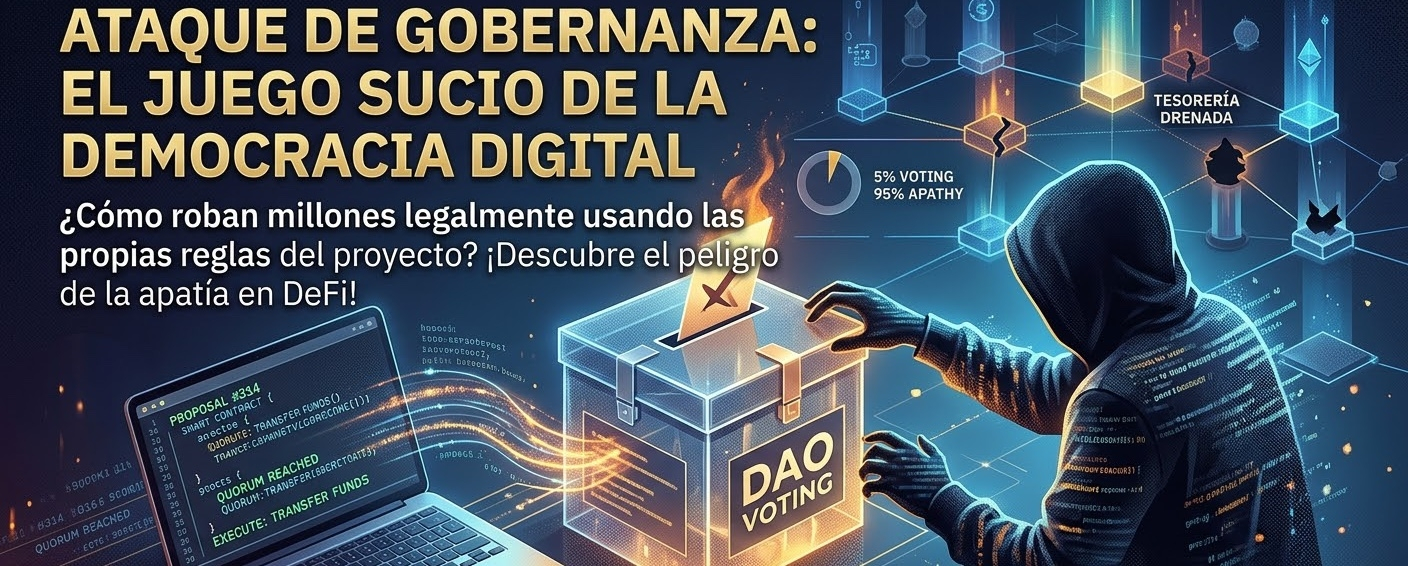

In the golden age of Decentralized Finance (DeFi), we were always told that “code is law.” What they forgot to mention is that if you control the votes, you write the law.
While most users believe that major thefts happen by breaking complex lines of code, a new wave of attacks is exploiting Web3’s weakest link: voter apathy and concentrated voting power.
🔍 What is a “Governance Attack” and how does it work?
Unlike a traditional hack, in a governance attack the attacker doesn’t break the smart contract; they play by its rules:
1. The Disguised Proposal: The attacker drafts an improvement proposal (DIP/VIP) that seems harmless or routine (e.g., “Liquidity parameter adjustment” or “Voter rewards”). Hidden in the proposal’s code is a call to transfer the treasury or change control of the funds to the attacker’s own wallet.
2. Buying Power: Taking advantage of typically low community participation (sometimes less than 5% of all tokens vote), the attacker quietly accumulates the minimum required threshold. They do this by buying tokens on the open market, using flash loans, or consolidating power in a few wallets.
3. The Instant Heist: The attacker votes in favor, gets the proposal approved before the community has time to notice, and, if the protocol has no waiting period (timelock), the contract executes the order and drains the treasury.
💡 Real-World Cases: From Theory to Multimillion-Dollar Drain
These types of attack vectors have been responsible for tens of millions of dollars in losses from DAO treasuries:
The Bought Vote ($20M): On governance platforms where only a 1% or 2% quorum is required and there is no delay before execution, attackers have spent a couple of million dollars buying tokens to authorize “rewards” that end up emptying project coffers in a single block.
Shadow Proxy Upgrade: In other cases (such as the historic Beanstalk attack or attacks on yield protocols), hackers use flash loans to temporarily take control of the token, vote in a single second, and repay the loan—all within the same transaction.
🛡️ The Investor’s Lesson:
If you’re staking or holding governance tokens in DeFi projects, check two key metrics before leaving your capital there:
Is there a timelock (a mandatory minimum delay) between the approval of a vote and its execution?
What percentage of community votes actually participate compared with large holders?
📌 Reflection / Token to Watch: Maker (MKR) / Sky
For those looking to understand how robust governance can be built to withstand mass manipulation attacks, Maker (MKR) is worth watching. It remains one of DeFi’s benchmarks thanks to its strict timelock periods, active voter delegation, and ongoing audits of every executive proposal.
⚠️ Disclaimer: This content is for informational and educational purposes only. It does not constitute financial or investment advice, nor a recommendation to buy. Always do your own research (DYOR) before making decisions in the crypto market.