



Irys ($IRYS ) - Infrastructure blockchain · #Datachain · #evm · #Web3 and #AI .


Irys is developing a blockchain designed for storing large volumes of data, verifying them cryptographically, and executing smart contracts. The project's core idea is to transform blockchain from a system that primarily processes transactions into infrastructure where data can not only be stored but also used in applications.
The Binance chart for October 24, 2026, shows an extreme IRYS surge: the price rose from around $0.02 to substantially higher levels, followed by a sharp correction. At the time of the snapshot, the price is shown at around $0.0809, up approximately 183% over 24 hours. According to CoinMarketCap data updated on October 24, the price was around $0.0811, up about 523% over 7 days, with a 24-hour trading volume of approximately $1.46 billion. This combination points not simply to an ordinary altcoin rally, but to an exceptional concentration of trading activity and speculative capital.
1. The Datachain concept and Irys’s place in the blockchain ecosystem. Most general-purpose blockchains, including Ethereum, are optimized primarily for executing transactions and smart contracts. Storing large collections of files, training data, images, event logs, and other informational assets can be expensive or inconvenient. Specialized storage networks address the problem of data placement, but integrating them with application logic often requires additional protocols and infrastructure. Irys aims to bring these functions together in a single architecture: data is stored on the network, verified by the protocol, and made available for applications to use. This positions the project at the intersection of blockchain infrastructure, decentralized storage, and the data economy. Its competitive advantage, however, will depend on the actual cost of storage, network reliability, the number of applications, and the extent of real-world usage—not just the stated concept.
2. Storage architecture and data availability. Irys supports different storage models: storage for a specified period and permanent storage. This allows developers to choose an economically suitable option for specific tasks. For example, temporary storage could be used for intermediate computing results, event logs, or frequently updated datasets, while permanent storage is suited to archives, historical records, and information that needs to remain available for a long time. The documentation describes mechanisms for distributing data among network participants, cryptographically verifying its integrity, and retrieving it through gateways using caching. Verifying data segments with Merkle tree roots makes it possible to detect discrepancies with the original content. The architecture also provides for horizontal scaling: as the volume of data grows, the network can expand its service capacity by adding participants and distributing stored segments. However, cryptographic integrity verification alone does not guarantee that any file can always be retrieved instantly. That also depends on node availability, replication, bandwidth, and infrastructure resilience.
3. IrysVM and programmable data. The IrysVM execution layer is compatible with the Ethereum Virtual Machine (EVM). This allows developers to use familiar languages, tools, and approaches to building smart contracts, potentially reducing the cost of moving to a new platform. Irys’s key idea is Programmable Data: smart contracts should be able to access data stored on the network directly while executing application logic. This opens up possibilities for DeFi protocols that use verifiable datasets, AI agents with persistent context, and digital identity, auditing, and access-control systems. But it is important to distinguish between the architectural goal and the product’s actual readiness: Irys documentation states that full Programmable Data functionality is in development and is not yet operational in its entirety. Therefore, the technology’s potential market cannot automatically be treated as demand for the IRYS token that is already being monetized.
4. Consensus, cryptographic verification, and economic security. The project’s materials describe a hybrid Useful Proof of Work and Stake (uPoW/S) approach, which links participation in securing the network to economic commitments and maintaining data availability. Participants must lock IRYS tokens as collateral and demonstrate that they are meeting their obligations; protocol-defined penalties for violations are intended to raise the cost of dishonest behavior. This design matters for a storage network: it is not enough to verify that a transaction is correct—the reliable servicing of data must also be ensured. Nevertheless, actual security should be assessed based on the distribution of stake and computing resources, the number of independent operators, the real-world operation of penalty mechanisms, resistance to attacks, and the mainnet’s track record. The presence of a complex consensus mechanism in the documentation does not automatically mean that all decentralization risks have been eliminated.
5. Tokenomics and the role of IRYS in the network economy. The IRYS token serves several functions: it is used to pay for network operations and data storage, supports security and staking mechanisms, and is tied to the funding of permanent storage. According to the published tokenomics model, the maximum supply is 10 billion IRYS. The project plans to burn 50% of execution fees and 95% of temporary storage fees; payments for permanent storage are directed to a dedicated reserve called the Irys Storage Endowment. The model also provides for rewards to network participants, initially set at 2% per year, with issuance decreasing according to a halving schedule every four years. The economic thesis is that increased real-world network usage will boost demand for the token, while fee burns will limit supply. However, deflation is not guaranteed at every level of activity: the outcome depends on the balance between actual burns, issuance, unlocks, and sales by existing holders. In addition, the need to pay for services with the token is not equivalent to a requirement to hold the entire volume of tokens long term.
6. An explosive influx of trading capital and increased attention to the token. The main directly observable factor is the sharp increase in trading activity on October 23, 2026. A CryptoTimes report published on October 24 said that IRYS had risen by more than 570% in 24 hours as of the evening of October 23; spot trading volume was estimated at around $964 million, while futures volume, according to CoinGlass, had risen to approximately $7.22 billion. A separate report by The Defiant noted an extreme intraday surge and activity on the South Korean exchange Upbit and other trading venues. The token’s availability on major exchanges, including Upbit, Gate, and OKX, broadens the pool of participants and makes it easier to move capital quickly between markets. However, a sharp increase in volume alone does not prove that long-term investors have entered the market: it may reflect speculative trades, short-term arbitrage, and intensive intraday trading.
7. A probable short squeeze and an amplified move through the derivatives market. The second important factor is the possible forced closure of short positions. When the price moves sharply against traders using leverage to short an asset, exchanges require additional margin or liquidate their positions. Closing a short requires buying back the asset, which can accelerate a price increase and trigger further liquidations. A Surf AI report dated October 24 interpreted the IRYS move as a short squeeze; it cited data showing a significant predominance of short liquidations during one of the time intervals examined. However, those figures apply to a specific snapshot in time, not the entire rally.
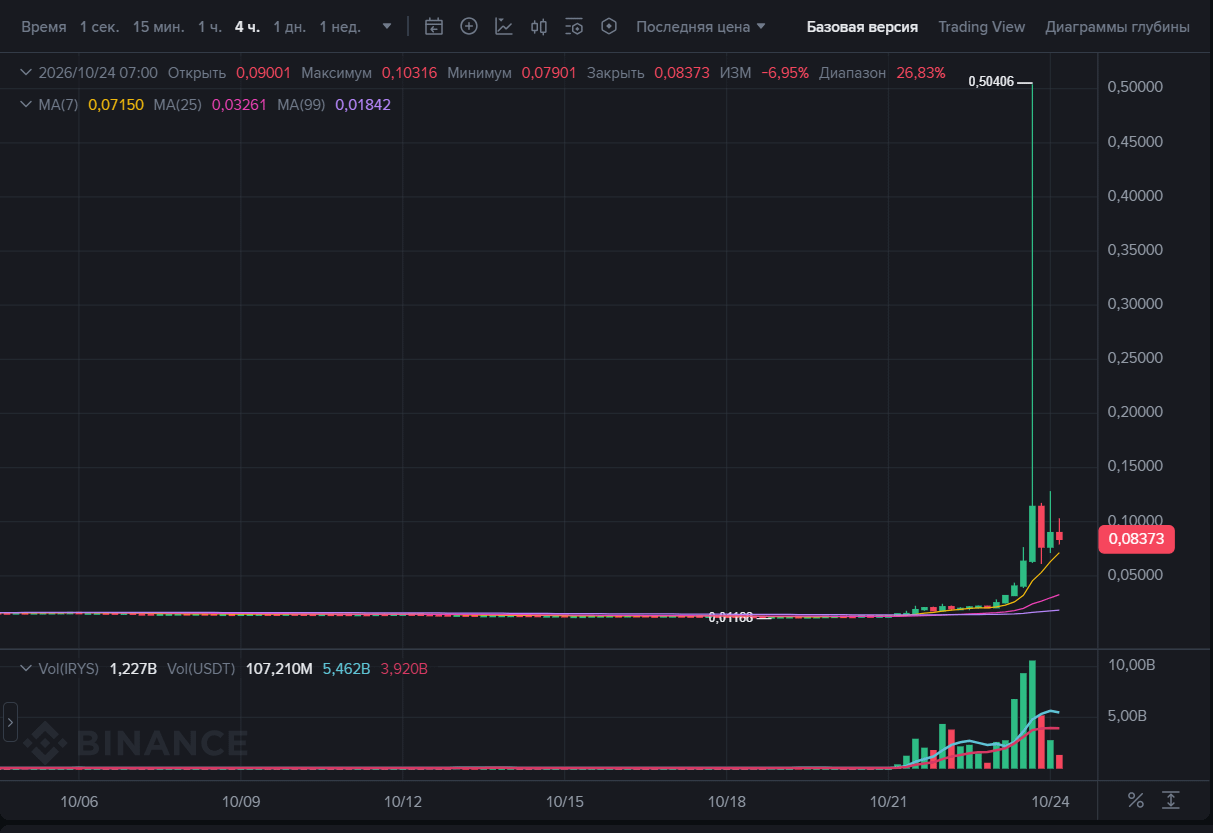
The chart shows a characteristic outcome of such a move: an almost vertical surge, an extreme peak near $0.50, and a subsequent decline. This is consistent with the hypothesis of cascading position closures and limited market depth at certain price levels, although the chart alone cannot prove that liquidations were the primary cause of the rally.
8. A strong infrastructure narrative, limited circulating supply, and speculative expectations. Irys’s fundamental story—the combination of data storage, EVM execution, and the potential use of data in AI applications—gives the market a compelling narrative for revaluing the project. Fee-burning mechanisms and a limited maximum supply may also attract speculative capital anticipating increased future demand. However, the other side of the tokenomics must be taken into account: according to published supply distribution data, a significant portion of tokens is not yet in free circulation, and unlocks could increase potential selling pressure. In particular, Tokenomics.com indicates a planned unlock of around 77.6 million IRYS on October 25, 2026. Therefore, the most well-supported explanation for the current surge is a combination of increased interest in the project, a sharp influx of trading capital, a probable short squeeze, and limited liquidity on some markets. Available data does not confirm that the surge was caused by one specific technology announcement or a comparable increase in actual network usage.
What does this mean for the valuation of the project and the token?
Fundamental strengths
A clear specialization in data infrastructure.
EVM compatibility and familiar developer tools.
Potential demand from AI, DeFi, and applications that handle large volumes of data.
Fee-burning mechanisms and economic incentives for network participants.
Key risks
The price may have significantly outpaced actual technology adoption.
High turnover does not mean a comparable inflow of long-term capital.
Future unlocks could increase market supply.
Sharp price moves and liquidations increase the likelihood of deep corrections.
Conclusion: Irys is a technologically interesting infrastructure project, not just a token without a practical use case. Its long-term investment prospects will depend on whether the network can turn its data storage and execution architecture into sustained demand from developers and users. However, IRYS rising by hundreds of percent over a short period cannot be considered proof of a fundamental revaluation. That would require data on actual network activity, fee revenue, storage volumes, smart contract usage, and the distribution of supply.
From a trading perspective, the chart shown calls for particular caution. After a vertical surge and an extreme upper wick, buying solely on the strength of the preceding move is risky. Confirming a continued trend would require price stabilization, the formation of a structure supported by volume, and the holding of key levels after a correction. Until such confirmation appears, the likelihood of sharp moves in either direction remains high.