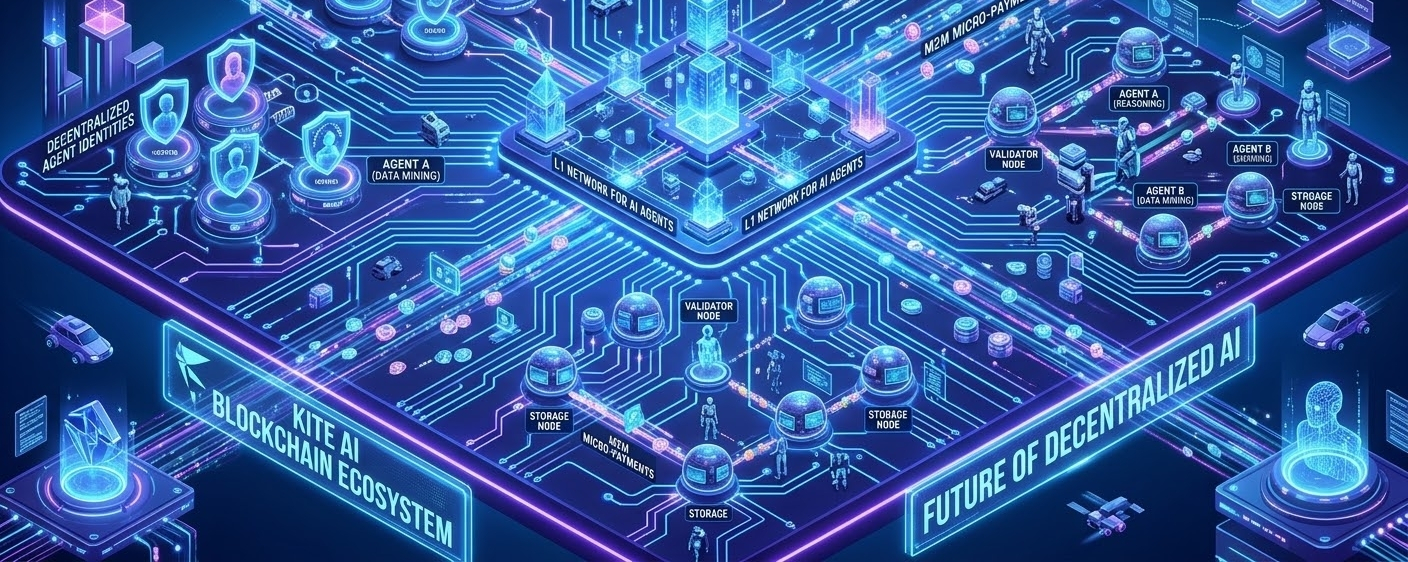

Kite AI (token symbol: KITE), as a dedicated Layer 1 blockchain built specifically for AI agents (AI Agents) and autonomous economic systems, is positioned at the core of the convergence of cryptocurrency and artificial intelligence (Web3 + AI).
The following is a comprehensive analysis of Kite AI (KITE), presented in structured text without tables:
1. Project positioning and core technical architecture
Kite AI aims to build the foundational layer of the “Agentic Internet,” addressing the pain points of AI agents lacking native identity, payment, and autonomous transaction capabilities in decentralized environments.
A Layer 1 blockchain designed specifically for AI agents
Kite provides an underlying environment that combines high performance, low latency, and extremely low transaction fees, optimized for high-frequency micropayments between machines (M2M).
x402 Payment Primitives and Programmable Governance
It introduces dedicated payment primitives (such as x402), enabling AI agents to procure services, call APIs, and settle resources directly using stablecoins or native tokens, without human intervention.
PoAI (Proof of AI) and On-Chain Verifiable Identity
It provides each autonomous AI agent with a decentralized, verifiable identity (DID) and permissions governance framework, ensuring that data exchanges and economic activities between agents are tamper-resistant and compliant.
Protocol-to-Protocol Token Model
Through a vertically integrated ecosystem, it incentivizes both the “supply side” of AI services (such as data providers and compute service providers) and the “usage side” (AI agents), creating a closed-loop ecosystem.
2. Tokenomics and Token Distribution
KITE is the native utility and governance token of the Kite AI ecosystem.
Total Supply and Token Allocation
Total supply: 10 billion KITE.
Initial circulating supply: Approximately 18% of the total supply.
Primary Token Utilities
Gas fees: All transactions initiated by AI agents, smart contract executions, and data transfers on the network require KITE.
Staking and node consensus: Validator nodes and AI service providers must stake KITE to maintain network security and earn rewards.
AI service settlement and governance: Used to pay for services between AI agents, and provides on-chain governance voting rights.
Listings on Major Exchanges
KITE is listed and traded on major global exchanges, including Binance, Coinbase, OKX, Upbit, Gate.com, and Bitget, giving it high market liquidity.
3. SWOT Analysis
Strengths
A clear market niche: Unlike general-purpose public blockchains, Kite focuses on “AI agent payments and economic settlement,” filling a gap in the market for autonomous AI transactions.
Strong backing from top exchanges: Its listing on Binance Launchpool and several leading exchanges gives it a significant advantage in token liquidity and international visibility.
Native micropayment primitives: Its underlying design is tailored to the high-frequency, low-value transactions of AI, avoiding the high fees and slow confirmations of traditional public blockchains.
Weaknesses
Limitations of an early-stage ecosystem: The AI agent economy is still at a very early stage, and actual high-frequency on-chain transaction volume depends heavily on a breakout in AI applications.
Risk of selling pressure from token unlocks: Only around 18% of the total supply is initially circulating. The remaining 82% will be released over time according to the unlock schedule, potentially weighing on the price in the medium to long term.
Opportunities
Upside from the AI agent boom: As Web3 and Web2 AI agents (such as AutoGPT and on-chain trading bots) become more widespread, demand for machine-native payment tools is expected to grow exponentially.
Cross-chain and cross-protocol integration: Through the Protocol-to-Protocol model, Kite can become a universal payment layer for other DeFi, DePIN, and AI decentralized compute networks.
Threats
Competition from Layer 2s and other AI-specific chains: Lightweight L2/L3 solutions focused on AI payments, such as Base, Solana, or others within the Solana ecosystem, may capture a share of the AI payments market.
Regulatory and compliance challenges: Autonomous AI agents capable of conducting on-chain financial transactions may face strict regulatory scrutiny related to anti-money laundering (AML) and fiat on-ramps.
4. Competitive Landscape and Market Differentiation
Comparison with general-purpose public blockchains (Solana, Ethereum L2s)
General-purpose public blockchains primarily serve “human users,” whereas Kite AI’s underlying architecture is optimized for “machines (AI agents)” to call and authorize contracts, offering more suitable identity authentication (DID) and extremely low micropayment costs.
Comparison with traditional AI crypto tokens (FET, NEAR, etc.)
Many AI projects focus on compute rentals or decentralized model training, while Kite AI is specifically focused on “AI commercialization and settlement infrastructure,” positioning itself more as an infrastructure and financial hub.
5. Summary and Investment Perspective
As an infrastructure pioneer for the “AI agent economy,” Kite AI (KITE) addresses a core pain point at the intersection of Web3 and AI: enabling machines to earn and spend autonomously. It has strong exchange backing and a clearly defined product positioning.
Key indicators to watch:
Real adoption of on-chain AI agents: Whether the ecosystem has any genuinely successful AI applications or agents making extensive use of the Kite network.
Token unlock schedule and absorption capacity: Monitor the token unlock schedules for the team and investors, and assess whether market liquidity is sufficient to absorb selling pressure.
Overall momentum in the AI sector: KITE’s price performance is highly correlated with the global AI technology wave and the AI segment of the crypto market.