

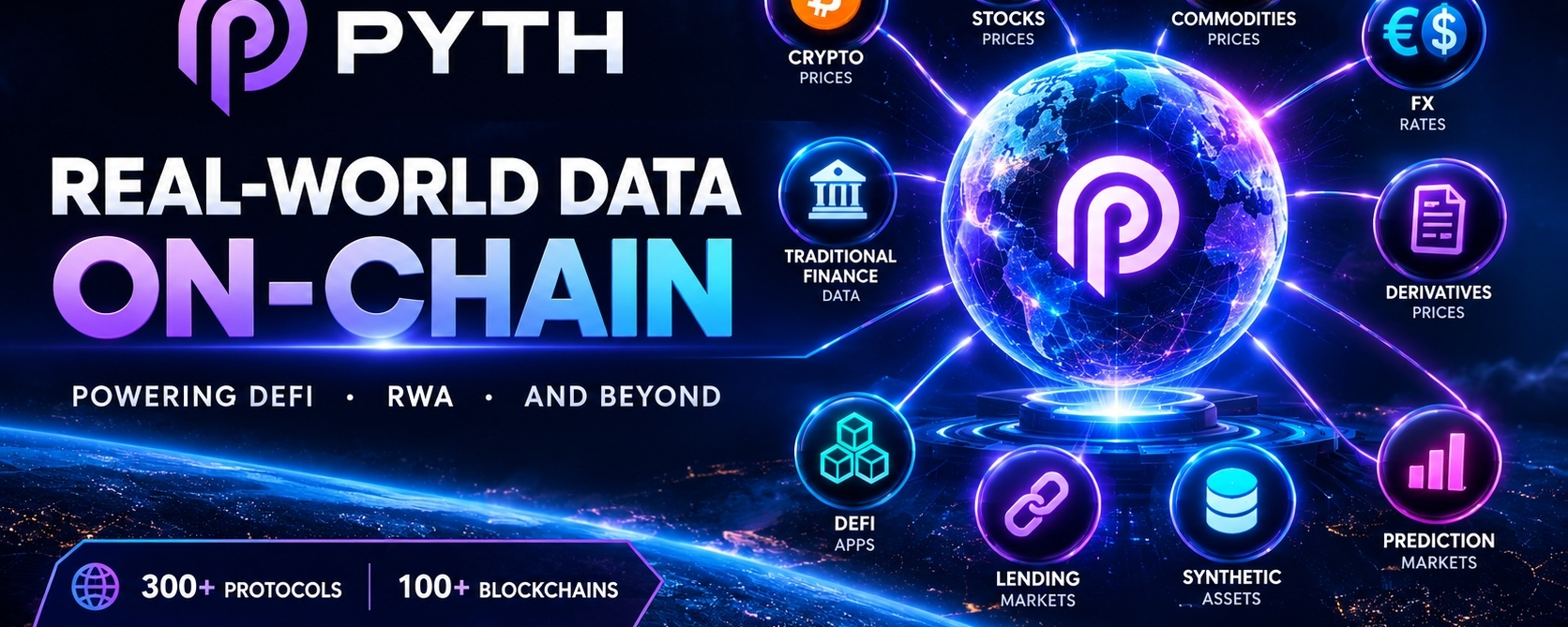


What if thousands of financial applications could access real-time market data across multiple blockchains?
That is the opportunity Pyth Network is building toward.
In crypto, blockchains cannot independently access live prices from traditional financial markets. They need reliable external data to support applications involving cryptocurrencies, stocks, commodities, foreign exchange and other financial instruments.
This is where Pyth Network ($PYTH) comes in.
🔹 1. What Is Pyth Network?
Pyth is an oracle network designed to bring market data on-chain. Its price feeds help decentralized applications obtain pricing information for smart contracts, trading systems, lending markets and other financial products.
Instead of relying solely on publicly scraped information, Pyth sources data from participants with direct access to financial markets, including trading firms, exchanges and market makers.
Its goal is to deliver accurate, timely market data where blockchain applications need it.
🔹 2. Why Does the Pyth Ecosystem Matter?
Imagine a decentralized trading platform offering exposure to gold or a stock-related instrument.
The smart contract needs appropriate market data to calculate prices, manage risk and determine how positions should be handled.
A price oracle can help provide that information.
The same general principle applies to:
📈 Trading & derivatives: Market prices for decentralized exchanges and derivatives platforms.
🌍 Real-World Assets (RWA): Market data for applications involving tokenized assets and traditional financial instruments.
💱 Synthetic assets: Pricing information used by applications that create blockchain-based exposure to other assets.
🔮 Prediction markets: Data that can support market mechanisms and financial applications, depending on the product.
⚙️ Multichain infrastructure: Oracle services that make pricing data available to supported applications across different blockchain networks.
One important distinction: providing a price feed does not mean Pyth issues, owns or tokenizes the asset itself. The application using that data determines what financial product it offers.
🔹 3. Who Uses Pyth?
Pyth has developed a broad ecosystem of integrations across decentralized finance and other financial applications.
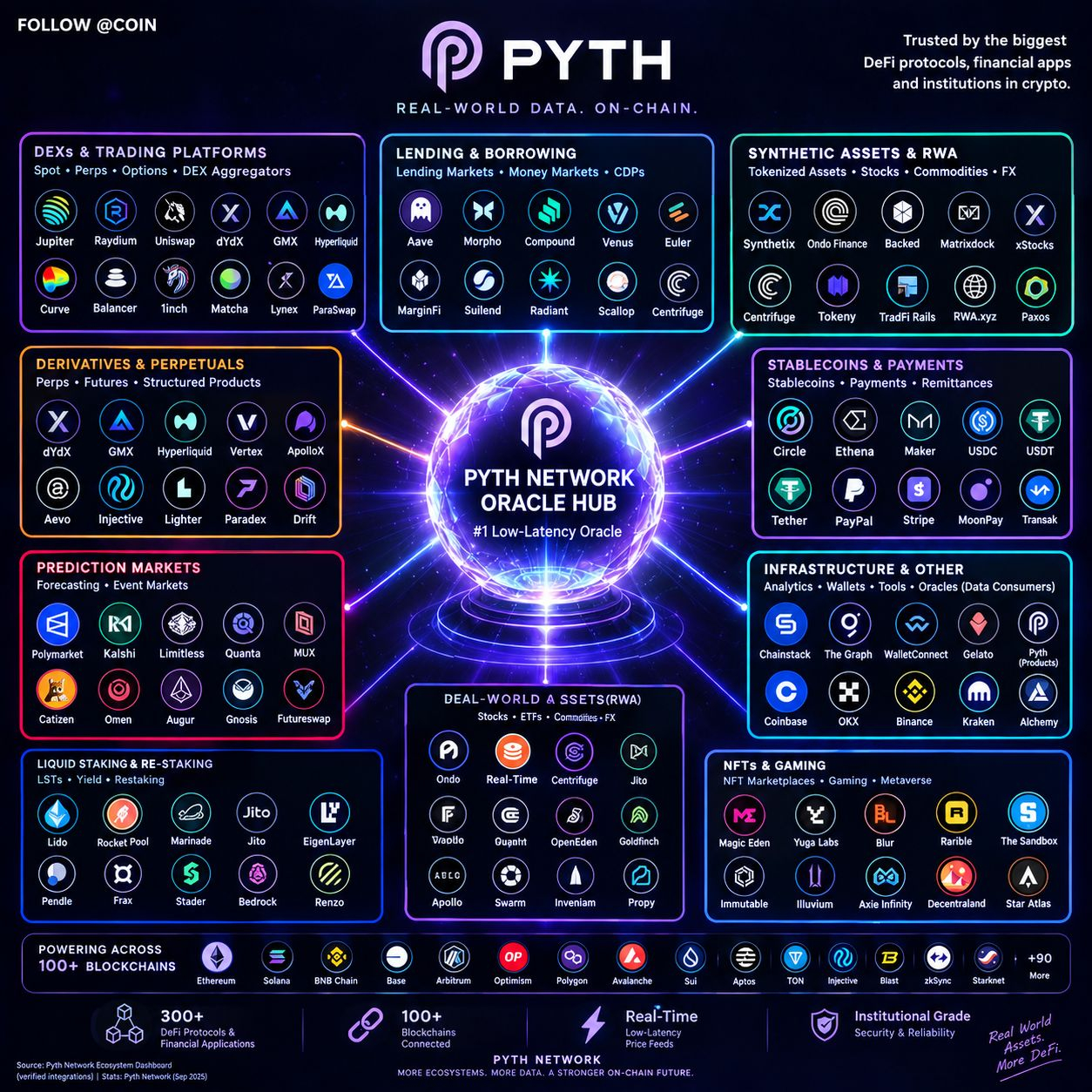
Its ecosystem includes projects in trading, lending, derivatives, synthetic assets and other categories. The infographic accompanying this article illustrates examples of projects and sectors associated with the wider ecosystem.
However, not every logo represents the same type of relationship. Some projects may use specific Pyth feeds, others may have indirect integrations, and some names may represent broader ecosystem relationships rather than confirmed current usage.
For that reason, the infographic should be treated as an ecosystem overview—not a claim that every listed project depends directly on Pyth.
You can explore Pyth's ecosystem and integrations through its official website:
https://pyth.network/
🔹 4. What Is the Role of the $PYTH Token?
PYTH is the network's native token. Its role within the ecosystem includes governance, allowing tokenholders to participate in decisions concerning the network.
But investors should distinguish the usefulness of Pyth's oracle services from the investment performance of its token.
A network can provide valuable infrastructure without guaranteeing that its token price will rise. Token demand, token distribution, emissions, competition, adoption and broader market conditions all matter.
🔹 5. Why Is Pyth Relevant to the RWA Narrative?
Tokenization aims to represent assets or financial interests on blockchain infrastructure.
As this sector develops, applications may need reliable pricing data from traditional markets. Pyth can serve as part of that data infrastructure when the relevant feeds and integrations are supported.
Its potential opportunity extends beyond RWA, including derivatives, lending and other on-chain financial applications.
Nevertheless, adoption of tokenized assets does not automatically translate into proportional demand for PYTH.
🔹 6. Risks Worth Understanding ⚠️
No oracle network is risk-free.
Potential challenges include incorrect or delayed data, network or application vulnerabilities, integration failures, competition from other oracle providers, changing regulations and limited adoption.
For investors, additional considerations include token unlocks, supply growth, valuation and whether the network's usage ultimately creates meaningful demand for the token.
A large ecosystem alone is not sufficient evidence that a cryptocurrency is undervalued.
🔹 My Take
Pyth is worth studying because reliable market data is an important component of blockchain-based finance.
If decentralized derivatives, tokenized financial assets and on-chain markets continue to develop, oracle infrastructure could remain an important part of that growth.
The key question is not simply how many logos appear on an ecosystem map. It is how many applications actively use Pyth, how important those integrations are, how the network generates value, and whether that value benefits PYTH tokenholders.
Infrastructure adoption and token investment returns are two different things. Understand both before making a decision.
📚 Official resource: OFFICIAL PYTH WEBSITE
📌 Educational content only. This is not financial advice or a recommendation to buy or sell PYTH. Always conduct your own research.