Breaking · Major development: Zelenskyy softens his stance: “We’ll sign if we keep 75% of our territory.” After 4 years and 8 months of fighting and three rounds of talks, is this the closest we’ve come to a ceasefire?
【What happened on October 21】
- Zelenskyy told Fox News he would accept an agreement to “freeze” the war along the current front line, with Ukraine retaining around 75% of its territory. This is the first time he has publicly accepted drawing the line at the status quo.
- That same day, after Putin met with a U.S. envoy, the Kremlin said it was willing to resume trilateral U.S.-Russia-Ukraine talks in early November. Putin also released a detained American teacher.
- Trump said, “We may have never been this close to the end of the war.” A BBC correspondent in Moscow reached the opposite conclusion: this latest U.S. push has done little to bring peace any closer.
【First, answers to three questions】
- How long has the war lasted? It began on February 24, 2022. As of today, it has been 4 years and 8 months.
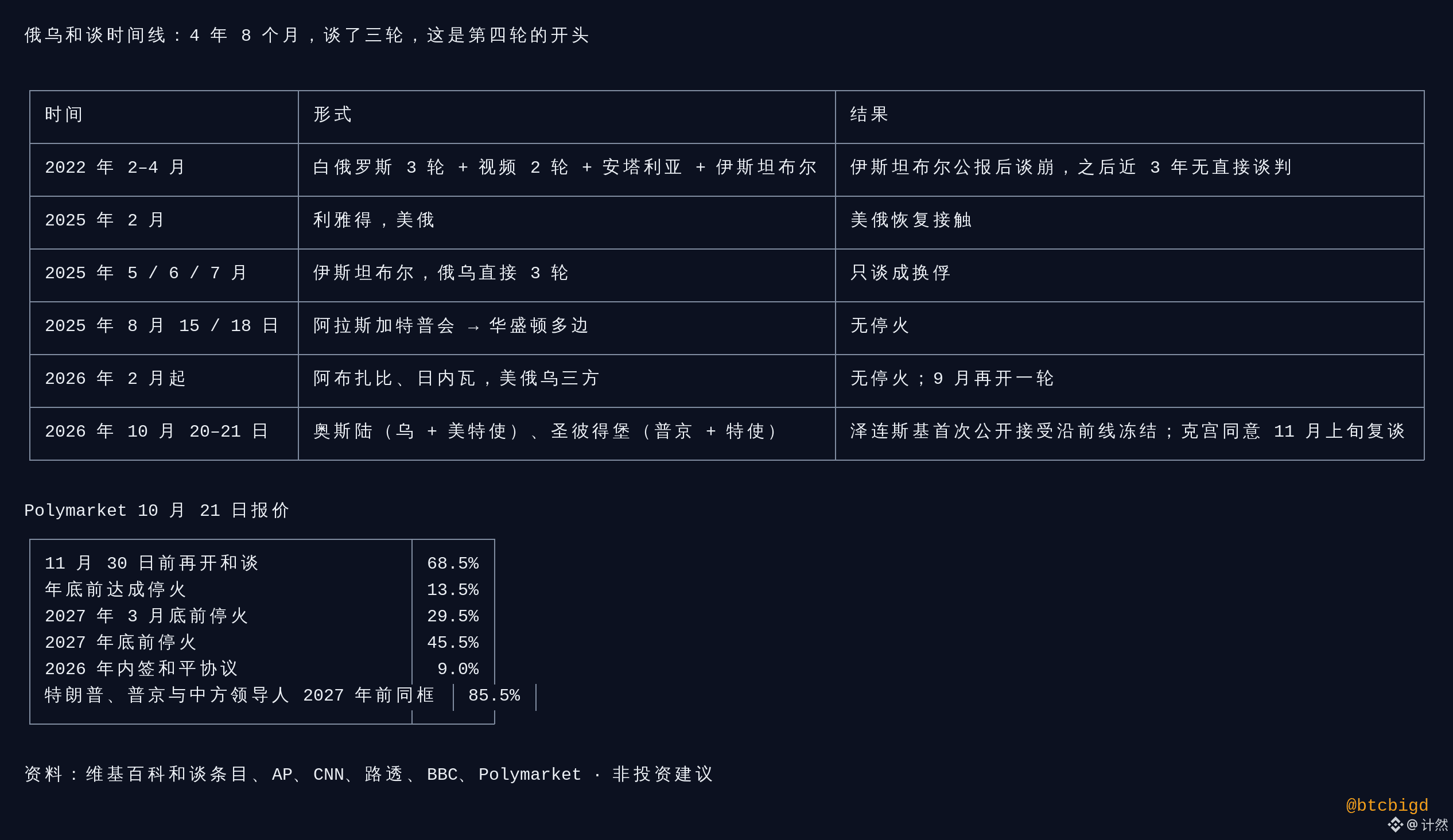
- How many times have they held talks? They held around eight rounds in Belarus and Istanbul between February and April 2022. Talks collapsed after the Istanbul Communiqué, followed by nearly three years without direct negotiations. In 2025, the U.S. and Russia met in Riyadh, while Russia and Ukraine held three direct rounds in Istanbul that only resulted in prisoner exchanges; then came the Trump-Putin meeting in Alaska. Since February 2026, the U.S., Russia, and Ukraine have held talks in Abu Dhabi and Geneva, followed by another round in September. All told, that makes three major rounds; this is the start of a fourth.
- Is this the closest we’ve come? In terms of the conditions, yes. In the first three rounds, neither side publicly accepted “drawing the line at the status quo.” This time, Ukraine has said so, Russia has proposed a date, and the U.S. is pushing for talks. But the odds tell a different story: Polymarket puts the chance of a ceasefire by the end of this year at 13.5%, by the end of next March at 29.5%, and by the end of 2027 at 45.5%. The odds of peace talks resuming by November 30, though, are 68.5%. The market is saying: talks are likely; a ceasefire is still a long way off.
【A China-U.S.-Russia meeting in Shenzhen: can we make a bold prediction?】
- The facts: On October 19, Putin proposed a trilateral summit, with Russia suggesting China as the location and November as the timing. Trump said he was willing, but said he wanted to discuss denuclearization, not Ukraine. Beijing has made no comment; Kyiv opposes it; and the Kremlin’s wording is that it is “under discussion.” APEC will be held in Shenzhen on November 17–18, and Putin has confirmed he will attend.
- The odds: Polymarket gives an 85.5% chance that “Trump, Putin, and China’s leader appear together before 2027.” The market thinks it’s likely all three will be in the same city; sitting down to discuss Ukraine and reaching an agreement is another matter.
- So, “a Shenzhen meeting” is fair to predict; “a meeting = a ceasefire” is not.
【Is the claim that “risk assets will soar” credible?】
- How markets actually reacted to the last two major peace headlines: After the Trump-Putin meeting in Alaska on August 15, 2025, the S&P 500 fell from 6,450 to 6,370 over the following week, while $BTC fell from 117,000 to 112,000. After direct talks in Istanbul on May 16, 2025, the S&P 500 fell from 5,958 to 5,803 over the following week, while BTC did rise 8%.
- Oil prices didn’t move either time. Brent stayed between 65 and 68. Today, Brent is at 109 because of the Strait of Hormuz, not Ukraine.
- In other words, neither of the last two developments lifted risk assets. For them to rise, the Strait of Hormuz issue needs to be resolved first.
【What to watch】
- Whether trilateral talks actually begin in early November, and where
- How Europe and Kyiv respond to a “frozen front line”
- Whether all three leaders appear together during APEC in Shenzhen, and whether they discuss Ukraine or nuclear issues
4 years and 8 months of war, three rounds of talks, and now, for the first time, someone has said, “Let’s draw the line at the status quo.” Are you betting on that 13.5% chance of a ceasefire this year, or on the market getting carried away too soon again?