


You open a DEX, type in a swap, and see two scary-sounding numbers: slippage and price impact. Many people treat them as the same thing. They aren't, and knowing the difference can save you real money on every trade you make, today or five years from now.
The short version
- Price impact is the price change your own trade causes. It depends on trade size versus pool size.
- Slippage is the gap between the price you expected and the price you actually got, for any reason (including price impact, delays, and volatility).
In other words, price impact is one possible cause of slippage. Slippage is the broader result.
Why price impact exists
Most DEXs use an Automated Market Maker (AMM). Instead of matching buyers and sellers in an order book, you trade against a liquidity pool: a reserve of two tokens held in a smart contract. The AMM sets the price from the ratio of tokens inside the pool.
When you swap, you add one token to the pool and take the other out. That changes the ratio, so the price moves. The bigger your trade relative to the pool, the bigger the move.
A simple example.
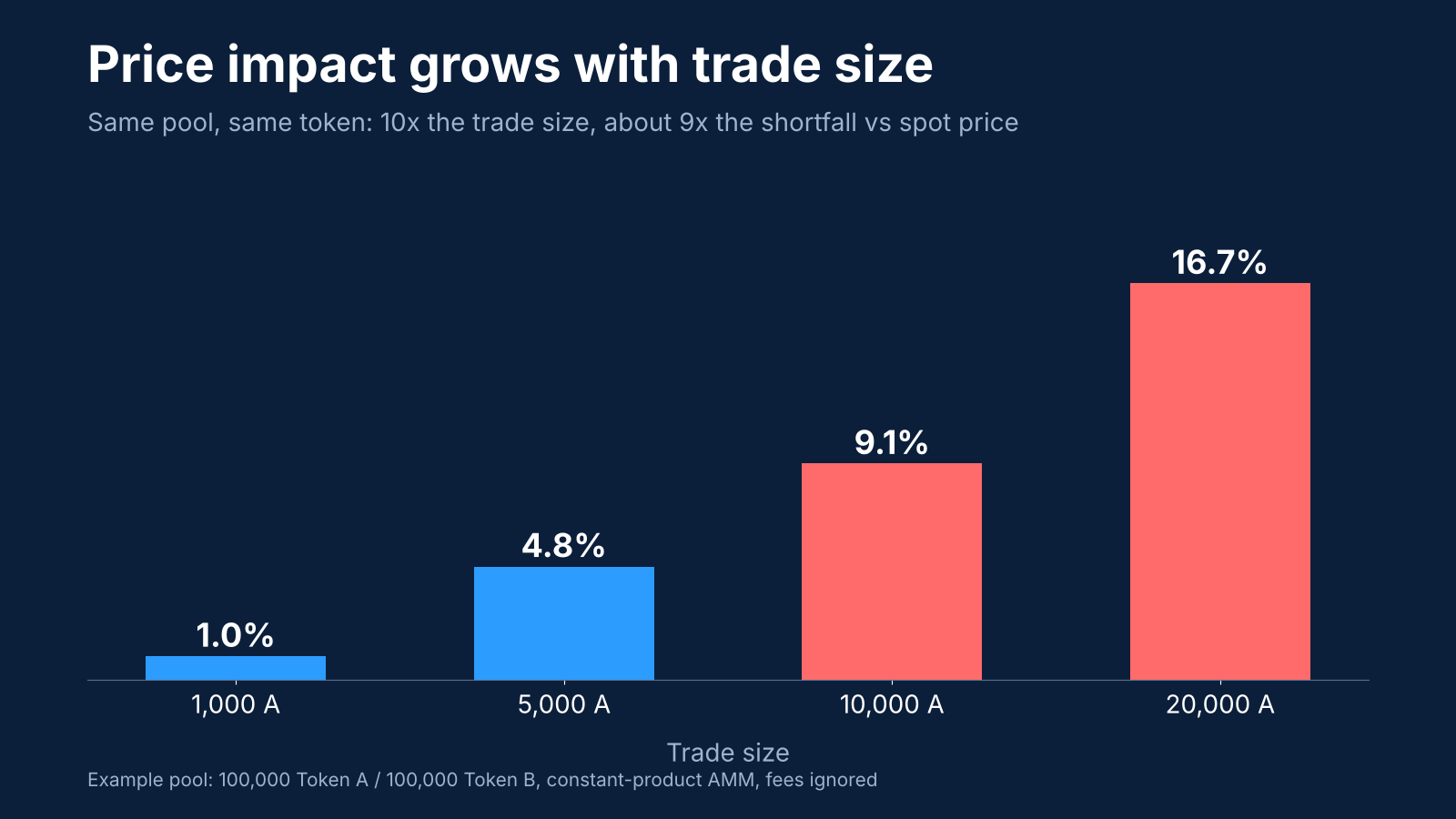
Imagine a pool with 100,000 Token A and 100,000 Token B. The spot price is 1 A = 1 B. (This uses the classic constant-product formula and ignores fees to keep the math clean.)
- Swap 1,000 A: you receive about 990.1 B. You paid roughly 1% worse than spot.
- Swap 10,000 A: you receive about 9,090.9 B. You paid roughly 9% worse than spot.
Ten times the trade size produced about nine times the damage. Same pool, same token, very different result. That shortfall is price impact, and it's why deep liquidity matters so much.
You'll see this on a real swap screen too. Here, STON.fi flags a 4.9% price impact in orange, and the button changes to "Swap anyway" as a warning.
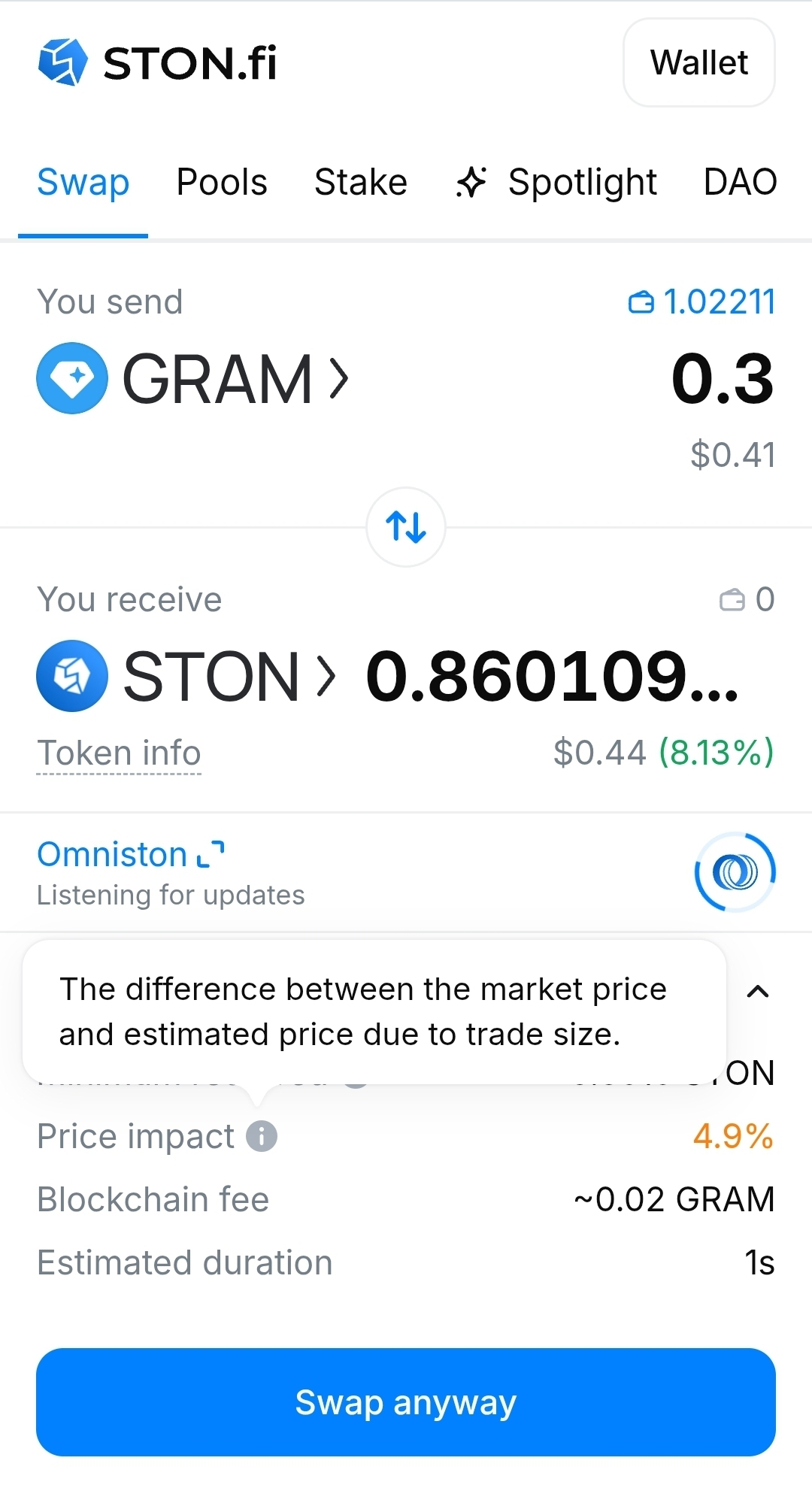
A real STON.fi swap quote: sending 0.3 GRAM for STON shows 4.9% price impact. The app defines it as the difference between the market price and the estimated price due to trade size.
## Where slippage comes in
Slippage covers everything that can make your final price differ from the quote:
1. Price impact from your trade size
2. Market volatility between clicking "swap" and the transaction confirming
3. Network delays or congestion
4. Price changes on other platforms that pull this pool's price
Slippage can even be positive if the price moves in your favor. Most of the time, though, people worry about the negative kind.
Your slippage tolerance setting
DEXs let you set a maximum slippage you'll accept. If the final price would be worse than that limit, the transaction fails instead of executing.
- Too low: your swap may fail often in fast-moving markets.
- Too high: you may accept a much worse price than you intended.
For low-liquidity tokens you'll usually see higher price impact, so check it before you confirm.
On STON.fi, this lives in the swap settings: you can type your own maximum slippage or pick a preset (0.5%, 1% or 2%), and there is also an Auto slippage toggle.
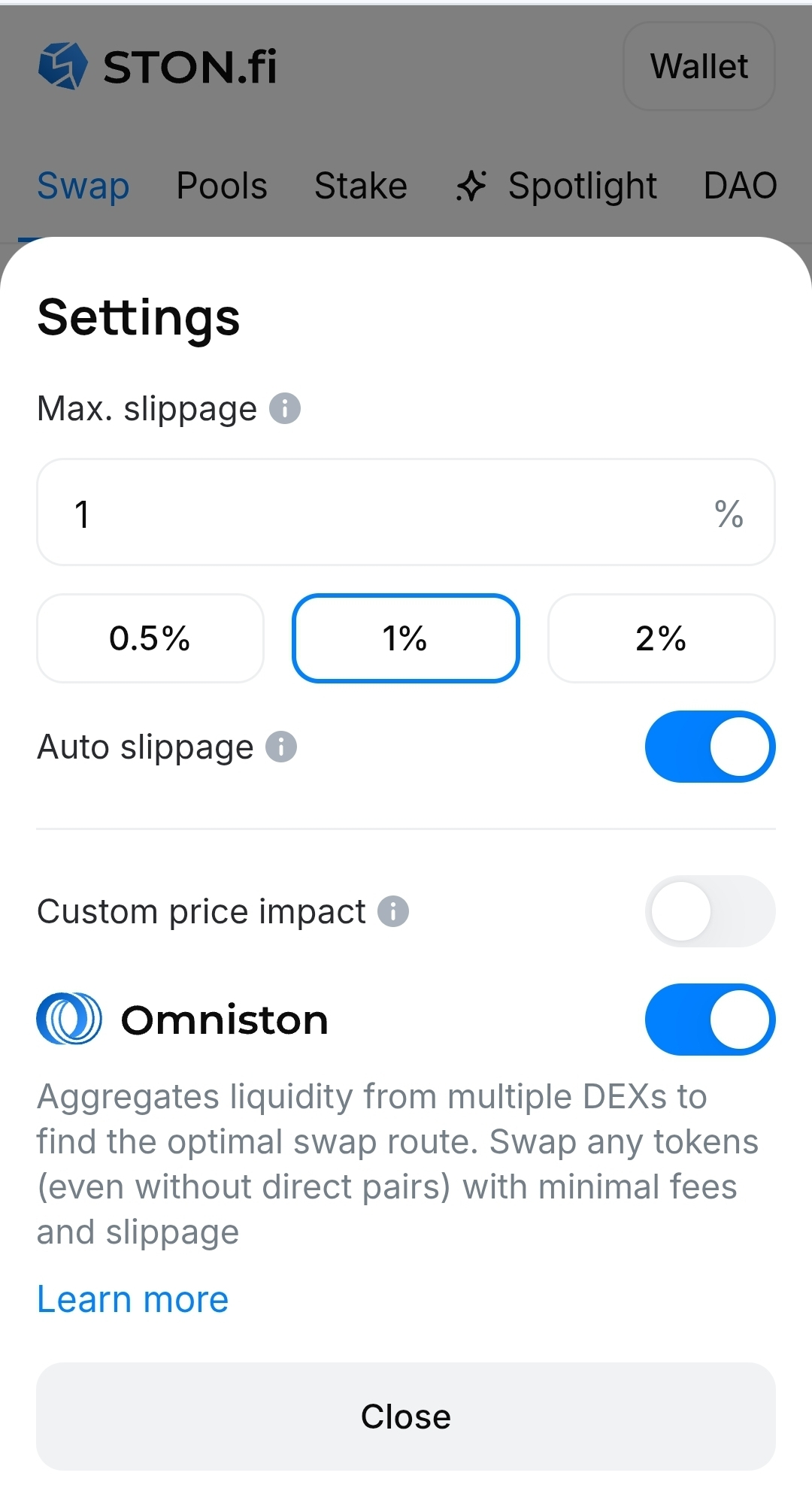
The slippage settings on the STON.fi swap screen: Max. slippage set to 1%, with 0.5%, 1% and 2% presets.
## A practical pre-swap checklist
1. Check the pool's liquidity relative to your trade size.
2. Read the price impact figure on the confirmation screen.
3. Review the exchange rate and fees, not only the output amount.
4. For a large trade, consider splitting it into smaller ones.
5. Do a small test swap first if the token is unfamiliar.
## Learn the rest of the DEX basics
Price impact is just one piece. If you want a clear, free walkthrough of how DEXs work, including liquidity pools, AMMs, impermanent loss, and a step-by-step first swap, the interactive guide at [whatisdex.com](https://whatisdex.com/) is a good place to continue. It even includes small calculators where you can plug in pool reserves and trade size to see price impact for yourself.
## Key takeaways
- Price impact comes from your trade size versus pool depth.
- Slippage is the broader gap between expected and actual price.
- Always read both numbers before you hit confirm.
This article is educational and is not financial advice. Crypto involves risk. Do your own research.