

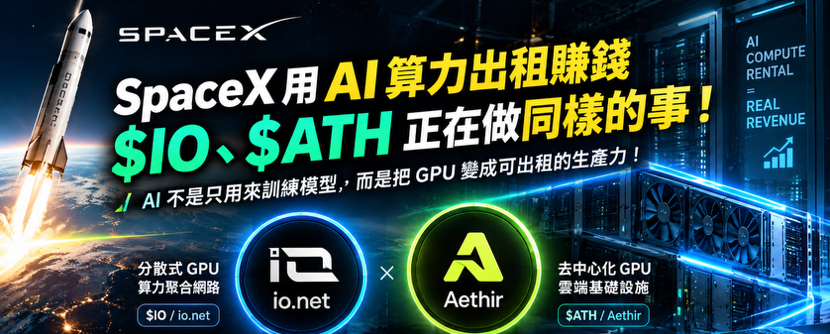

SpaceX’s recently announced third-quarter results showed a sharp increase in AI-related revenue. One business model worth watching is renting computing power to customers who actually need it, turning GPUs from a cost into a source of revenue. Reuters reported
This is what’s truly worth studying about AI infrastructure:
It’s not just about telling an AI story—it’s about who can integrate GPUs, improve compute utilization, and keep selling that computing power.
🚀 $IO | io.net
It aggregates globally distributed GPU resources to provide the computing power AI needs. Its official economic model is also beginning to link actual network revenue with a token-burning mechanism.
👉 https://io.net/tokenomics
⚡ $ATH|Aethir
Building a decentralized GPU cloud for computing needs such as AI training and inference; its official dashboard tracks network revenue, compute delivered, and supply-side data.
👉 https://aethir.com
Why is it worth adding to your research list?
As AI demand continues to grow, computing power is more than just hardware—it’s a resource that can be sold continuously.
SpaceX demonstrates the value of commercializing computing power; $IO and $ATH give the market a chance to explore this growth sector through the lens of decentralized computing networks.
But what truly determines whether a token has investment value isn’t just how great the demand for computing power is, but:
① Can the computing power actually be rented out?
② Can revenue continue to grow?
③ Can revenue growth translate into demand for the token or value for holders?
④ Does the current valuation already factor in future growth?
Large investors are looking for more than a hot narrative. They want assets with real demand and commercial revenue, whose token value still has room to be reassessed.
$IO , $ATH are worth researching, but don’t look at the story alone—consider the data, tokenomics, and valuation too.


