I recently came across a technical case study on NodeGhost by @Acurast and saw a pretty interesting test result.
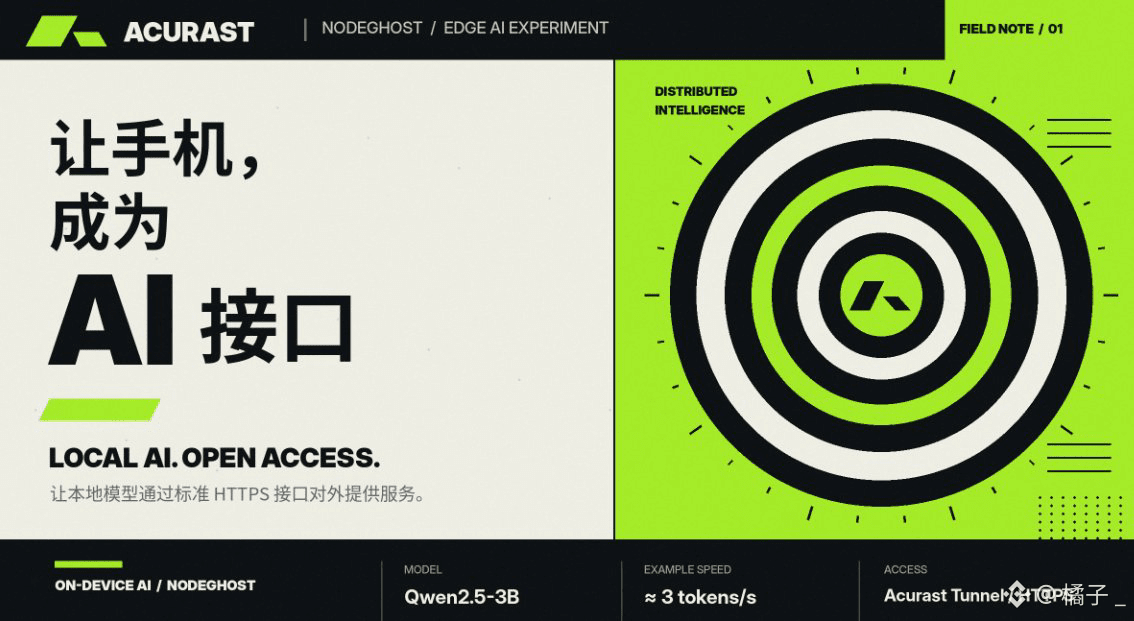
A phone running a quantized Qwen2.5-3B model generated about 3 tokens per second.
Answering a question of around 120 tokens took about 45 seconds.
By today’s standards for using large language models, that’s definitely a bit slow.
But what caught my attention about this case was another part of the design.
With Acurast Tunnel, a model that’s normally tucked away on a phone with no public IP address can provide an HTTPS interface to the outside world.
Then, by using NodeGhost’s OpenAI API compatibility, developers can send requests to run on the phone with almost no changes to their existing calling methods.
This means a phone is no longer just a Processor passively waiting for tasks to be assigned over the network—it can also provide standardized AI inference services to the outside world.
Of course, this case is still a reference implementation on the Canary network, with significant limitations in speed and complex reasoning capabilities.
But I think it already answers a very practical question:
If developers want to deploy their own models on a distributed network of phones, can existing applications call them easily?
At least there’s now a working example of how this could be done.
As for commercialization, latency, concurrency, costs, and long-term stability still need further validation.
Acurast’s $ACU supports network usage and computing incentives, but whether it can ultimately attract paying demand will depend on whether these applications are genuinely competitive.
A phone running a quantized Qwen2.5-3B model generated about 3 tokens per second.
Answering a question of around 120 tokens took about 45 seconds.
By today’s standards for using large language models, that’s definitely a bit slow.
But what caught my attention about this case was another part of the design.
With Acurast Tunnel, a model that’s normally tucked away on a phone with no public IP address can provide an HTTPS interface to the outside world.
Then, by using NodeGhost’s OpenAI API compatibility, developers can send requests to run on the phone with almost no changes to their existing calling methods.
This means a phone is no longer just a Processor passively waiting for tasks to be assigned over the network—it can also provide standardized AI inference services to the outside world.
Of course, this case is still a reference implementation on the Canary network, with significant limitations in speed and complex reasoning capabilities.
But I think it already answers a very practical question:
If developers want to deploy their own models on a distributed network of phones, can existing applications call them easily?
At least there’s now a working example of how this could be done.
As for commercialization, latency, concurrency, costs, and long-term stability still need further validation.
Acurast’s $ACU supports network usage and computing incentives, but whether it can ultimately attract paying demand will depend on whether these applications are genuinely competitive.