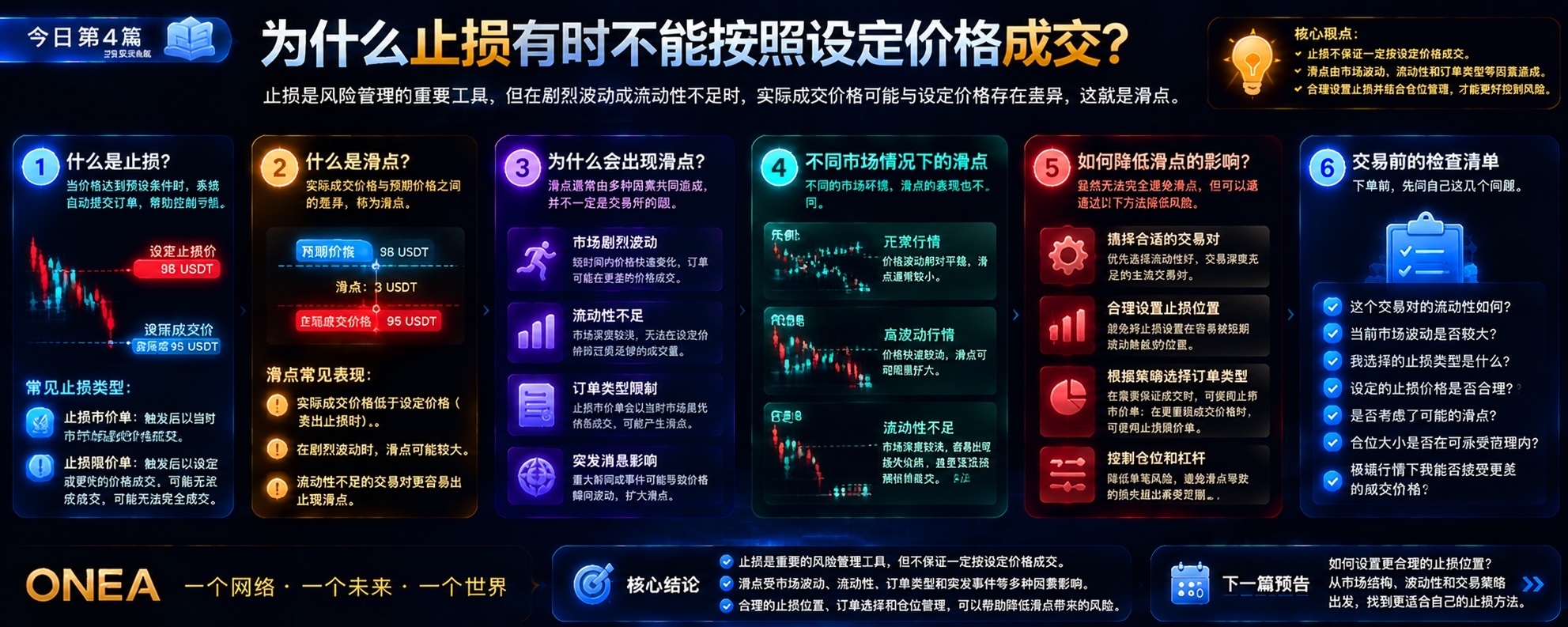
Why doesn’t a stop-loss always execute at the set price? These are the factors that really affect the outcome
In cryptocurrency futures trading, there’s one situation that can be especially frustrating:
You set a stop-loss before opening a position. The market suddenly reverses, and when the order is filled, you find that the actual execution price is worse than the price you set.
The first thing many people wonder is: Is something wrong with the exchange? Did the stop-loss fail?
In reality, a stop-loss being triggered, an order being filled, and the final execution price are three separate concepts that need to be understood individually.
If you don’t understand the differences between them, even with a stop-loss in place, you may underestimate the risks you face in extreme market conditions.
Today, we’ll explain this clearly by looking at how trading mechanisms work.
1. What exactly is a stop-loss, and what can it guarantee?
A stop-loss is a risk management tool. Its purpose is to execute an exit according to specified order rules when the market price reaches a preset trigger condition.
But a stop-loss does not mean the trade will necessarily be filled at the specified price.
Different types of stop orders may follow different execution logic. Common types include:
1. Stop-market order
Once the trigger condition is met, the system submits a market order and attempts to fill it at the best available market price.
The advantage is that it generally prioritizes prompt execution. However, during periods of sharp volatility or insufficient liquidity, the execution price may differ significantly from the trigger price.
2. Stop-limit order
Once the trigger condition is met, the system submits a limit order, requiring it to be filled at the specified limit price or a more favorable price.
The advantage is that you can control the acceptable price range for the order. The downside is that if the market price moves past the limit quickly, the order may not be filled or may only be partially filled.
So, there is a very important distinction here:
A stop-market order prioritizes the chance of execution but cannot guarantee the execution price; a stop-limit order prioritizes price constraints but cannot guarantee that the order will be filled.
The specific order names, trigger conditions, and execution mechanisms depend on the rules of the exchange you use.
2. What is slippage, and why can the actual execution price differ from what you expected?
Slippage generally refers to the difference between the expected execution price and the actual execution price.
For example, suppose you hold a long position in a contract and set your stop-loss trigger price at 98 USDT.
When the price falls and triggers the stop, you hope to exit at a price close to 98 USDT.
But the market suddenly drops quickly, buy-side liquidity is insufficient, and the available bids able to immediately absorb sell orders have fallen to around 95 USDT.
If triggering the stop submits a market sell order, the final execution price may be close to 95 USDT rather than 98 USDT.
This example is intended only to explain the mechanism and does not represent any actual market quote.
Slippage does not necessarily mean the system has malfunctioned, nor does it necessarily mean the exchange has violated its rules. It can result from the combined effects of market liquidity, the speed of price movements, and the order execution method.
Of course, if you suspect an order was executed abnormally, you should also check the order history, trigger conditions, execution details, and exchange rules, rather than simply attributing every discrepancy to slippage.
3. Why does slippage occur? There are four main reasons
Reason 1: Excessive market volatility
During major news releases, unexpected events, or periods of widespread liquidations, prices can change rapidly in a very short time.
By the time a stop is triggered, market quotes may already differ significantly from the earlier price.
The trigger price is the condition that starts order execution. It does not mean the market will pause at that price and wait for your order to be filled.
Reason 2: Insufficient market liquidity
Liquidity can be understood simply as how many buy and sell orders the market can absorb within a given price range.
If market depth is insufficient, a large market order may need to consume liquidity across multiple price levels before it can be filled.
For example, part of the order might be filled at 98 USDT, while the rest might be filled at 97 USDT or lower.
As a result, the final average execution price may be lower than the quote you initially saw.
Reason 3: Different order types
Stop-market and stop-limit orders follow different execution logic.
The former generally prioritizes the chance of execution, while the latter is constrained by its limit price.
If the market gaps down or continues falling rapidly, a stop-limit order may not be filled because the market price has already fallen below the limit price.
This means that even if the limit order avoids being filled at an unfavorable price, the risk has not disappeared: the unfilled position remains exposed to the market.
Reason 4: Trigger prices and actual execution prices work differently
Some exchanges let users choose the mark price, last traded price, or another price as the basis for triggering a stop. The available options vary by product.
These prices are not always exactly the same.
For example, the mark price may differ from the last traded price. If the trigger basis you selected differs from the price you are watching, you may wonder, “Why did the order trigger when the price I saw hadn’t reached that level yet?”
In addition, submitting, matching, and reporting the execution of an order after it is triggered all take time. When the market is moving rapidly, the price differences between these stages may widen further.
So, before setting a stop, you need to understand not only the stop price, but also the trigger basis and order execution method.
4. Why does leverage make slippage more important to consider?
Suppose you open a position with a notional value of 10,000 USDT.
If the final execution price differs adversely from the expected price by 0.5%, then, using a simplified calculation that ignores fees and other factors, the impact of the price difference would be approximately:
10,000 × 0.5% = 50 USDT.
This calculation shows the impact of the price difference on the notional position. It is not necessarily the amount your account will lose, nor is it a prediction of how much slippage will occur.
But this example highlights a key point:
When assessing trading risk, you need to consider not only how much margin you put in, but also the size of the entire notional position.
When your position is large, even a small percentage difference in the execution price can have a noticeable impact on the trade outcome.
Leverage also means that your margin is smaller relative to the notional position. So, slippage, trading fees, and adverse price movements are all worth considering carefully before opening a position.
Note that leverage does not directly determine the amount of slippage. Slippage depends more on market liquidity, volatility, order size, and execution mechanisms; leverage affects how much those price differences impact your margin and account equity.
5. How can you reduce the impact of slippage?
There is no way to guarantee that slippage will always be zero, but you can take steps to reduce unnecessary risk.
First, pay attention to the liquidity of the trading pair.
Don’t look only at the trading pair’s volume. Also consider the bid-ask spread, order book depth, and the potential price impact of larger orders.
Second, avoid chasing sharp price movements without understanding the risks.
During major news releases or rapid market declines, prices can change quickly, making order execution results harder to predict.
Third, understand the trade-offs between different stop orders.
If you prioritize exiting promptly, understand that market orders can result in price slippage. If you use limit orders, consider the risk that they may not be filled.
Don’t focus on one advantage while ignoring the cost on the other side.
Fourth, manage your position size and leverage appropriately.
Your position size should match your risk budget. Don’t assume that setting a stop-loss means you can increase your position without limit.
Fifth, check the exchange’s order rules.
Understand the stop trigger basis, order types, fees, liquidation mechanisms, and any special rules that may apply during extreme market conditions.
Sixth, regularly review your actual execution records.
Compare the expected price, trigger price, actual execution price, and filled quantity. Analyze whether price differences were related to market volatility, liquidity, or your order settings.
By keeping records and reviewing them, you can gradually learn how your trading strategy actually performs in different market conditions.
6. Before opening a position, ask yourself these six questions
Is there enough liquidity in this trading pair?
Am I using a stop-market order or a stop-limit order?
Is the stop triggered by the last traded price, the mark price, or another condition?
If the actual execution price is worse than expected, will my risk budget still be reasonable?
If my stop-limit order cannot be filled, how will I manage the remaining position?
Do I understand this exchange’s order execution, fees, and liquidation rules?
These questions cannot eliminate all trading risks, but they can help you identify risks that are easy to overlook before opening a position.
7. Remember: A stop-loss is not a guarantee; it is part of risk management
Stop-losses are important, but they are not a button that guarantees an outcome.
A stop being triggered does not mean the order will be filled in full; an order being filled does not mean it will be filled at the trigger price.
Stop-market orders may be subject to slippage, while stop-limit orders may not be filled.
Effective risk management means considering stop settings, position size, leverage, market liquidity, and exchange rules together.
Before trading, take a moment to ask yourself:
If the market suddenly moves quickly and the execution price is worse than I expected, or the order cannot be filled right away, will I still understand the risk I’m taking?
If the answer is no, it may not be just your stop price that needs improvement—it could be your entire trading plan.
Three questions for the community
Do you prefer using stop-market orders or stop-limit orders? Why?
Have you ever had a stop triggered and then found that the actual execution price differed significantly from what you expected?
In your view, are traders more likely to overlook liquidity, order type, or position size?
Feel free to share your experience and different perspectives. We hope that discussing specific mechanisms and real questions will help more traders develop a clearer awareness of risk.
Coming in the next article: Where exactly should you set your stop price? We’ll explore the relationship between market structure, volatility, trading logic, and position risk, and explain why simply setting a stop at a fixed percentage may not suit every trade.
Follow ONEA to keep learning about Web3, digital asset security, and risk management.
This article is for trading risk education only and does not constitute investment advice or a promise of returns. Contract trading involves significant risk. Please make decisions cautiously after fully understanding the trading rules.