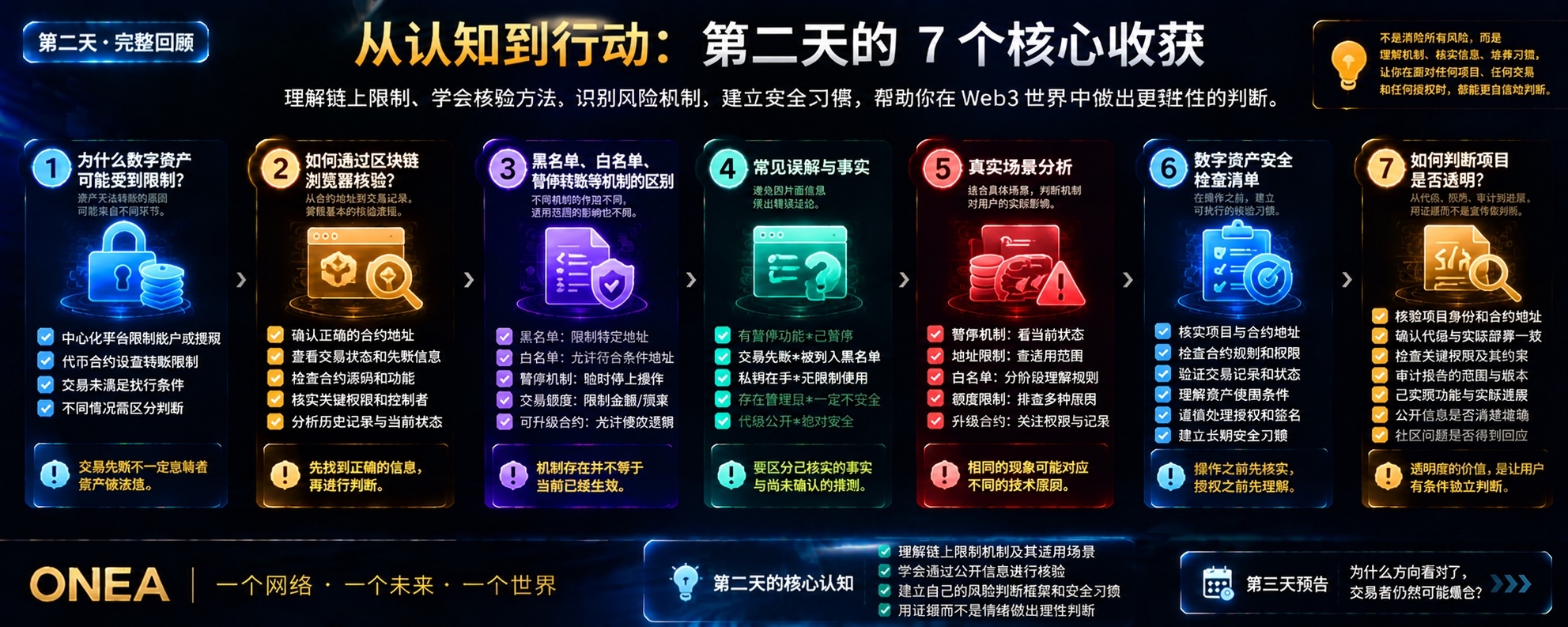
From Understanding to Action: Build Your Own Web3 Risk Assessment Framework
Today, we discussed a range of topics related to digital asset self-custody, private keys, smart contracts, on-chain restrictions, admin privileges, open-source code, security audits, and project transparency.
These questions may seem different, but they all point to the same central issue:
In the Web3 world, how can you build your own ability to assess risk over time instead of relying on other people’s conclusions?
I believe what truly matters isn’t how many technical terms you can memorize. It’s knowing what to check, how to look for evidence, and when to pause before taking action—whether you’re evaluating a project, making a transaction, or granting authorization.
1. Don’t Equate Having Assets in a Wallet with Having Absolute Control Over Them
Private keys are an important part of digital asset control, but wallet control, smart contract execution conditions, and the actual usability of assets are not exactly the same thing.
Transactions may be affected by factors such as network conditions, balances, fees, contract rules, or permission settings.
So when assets can’t be transferred or a transaction fails, don’t rush to assume it was caused by any one specific factor.
First check the transaction record, then review the contract rules and relevant state. Verify what you can, and keep questions open when something cannot yet be confirmed.
2. Don’t Equate Publicly Available Code with a Secure Project
Open-source code gives more people the opportunity to inspect it, but it doesn’t automatically prove the code is free of vulnerabilities or guarantee that the published source code exactly matches the contracts actually deployed.
What’s really worth checking is which project, contract address, and version the code corresponds to, and whether its key functions can be understood and verified.
Similarly, a security audit is an important reference, but you should still check its scope, the version it covers, the issues it identified, and how those issues were addressed afterward.
Assessing security requires multiple pieces of evidence to corroborate one another—not reliance on a single label.
3. Don’t Equate the Presence of Permissions with Malice—but Don’t Ignore Permission Risks
Admin permissions, pause mechanisms, whitelists, and upgradeable contracts should all be assessed based on their specific implementations.
The key is not just to ask, “Are there permissions?” but to go further and ask:
Who holds those permissions?
Which functions can those permissions affect?
Are there multisig, timelock, or other constraints?
Can changes to permissions be verified?
Does the current state match the public descriptions?
Only by considering the scope of permissions, how they are controlled, and their actual status together can we understand the risks more reasonably.
4. Don’t Treat a Single Failed Transaction as a Conclusion
Transactions can fail for a variety of reasons.
Address restrictions, amount limits, and pause mechanisms may be among the causes, but insufficient gas fees, incorrect parameters, network issues, and other execution conditions can also lead to failure.
Troubleshoot step by step based on the transaction receipt, execution logs, and contract state.
Gather evidence before reaching a conclusion; don’t let guesswork take the place of investigation.
5. When Evaluating a Project, Distinguish Facts, Progress, and Future Plans
A project may have features that are already live, work that is underway, and goals for future development—all at the same time.
These three categories of information should be clearly distinguished.
We should apply the same standard to ONEA: specific features, contract information, security measures, audit materials, and actual progress should be supported by verifiable information wherever possible.
Without sufficient evidence, we should not present speculation as fact or describe future plans as accomplishments already delivered.
Long-term trust requires ongoing information updates, as well as accurate explanations of what has been completed, what is still in progress, and what remains to be confirmed.
6. Make Risk Assessment a Habit You Can Practice Every Day
When dealing with Web3 projects or transactions, start by asking yourself these seven questions:
Have I confirmed the project’s identity and the relevant addresses?
Do I understand what this operation will actually do?
Do I know the key rules of the relevant contracts?
Do I know who holds important permissions?
Have I checked the relevant transaction records or public evidence?
Have I distinguished verified facts from unverified claims?
If important questions remain, do I really need to proceed right now?
This checklist can’t eliminate all risks, but it can help us avoid problems caused by insufficient information, blind approvals, and hasty decisions.
7. The Most Important Takeaway from Day Two
We shouldn’t think of Web3 as a market where all you need to do is chase opportunities.
It is also an environment where you need to learn how the technology works, understand permission structures, identify risks, and continually verify information.
Don’t assume a project is trustworthy just because it’s being widely discussed, and don’t give up on independent judgment just because a technical term sounds complicated.
The ability worth developing is to gradually learn what can be verified, what remains unknown, and how you should act.
A long-term mindset doesn’t mean waiting indefinitely or believing unconditionally. It means observing continuously, verifying independently, and revising your judgment in light of new evidence.
That wraps up the content for Day Two.
But we haven’t finished discussing risk.
Even if you carefully research a project and understand its contract rules, that doesn’t necessarily mean you can protect your funds in the trading market.
Why do some people correctly predict the market’s direction but still end up liquidated?
Why can increasing your position after a profitable trade make the next loss harder to bear?
On Day Three, we’ll continue discussing leverage, position sizing, liquidity, and risk management, and explore why predicting the market correctly doesn’t guarantee the trading results you expect.
If you want to understand Web3 systematically instead of chasing short-term trends, follow ONEA for more.
In the next article, we’ll start with the risks traders are most likely to overlook.
ONE NETWORK. ONE FUTURE. ONE WORLD.
#ONEA #Web3 #Blockchain #DigitalAssets #RiskManagement