“The global debt crisis has never been this severe”? Debt ratios haven’t hit new highs—the cost of interest has
【First, a correction to a widely shared chart】
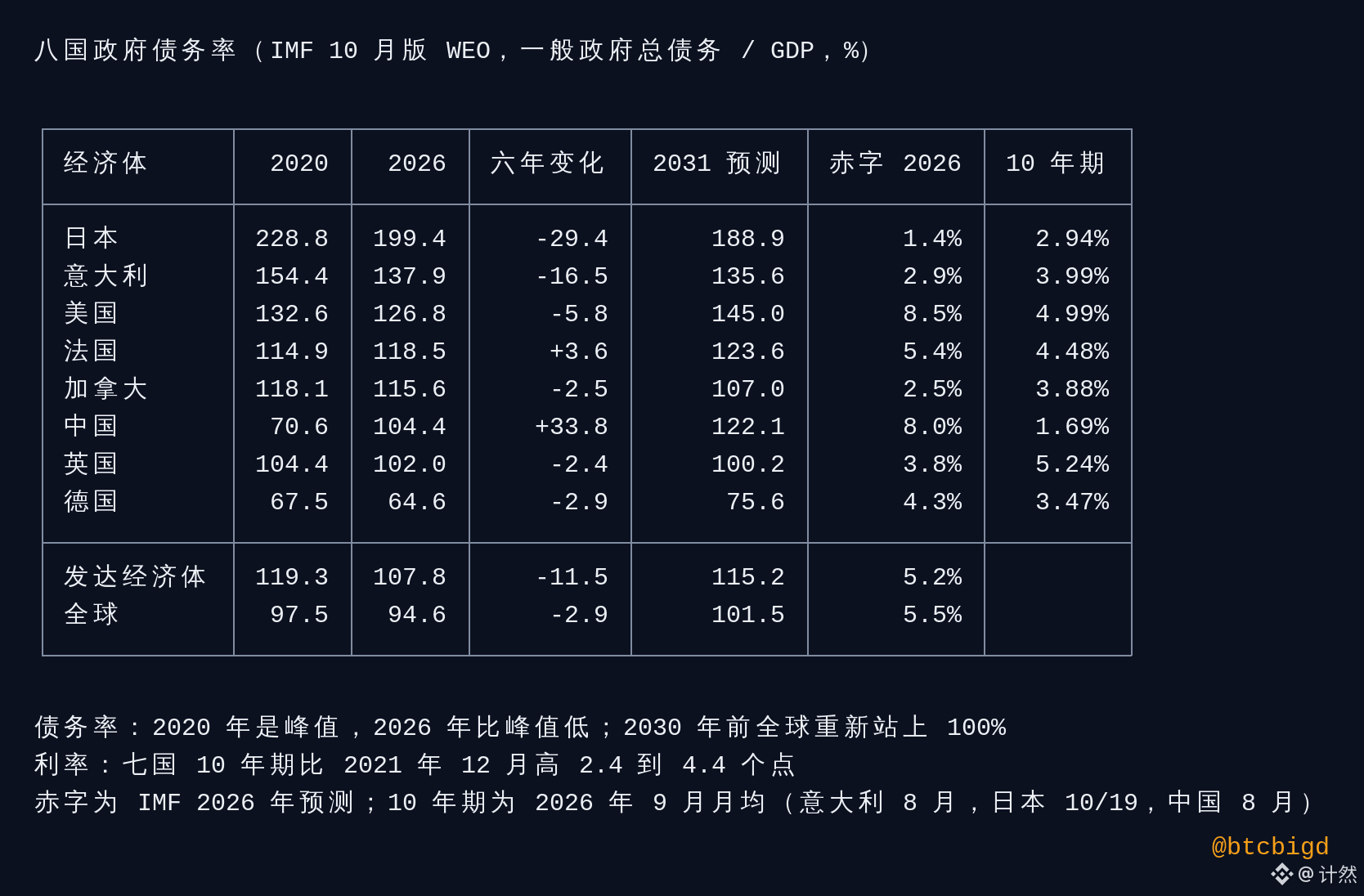
On October 20, a post with 80,000 views claimed that “the global debt crisis has never been this severe,” and included debt ratios for nine countries. Each of the nine figures matches the IMF’s forecast for 2026 in its April edition this year. They are not “current debt ratios,” and the IMF has already released a new edition on October 14. The new 2026 figures are: Japan 199.4% (204.4 in the previous edition), China 104.4% (106.9), Canada 115.6% (110.7, the biggest upward revision), the United States 126.8%, France 118.5%, Italy 137.9%, the United Kingdom 102.0%, and Germany 64.6%. Using an outdated edition and presenting forecasts as current figures isn’t fabrication, but it gets the ranking wrong: Canada was undercounted by the most.
【“Never been this severe”—let’s look at the two halves separately】
- By debt ratio, the claim doesn’t hold. Global public debt peaked at 97.5% in 2020, compared with 94.6% in 2026; advanced economies were at 119.3% in 2020 and 107.8% in 2026.
- By absolute amount, it does. According to the IIF, total global debt (government, household, corporate, and financial) reached a record $365.5 trillion in the first half of 2026.
- The gap between the two is inflation from 2021 to 2024: it pushed up nominal GDP and brought the ratio down. The IIF itself says, “Inflation helped contain debt ratios, masking vulnerabilities.”
【What’s really gotten worse is interest rates】
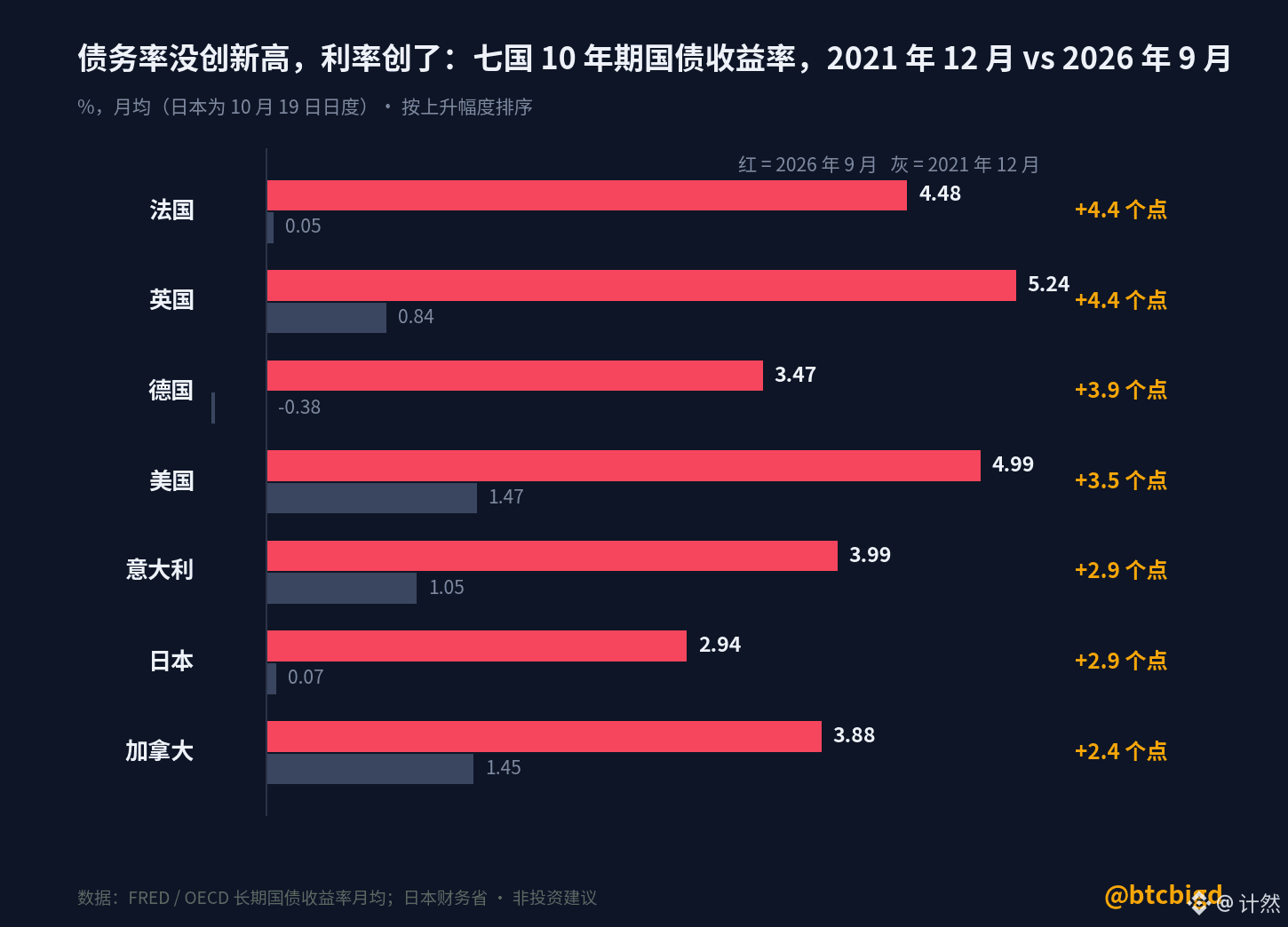
10-year government bond yields in the G7, December 2021 versus September 2026 (monthly averages):
- France: 0.05% → 4.48%, up 4.4 percentage points
- United Kingdom: 0.84% → 5.24%, up 4.4 percentage points, the highest in the G7
- Germany: −0.38% → 3.47%, up 3.9 percentage points
- United States: 1.47% → 4.99%, up 3.5 percentage points
- Italy: 1.05% → 3.99%, up 2.9 percentage points
- Japan: 0.07% → 2.94% (October 19), up 2.9 percentage points
- Canada: 1.45% → 3.88%, up 2.4 percentage points
In a nutshell: in 2020, there was more debt, but it cost almost nothing. In 2026, there’s slightly less debt, but every dollar costs 2.4 to 4.4 percentage points more. It will take years to replace old low-interest debt, so the increase in interest burdens is far from over. U.S. federal interest outlays were running at an annualized rate of about $1.28 trillion in the second quarter of 2026, around 3.9% of GDP.
【A country-by-country look at who’s most at risk (estimates)】
Using “long-term interest rate minus nominal growth” as a rough measure:
- “France” is most at risk: the interest rate minus growth is about +1.7, the highest of the eight countries; the deficit is 5.4%; and it has no central bank of its own. The 10-year yield of 4.48% is already higher than Italy’s 3.99%—markets have reversed the risk ranking of the two countries.
- The “United States” is accumulating debt the fastest: the IMF forecasts an 18-percentage-point rise from 2026 to 2031, to 145%; its 8.5% deficit is the highest among advanced economies. The interest rate minus growth is still negative, but the deficit is so large that growth alone can’t contain it.
- “Japan” is having its debt diluted by inflation: its debt ratio has fallen 29 percentage points in six years, but its 30-year yield has reached 4.03% and its 40-year yield 4.04%. The interest rate minus growth has just turned positive, and the old strategy of “carrying high debt with low interest rates” is on its way out.
- “China” is moving in the opposite direction: its debt ratio has risen 34 percentage points in six years, the fastest among the eight countries. But its 10-year yield is only 1.69%. The problem isn’t high rates; it’s rates so low that they reflect a scarcity of investment opportunities.
【What the IMF itself says】
According to the IMF’s October 14 Fiscal Monitor, as recounted in an interview by Xinhua: global public debt will exceed 100% of GDP before 2030; the real interest rate on government debt is higher than it was before the pandemic; and when debt is already high, rate hikes will worsen deficits and debt by a greater margin. Meanwhile, in 2026, the Federal Reserve, the European Central Bank, and the Bank of Japan are all raising rates.
【A crisis won’t unfold everywhere in the same way (assessment)】
Countries with their own central banks can turn to inflation and currency depreciation, rather than default. France and Italy, which don’t have their own national currencies or central banks, are the ones more likely to face a traditional spread crisis. So a “global debt crisis” looks more like several different illnesses, with the first outbreak most likely to be in the eurozone.
Debt ratios are falling, interest rates are rising: which do you think will hit trouble first—the French bond spread or the U.S. dollar? If you hold $BTC , which side are you on?