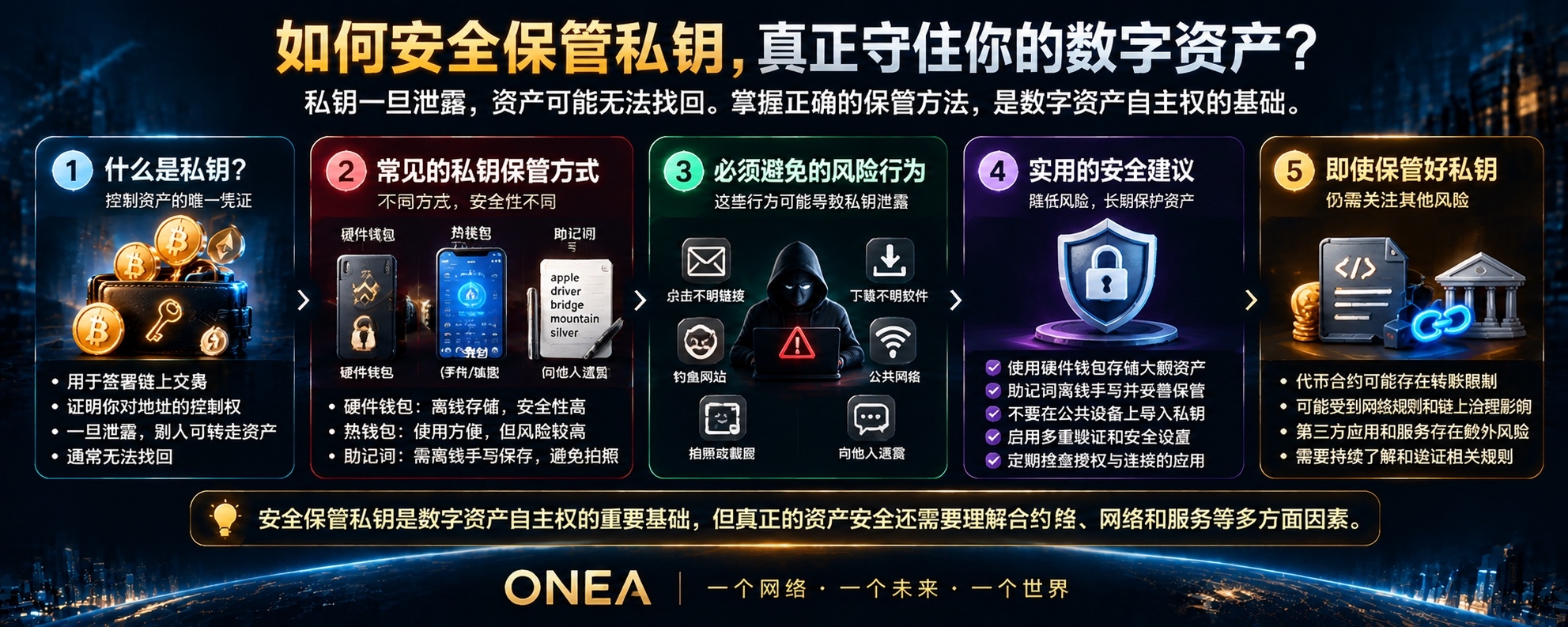
🔐 How can you securely store your private keys and truly safeguard your digital assets?
In the Web3 world, we often talk about asset ownership.
Some focus on whether wallets are decentralized, others examine whether smart contracts are public, and still others care about whether users truly control the project.
But before discussing these questions, there’s something that may seem basic but is actually crucial:
Have you truly protected your private keys?
For non-custodial wallets, private keys are not only essential credentials for accessing assets, but also the key to authorizing on-chain transactions. If a private key is exposed, an attacker may be able to transfer assets, depending on the networks and permissions involved.
And once a transaction is confirmed on the blockchain, recovering the assets is often extremely difficult.
Therefore, understanding what private keys are, how to store them securely, and which risks are easy to overlook is essential knowledge for everyone involved in digital assets.
I. What exactly is a private key, and why is it so important?
You can think of a private key as an important key that controls a wallet.
With a non-custodial wallet, users authorize transactions using a private key or a corresponding signing mechanism. A wallet address can be used to receive assets and publicly view related on-chain records.
One distinction is important here: a wallet address can be shared publicly, but a private key must never be shared casually.
If someone knows your wallet address, they can generally only view public on-chain information; they cannot transfer your assets using the address alone.
But if someone obtains your private key, or a seed phrase that is sufficient to restore your wallet, they may gain control of the associated assets.
That is why private keys and seed phrases should not be treated like ordinary passwords.
II. What are the risks of different storage methods?
First: Hardware wallets.
Hardware wallets typically store private keys in dedicated devices and, whenever possible, perform signing operations inside the device, reducing the risk of exposing private keys directly to internet-connected devices.
But hardware wallets are not absolutely secure.
Users still need to pay attention to the source of the device, firmware security, transaction signing details, and how seed phrases are backed up. Even if the device itself is secure, assets may still be at risk if the seed phrase has been exposed.
Second: Software wallets.
Software wallets are generally convenient to use and suitable for everyday management and on-chain interactions.
But if a device is infected with malware, the wallet app comes from an unreliable source, or the user enters their seed phrase in an unsafe environment, information related to the private key may be stolen.
Therefore, choosing a wallet from a trusted source, updating the software promptly, and keeping the device secure are essential precautions when using a software wallet.
Third: Seed phrase backups.
A seed phrase can help users restore the corresponding wallet keys in a compatible wallet, so it should be protected at least as securely as a private key.
We recommend using a reliable offline backup method and storing it securely. Avoid taking photos or screenshots, uploading it to cloud storage, or sending it through messaging apps.
If someone else obtains your seed phrase, the fact that you still have your original phone or hardware wallet does not mean your assets are still safe.
III. Which actions are most likely to expose private keys?
Many asset security incidents do not happen because blockchain technology suddenly fails, but because users overlook risks during everyday operations.
Pay particular attention to the following situations:
• Clicking links from unknown sources and visiting fake wallets or phishing websites.
• Downloading unverified wallet apps or software, leaving your device vulnerable to malware.
• Entering your private key or seed phrase on a website, in a chat window, or on a so-called customer support page.
• Taking screenshots of your seed phrase, uploading it to the cloud, or sending it to someone else.
• Using a wallet on a public device or authorizing transactions in an untrusted environment.
• Signing unfamiliar authorization requests without carefully checking the transaction details.
There is one issue that is particularly easy to overlook:
Not every risk requires you to hand over your private key directly.
Some malicious contracts or authorization requests may cause users to grant third parties certain permissions to manage their assets without understanding the details.
So protecting your assets requires not only safeguarding your private key, but also carefully checking what you sign and what you authorize.
IV. What security habits can everyday users develop?
First, use wallets and related tools from trusted sources, and avoid installing software from unknown sources.
Second, store your seed phrase and private key securely. Use a reliable offline backup method whenever possible, and prevent unauthorized access.
Third, never give your private key or seed phrase to anyone claiming to be customer support, a project team member, or a security professional. If you need help, verify through official channels, but never hand over your secret credentials.
Fourth, check the transaction recipient, authorization scope, and relevant prompts before signing a transaction. If you cannot understand a request, do not rush into it out of fear of missing an opportunity.
Fifth, regularly review wallet permissions and related security settings. When you confirm that you no longer need a permission, find out whether it can be safely revoked and what fees or limitations the revocation may involve.
Sixth, enable appropriate security protections for important accounts, and understand what to do if a device is lost, a backup is damaged, or credentials are exposed.
These habits cannot eliminate all risks, but they can help users avoid many problems that could have been prevented.
V. Even if your private key is stored securely, are your assets absolutely safe?
The answer is still no.
Private key security is only one part of digital asset security.
Token contracts may have specific transfer restrictions; smart contracts may have administrator or upgrade privileges; third-party services may be affected by security incidents, service interruptions, or policy changes.
The operating rules may also differ across blockchains and assets.
Therefore, we need to consider several questions separately:
Is the private key secure?
Is the wallet trustworthy?
Is the transaction authorization reasonable?
Are the contract permissions clear?
Do the services you rely on pose additional risks?
Together, these questions provide a more complete basis for assessing asset security.
At ONEA, we also hope the community will develop this habit: do not assume a project is absolutely secure just because it uses a particular technology; and do not mistake future plans for existing capabilities just because a feature has not yet been implemented.
Genuine trust must be built on clear information, reasonable security measures, and real progress that can be continuously verified.
Private keys are an important foundation of asset ownership, but true security comes from a more comprehensive awareness of risk.
Protect your private key, understand every transaction you sign, and stay informed about the rules governing your assets.
Because in the Web3 world, having control is important, and knowing how to use that control safely is just as important.
One final question for the community:
What do you think is the asset security risk that everyday users are most likely to overlook?
A. Exposure of private keys or seed phrases
B. Phishing websites and malware
C. Not understanding transaction authorizations and smart contract permissions
D. Trusting projects or third-party services too much
Share your thoughts and help more people learn how to participate in Web3 more safely.
ONE NETWORK. ONE FUTURE. ONE WORLD.
Transparent communication, long-term building, continuous verification.
#ONEA #Web3 #DigitalAssets #PrivateKeySecurity #Blockchain