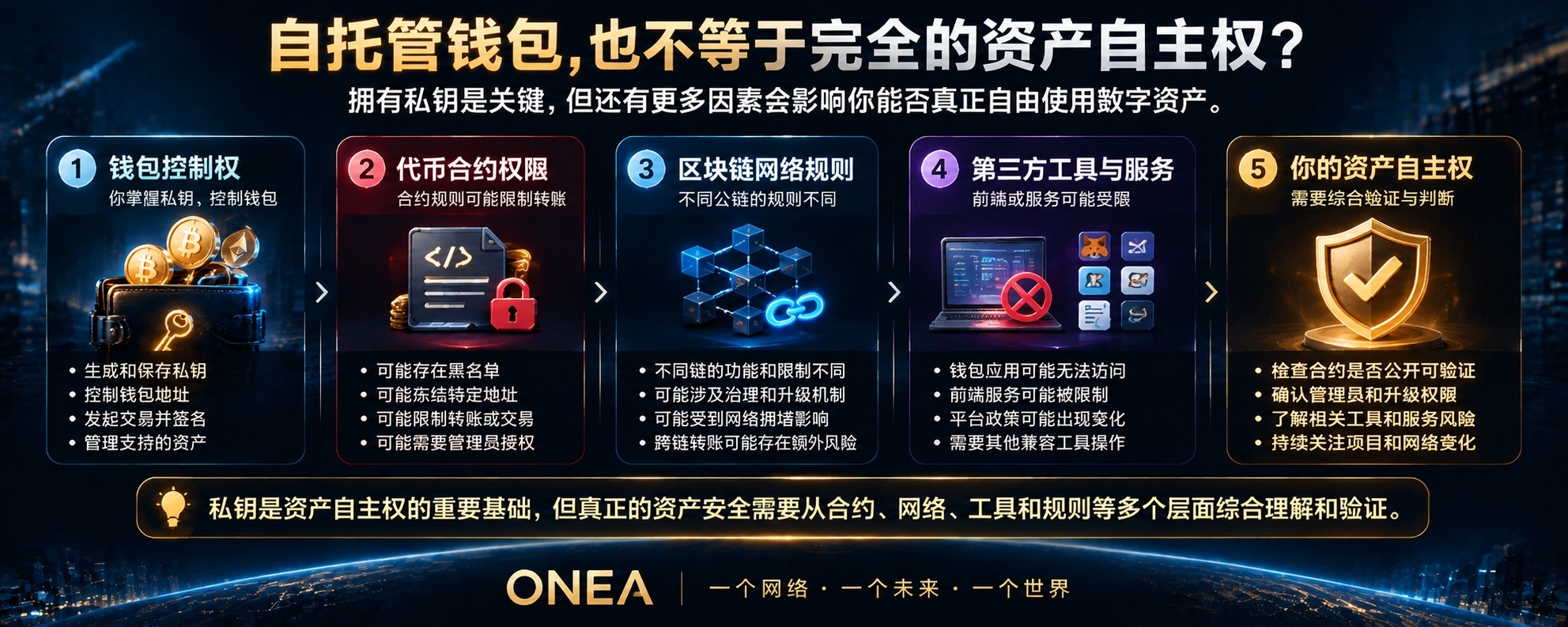
Does using a self-custody wallet mean you fully own your digital assets? 🔐
In the Web3 world, we often hear the idea that:
As long as you hold the private keys, the assets truly belong to you.
But to understand digital asset self-sovereignty more deeply, we need to think further:
What does holding the private keys actually mean? What can you control, and what is not entirely up to you?
This is not just a play on words—it’s an important step toward understanding digital asset security.
1. Private keys address the issue of control, but they don’t solve every problem.
In a non-custodial wallet, the private key is typically essential for authorizing on-chain transactions.
You can use your private key to sign transactions and, when network rules allow, broadcast them to the blockchain.
This is an important distinction from entrusting your assets to a centralized platform for custody.
But a private key is not a pass that lets you bypass every rule.
Whether a transaction succeeds may also depend on the state of the blockchain network, the account balance, the smart contract logic, and restrictions on the asset itself.
Therefore, we cannot ask only:
“Is the private key mine?”
We should also ask:
“What actions can I perform with my private key, and what rules constrain those actions?”
2. A token contract may determine how an asset can be transferred.
The contract design of different tokens can vary completely.
Some tokens may have blacklist, address-freezing, transfer-restriction, or pause functions; others may not have these mechanisms.
If administrative privileges exist, we need to look further into:
Who holds these privileges?
Which addresses or operations can these privileges affect?
Can administrators upgrade the contract or modify its rules?
Can these privileges be verified using on-chain data?
It is important to emphasize that we cannot conclude that an asset is definitely safe or unsafe based solely on the contract name, project claims, or the presence of a particular feature.
What truly matters is examining the specific contract implementation, permission configuration, and actual operation.
3. Blockchain networks, wallet applications, and third-party services are not all on the same level.
Sometimes a wallet application may fail to open, a website may be temporarily inaccessible, or a third-party service may restrict certain features.
But this does not necessarily mean that on-chain assets have been frozen.
A wallet interface helps users view assets, build transactions, or interact with the blockchain; the blockchain network processes transactions according to protocol rules; and a smart contract may set additional rules for specific assets.
These layers need to be assessed separately.
For example, the shutdown of a particular frontend service does not necessarily mean users cannot access the relevant on-chain data through other compatible tools.
But if the token contract itself restricts transfers, switching to another wallet interface may not be enough to bypass that restriction.
So true self-custody requires not only control of your private keys, but also an understanding of the tools, networks, and asset rules you use.
4. Don’t overlook third-party dependencies and governance privileges.
Some Web3 applications depend on specific frontend services, network nodes, or other infrastructure.
Some smart contracts may also retain administrator privileges, upgrade permissions, or emergency pause mechanisms.
These designs do not necessarily mean that a project has a problem, but users should understand their purpose and limits.
Multisig can require multiple authorized parties to jointly approve specific actions, while timelocks can provide a review window for some administrative actions.
However, multisig does not mean that all participants are risk-free, and a timelock does not mean that every action can necessarily be blocked.
What we should focus on is not how advanced the technical terms sound, but how they are actually implemented, who controls them, and whether they can be independently verified.
5. How can ordinary users check their asset self-custody?
Before evaluating a Web3 project, you can start with a simple checklist:
Check wallet control: Confirm whether the wallet is custodial or non-custodial, and understand who actually controls the private keys.
Check the token contract: See whether the contract is publicly verified and whether it includes freezing, blacklisting, or transfer-restriction features.
Check key privileges: Understand the specific configurations for administrators, upgrade permissions, multisig, and timelocks.
Check tools and services: Understand the dependencies that wallet applications, frontends, and third-party infrastructure may introduce.
Verify continuously: Monitor contract changes, permission adjustments, and actual deployment information. Don’t rely solely on one-time claims or audit conclusions.
Of course, circumstances vary across blockchains, tokens, and wallets. This checklist is a starting point, not a security guarantee.
6. True asset self-custody must move beyond slogans to verifiable facts.
We’re interested in Web3 not only because it brings new technology, but also because it raises a question worth exploring over the long term:
As digital assets become more widespread, how much control can users actually have?
This question cannot be answered through claims alone.
It requires clear technical design, transparent permission configurations, verifiable on-chain information, and honest explanations of actual limitations.
At ONEA, we are committed to the same approach to discussion: distinguishing between features that have been implemented and plans for the future, so the community can form its own views based on actual information rather than being asked to trust blindly.
Because true trust does not mean never being questioned; it means being able to face questions, explain the rules, and remain open to ongoing verification.
Finally, here’s a question for the community to discuss:
If you could prioritize checking just one aspect to assess a Web3 project’s asset self-custody, which would you choose?
A. Private keys and wallet control
B. Smart contracts and administrator privileges
C. Third-party services and infrastructure dependencies
D. Whether all key rules can be independently verified
We welcome you to share your reasons.
ONE NETWORK. ONE FUTURE. ONE WORLD.
Transparent communication, long-term building, continuous verification.
#ONEA #Web3 #DigitalAssets #AssetSelfCustody #Blockchain