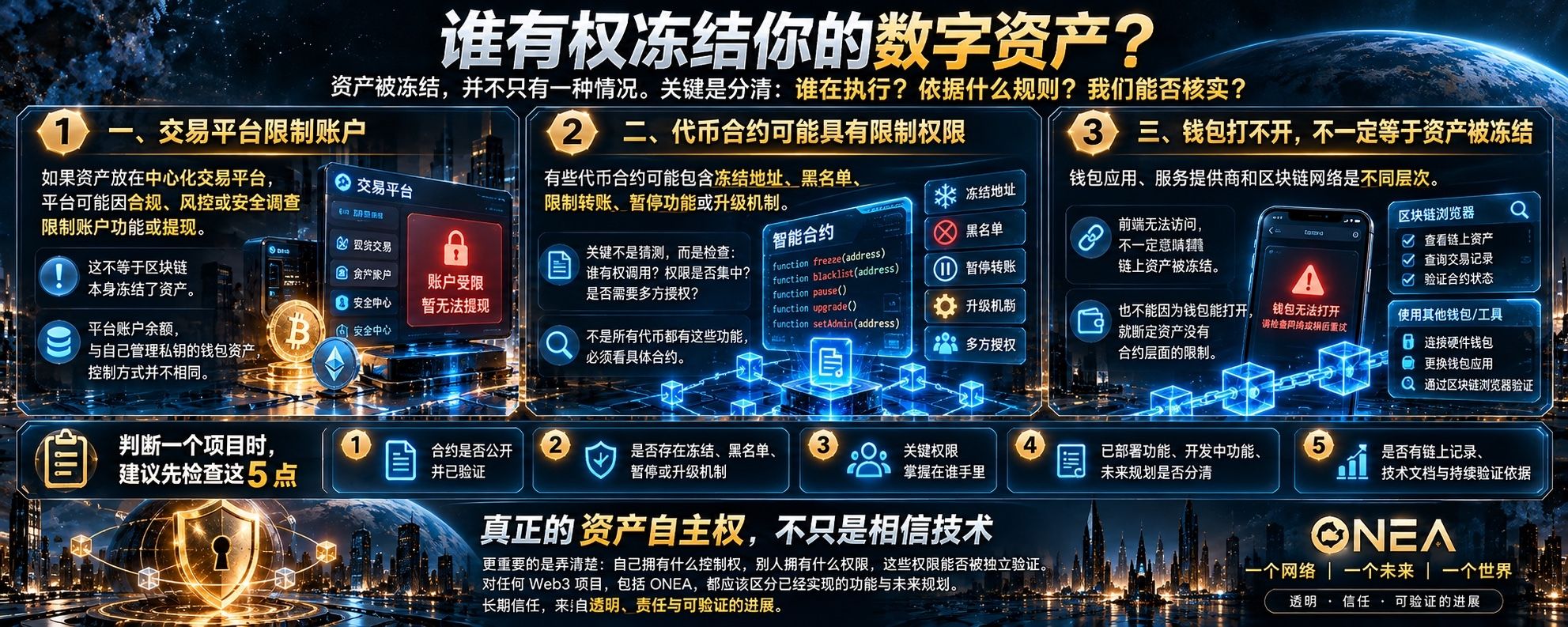
Who has the power to freeze your digital assets? 🔐
In the Web3 world, there’s a question every digital asset holder should think carefully about:
If your assets are in your own wallet and you hold the private keys yourself, why might you still be unable to transfer them in some cases?
To answer this question, we first need to clarify one thing:
“Assets being frozen” can mean more than one thing. Different freezing mechanisms may involve completely different permissions, technical rules, and risks.
First: An exchange restricts your account.
If your assets are held on a centralized exchange, the platform may restrict certain account functions or withdrawals based on applicable laws, compliance requirements, risk-control rules, or an account security investigation.
But there's an important point to note: restrictions imposed by a trading platform on an account do not mean that the blockchain network itself has frozen your assets.
If you hold an asset balance in a platform account, the way you actually control those assets is different from how you control assets in an on-chain wallet that you manage yourself.
Therefore, before using any trading platform, you should understand its account rules, withdrawal restrictions, custody arrangements, and what steps you can take if a dispute arises.
Second: A token contract may have the authority to freeze assets or restrict transfers.
Many people believe that as long as an asset exists on a blockchain, it can always be transferred freely.
In reality, the smart contract designs of different tokens can vary considerably.
For example, some token contracts may include mechanisms for address blacklisting, address freezing, transfer restrictions, or pausing specific functions.
If a contract has these features, you should investigate further: Who is authorized to invoke them? Are the permissions concentrated in a single address? Is authorization from multiple parties required? Can these permissions be revoked or changed?
Not all tokens have these features, and not all smart contracts allow administrators to change the rules.
The key is to inspect the specific contract, rather than making assumptions based only on the label “blockchain asset”.
Third: An unusable wallet interface does not necessarily mean that on-chain assets are frozen.
Sometimes, users may be unable to log in to a wallet app, access a service, or use a particular front end.
However, wallet apps, service providers, and blockchain networks are different layers.
If only a particular app is inaccessible, that does not necessarily mean that on-chain assets have been frozen. Whether you can interact with them using other compatible tools depends on the type of wallet, how the private keys are controlled, the network status, and any restrictions on the assets themselves.
Conversely, even if a wallet app opens normally, that does not prove that none of the assets in it are subject to transfer restrictions at the contract level.
Therefore, we need to distinguish between app access issues, account permission issues, and actual on-chain transfer restrictions.
So, how should ordinary users check?
When assessing the security of a Web3 project's assets, you can start with the following:
Check the contract. Find out whether the token contract is public and verified, and whether it has freezing, blacklisting, pausing, or upgrade mechanisms.
Check permissions. Confirm which addresses hold critical permissions, whether those permissions are concentrated, and whether governance arrangements such as multisig or timelocks are in place.
Check the actual rules. Don't rely only on the project's descriptions; assess the contract code, on-chain records, and relevant technical documentation together.
Distinguish facts from promises. Features that have been deployed, features under development, and future roadmap items are three different things.
Keep verifying. Contracts may have upgrade mechanisms, and project permissions may change. A one-time check may not reflect the situation in the future.
It's important to emphasize that multisig, timelocks, and security audits are not absolute guarantees of safety. Their actual value depends on their implementation, permission settings, participant arrangements, and the scope of the audit.
True asset sovereignty isn't simply about trusting a particular technology. It's about understanding, as clearly as possible, what control you have, what permissions others have, and whether those permissions can be independently verified.
We at ONEA also believe this is the right standard: lasting trust cannot be built on vision and slogans alone. It also requires clear information, responsible execution, and tangible progress that can stand up to scrutiny.
We hope the community will pay attention not only to what the project aims to achieve, but also to which features have been implemented, which are still in development, and whether the relevant information is transparent enough.
Because in the Web3 world, technology can be complex, but the first step in assessing risk can be simple:
Who has the authority to act? Under what rules? Can we verify it?
If you were evaluating a digital asset project, what would you check first?
A. The token contract's freezing permissions
B. Admin and upgrade permissions
C. Governance mechanisms such as multisig and timelocks
D. Actual deployment records and verifiable technical documentation
Feel free to share your reasons.
ONE NETWORK. ONE FUTURE. ONE WORLD.
Transparency. Trust. Verifiable Progress.
#ONEA #Web3 #Blockchain #CryptoSecurity #SelfCustody