

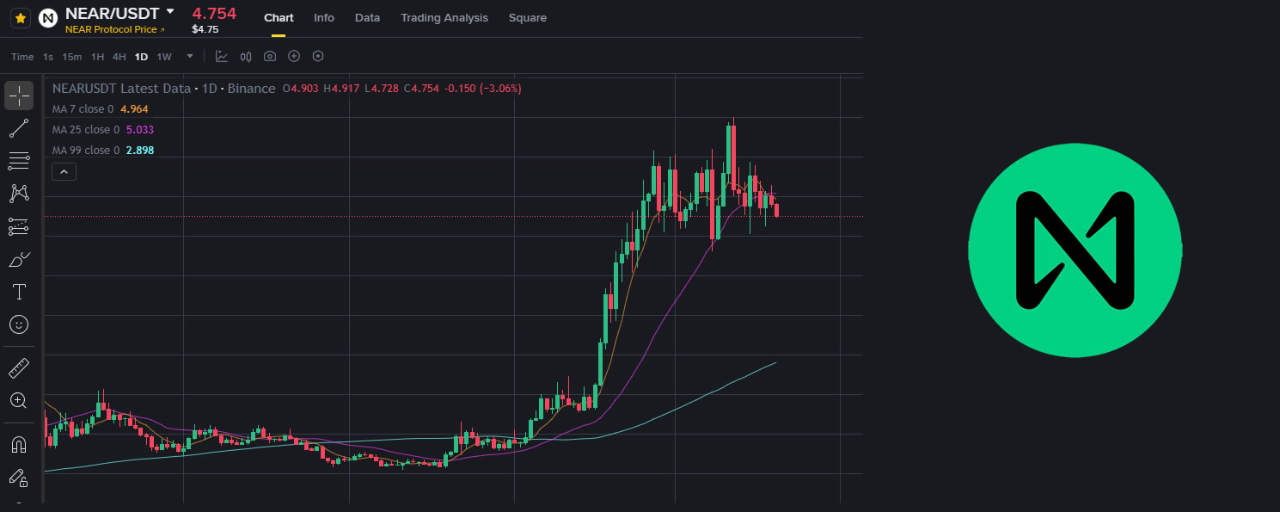

NEAR Protocol has developed a habit that many holders have started to notice: when the price pulls back, buyers often step in quickly and push it back up. While the broader market can stay soft for longer, $NEAR has repeatedly shown short, sharp recoveries. That pattern is not random. Several concrete developments are helping create the kind of support that makes dips attractive to buyers.
The ETF Effect Is Still Fresh
In late September 2026, Bitwise launched the first U.S. spot NEAR ETF under the ticker NRR. The product gave traditional investors a simple way to gain exposure to NEAR without managing wallets or exchanges. Early inflows were solid, and the ETF has continued to attract capital in the weeks since launch.
For a token that previously relied mainly on crypto-native buyers, this opened a new channel of demand. When price dips, some of that institutional and retail flow through the ETF can reappear, helping absorb selling pressure faster than it would in a purely crypto-native market.
NEAR Intents Is Generating Real Revenue and Buybacks
The bigger structural story sits with NEAR Intents, the cross-chain trading layer. Cumulative volume has climbed past $32 billion, with strong growth in Q3 2026. A portion of the fees generated by this activity is directed toward open-market buybacks of the NEAR token.
This creates a direct link between usage and token demand. Higher Intents volume tends to mean more fees, which can mean more buybacks. When the market sells off and price falls, the ongoing fee-driven buying can help limit how deep the dips go and speed up the recovery. It is one of the clearer examples in crypto of product revenue translating into actual token support.
Tokenomics Are Moving in a Friendlier Direction
NEAR currently has a maximum annual issuance rate of 2.5%. A governance proposal is under discussion to lower that rate to 1.6% over time, with the longer-term ambition of eventually reaching a fixed supply. While the reduction is not yet live, the conversation itself signals a shift toward slower dilution.
At the same time, the buybacks funded by Intents fees are already removing tokens from the open market. When issuance growth is expected to slow and a revenue stream is actively buying tokens, holders have more reason to treat pullbacks as potential entry points rather than the start of a deeper downtrend.
Why the Recoveries Look So Consistent
The combination of these factors helps explain the price behavior. The ETF brings new capital that can re-enter on weakness. Intents activity provides ongoing fee-based buy pressure. And the tokenomics discussion reduces the fear of heavy ongoing dilution. Together they create a floor of demand that has shown up repeatedly when the price has softened.
Of course, none of this guarantees the pattern continues forever. Broader market moves, changes in Intents volume, or delays in the issuance proposal can still affect how strongly the dips get bought. But right now, the setup is different from periods when NEAR had to rely purely on narrative and speculative interest.
What to Watch Next
The key variables are straightforward: continued ETF inflows, sustained or growing Intents volume (and the buybacks that come with it), and progress on the issuance reduction proposal. If these remain intact, the tendency for NEAR to recover quickly after pullbacks has a solid foundation. If any of them weaken, the resilience could fade.
For now, the market is treating dips in NEAR as opportunities more often than not. Whether that stays true will depend on whether the revenue, institutional access, and tokenomics improvements continue to deliver.
What do you think is the biggest reason $NEAR has been bouncing so reliably lately - the ETF, the Intents buybacks, or something else?