



Written by: TechFlow
There is a famous saying in the LOL circle: each generation of patches brings its own god, and the same is true for the crypto market.
Every cycle has its own heroes.
In line with the nature of "speculating on new things but not old things" and "getting tired of the old and loving the new", we focus on new projects, or "big projects", which will be launched in 2024; the screening criteria are very subjective, and the core revolves around new narratives, such as AI, parallel EVM, DePIN, Bitcoin ecology, and modular blockchain. Most of them are still infrastructure. In our view, the infrastructure narrative has a larger space and is more difficult to falsify.
Note: This article is divided into two parts. The screening criteria are very subjective and mainly focus on new projects that have not yet issued tokens.
Monad: Parallel EVM Narrative Frontrunner
When talking about the parallel EVM narrative, Monad must be mentioned.
Monad is an innovative project focused on improving EVM performance. Through parallel processing technology, it aims to solve the performance bottleneck of existing blockchain networks.
Parallel EVM is an innovative optimization of traditional EVM. Under traditional EVM, smart contracts and transactions are processed sequentially, which will lead to inefficiency and network congestion under high load. The core idea of parallel EVM is to change this serial processing mode and realize the simultaneous parallel processing of multiple transactions.
By implementing parallel execution, Monad aims to significantly increase transaction throughput and solve the congestion problem of the existing EVM chain under high load. Its ultimate goal is to reach 400,000 TPS within the physical bandwidth limit.
In terms of specific implementation, the core of Monad's parallel execution strategy is that it can identify and execute transactions that have no common dependencies in parallel. Although Monad and Ethereum's blocks are both linear and ordered transaction sets, Monad allows transactions to proceed in parallel without affecting the final result by optimizing the execution strategy. Its functions are reflected in:
Optimistic Execution: Execute subsequent transactions before the previous transaction is completed. This method may cause transaction dependency errors, but by tracking input and output comparisons, once data inconsistencies are found, the system will re-execute the transaction to ensure the correct execution result.
Scheduling and Dependencies: To reduce unnecessary repeated execution, Monad uses a static code analyzer to predict dependencies between transactions and intelligently schedule transaction execution to optimize the efficiency of parallel execution.
State Merging: Although transactions are executed in parallel, the state updated by each transaction eventually needs to be merged in sequence to ensure the state consistency of the entire block.
In 2024, Monad will become a major player that cannot be ignored in the L1 battlefield.
On February 14, 2023, Monad completed a $19 million seed round of financing led by Dragonfly Capital.
Official website: https://www.monad.xyz/
Twitter: https://twitter.com/monad_xyz
For more information, please check out our previous research and founder interviews:
《Pre-positioning the next narrative: Parallel EVM is on the rise, which projects deserve special attention?》
《Dialogue with Monad Labs CEO: From tradition to the future, the original Jump Trading team explores the role of public chains in on-chain finance》
Eclipse: Solana Virtual Machine (SVM) L2
Eclipse is Ethereum's Layer2, which can use the Solana Virtual Machine (SVM) to accelerate transaction processing.
The project goal is to provide a massively parallel execution environment that allows multiple operations to proceed simultaneously, thereby increasing network throughput and efficiency while reducing congestion and transaction fees. Through this structure, Eclipse aims to improve the scalability and user experience of dApps.
Simply put, the design logic of Eclipse is that transactions are executed in Solana's SVM, and transaction settlement is still on Ethereum. It is a bit like Zhang Wuji in martial arts novels, who learns from many masters, the essence of various martial arts, and then integrates them, with Ethereum security and Solana speed.

Settlement Layer - Ethereum: Eclipse uses Ethereum as the settlement layer and ETH as Gas.
Execution Layer - Solana Virtual Machine (SVM): For application logic and smart contracts, Eclipse uses the Solana Virtual Machine (SVM). This allows Eclipse to benefit from Solana's high throughput and low latency, providing fast transaction processing. By being compatible with both Ethereum and Solana virtual machines, Eclipse provides a flexible and efficient environment for developers and users.
Data Availability - Celestia: To ensure data is always available and verifiable, Eclipse uses Celestia as the DA.
Fraud Proofs - RISC Zero: For verification and zero-knowledge proofs, Eclipse uses RISC Zero, which eliminates the need for intermediate state serialization, making the system more efficient and secure.
On September 27, 2022, Eclipse completed a $9 million seed round of financing, led by Tribe Capital and Tabiya.
Official website: https://www.eclipse.builders/
Twitter: https://twitter.com/EclipseFND
EigenLayer: Reinventing Ethereum
EigenLayer is an innovative protocol on the Ethereum blockchain that introduces the concept of “restaking”, allowing users to use their locked Ethereum or Liquid Staking tokens to obtain additional rewards and security contributions.
This is the general public's perception of EigenLayer, but in our opinion, EigenLayer is an attempt to directly expand the Ethereum base layer. It may be the most important protocol since the launch of Ethereum, and it is responsible for reshaping Ethereum, although Vitalik may not think so.
On the one hand, Eigenlayer releases the capital efficiency of staked ETH. On the premise of inheriting the security of Ethereum, the innovation speed of various application fields of Ethereum has been greatly improved, and the verification cost has dropped rapidly, making ETH a productive asset that can generate high returns.
On the other hand, Eigenlayer is not just about Restaking, it has rebuilt many of Ethereum's underlying infrastructures.
For example, one of Eigenlayer’s flagship products is its data availability module, EigenDA (Eigen Data Availability). Compared with Celestia, EigenDA has a clear advantage - it can more easily bootstrap large validator networks by leveraging existing ETH validators and stakes, with lower costs and greater throughput.
For example, Mantle Network is the first Layer 2 to use EigenDA.
In addition, you can also run a decentralized Rollup sorter on Eigenlayer, changing the current situation where most L2s are centralized. In addition, Eigenlayer will implement a truly decentralized RPC node.
Recently, Eigenlayer has extended its tentacles to the Cosmos ecosystem, and Eigenlayer has announced that it can provide Ethereum's security guarantees for Cosmos child chains.
According to the latest data on the official website, Eigenlayer currently has more than 65 ecological projects.
For example, AltLayer, which was recently launched on Binance, is also an Eigenlayer ecological project. In the early days, AltLayer focused on the Raas concept and one-click chain launch. Later, it focused on promoting Restaked Rollups created in cooperation with Eigenlayer. This concept is relatively abstract, so let us explain it in simple terms:
For most other projects, the best case scenario for building an application chain might be:
I don’t have to worry about how to make a Rollup from start to finish, nor do I have to worry about how to ensure the security of the chain after the Rollup.
AltLayer’s Restaked rollups improve the security of rollups through EigenLayer’s restaking mechanism.
We all know that re-staking is essentially about re-utilizing the staking mechanism and depositing ETH to enhance the security of other infrastructure outside the Ethereum mainnet. So for a Rollup, after it is built, where is the most unsafe part?
It’s nothing more than whether the transaction can be confirmed quickly, whether the sorter is centralized, and whether the transaction is actually being verified by multiple parties.
Therefore, you can think of Restake Rollup as a lazy proof package that proactively proves to the outside world that these places are safe.
The means of implementation is a set of vertically integrated active verification services (AVS), which ensures the operation of the LST generated by staking ETH and then staking it into the following active verification services. At the same time, it also adds a more reassuring security lock to the self-built Rollup.
In 2023, EigenLayer announced that it had received US$50 million in financing, led by Blockchain Capital, with participation from well-known VCs in the industry such as Coinbase Ventures, Polychain Capital, Bixin Ventures, and Hack VC.
Official website: https://www.eigenlayer.xyz/
Twitter: https://twitter.com/eigenlayer
io.net: Solana Ecosystem DePIN & AI
io.net is a decentralized computing network that supports the development, execution, and scaling of ML (machine learning) applications on the Solana blockchain, leveraging the world's largest GPU clusters to allow machine learning engineers to access distributed cloud service computing power at a lower cost.
What makes io.net different is its ability to quickly cluster GPU resources in different locations, allowing 50,000 to 70,000 GPUs to be gathered into a cluster, enabling efficient communication between clustered GPUs. If users have enough resources, it is possible to build large language models through the platform.
It is reported that the product has been demonstrated to well-known companies such as OpenAI, Instacart and Uber.
io.net uses three products to enable users and computing power providers to participate in this process and improve the user's product experience:
IO Cloud: a page for deploying and managing decentralized GPU clusters;
IO Worker: Provides users with real-time insights into their compute, providing operations and a bird's-eye view of devices connected to the network, enabling them to monitor those devices and perform quick actions such as removing and renaming devices.
IO Explorer: Provides a window into the inner workings of the network, including complete visibility into network activity, vital statistics, data points, and reward transactions.
IO is the native token and protocol token of the io.net network. The main utility of the token is in two aspects:
IO will be the main payment method in the io.net ecosystem, such as paying for GPU deployment. And every model deployed on io.net must perform a tiny IO transaction for inference.
IO tokens are used to reward GPU contributors.
According to TechFlow, io.net has been sought after by major VCs in the primary market.
Official website: https://io.net/
Twitter: https://twitter.com/ionet_official
Berachain: With MEME attributes, EVM-compatible public chain in the Cosmos ecosystem
Berachain is an EVM-compatible Layer1 built on top of the Cosmos SDK, characterized by its use of liquidity consensus proof as a consensus mechanism.
Through proof of liquidity, users can pledge blue-chip assets such as BTC, ETH, and stablecoins and delegate these assets to validators. At the same time, these pledged assets will be used to provide liquidity to the chain's native virtualized AMM, making capital production more efficient. Therefore, users have fewer reasons to leave this public chain.
Berachain token economy introduces a three-token system: $BERA — Gas token, $HONEY — Stablecoin, $BGT — Governance token. Among them, $BGT cannot be purchased on the secondary market. It is a non-transferable NFT, and the holder can obtain a certain proportion of the fees generated on Berachain.
The project was initiated by four anonymous co-founders who established an NFT collection Bong Bears in 21 years, inspired by Olympus DAO, and has continued to develop with strong community and MEME attributes.
On April 20, 2023, Berachain announced the completion of a $42 million Series A funding round led by Polychain Capital.
Official website: https://www.berachain.com/
Twitter: https://twitter.com/berachain
Blast: Profitable L2, Operation Master
Whether it is Blur or Blast, they are like a sharp sword, changing the original situation of the battle and pulling the former king off the altar.
What is the most important metric for a Layer 2? Number of users or TVL? Blast has shown that TVL is king.
While all Layer2s are talking about technical narratives and describing the "airdrop" vision in a specious way, Blast is very simple and direct: an open airdrop; deposited ETH brings its own income.
Blast is the first L2 blockchain network designed specifically to provide passive income for funds in Layer 2 accounts.
Specifically, when a user deposits funds into Blast, Blast will immediately use ETH for network native staking (mainly on Lido) and automatically return the staking income to users on Blast.
In addition to ETH, Blast also supports passive interest on stablecoins. The operating mechanism is that when users bridge stablecoins (such as USDC, USDT, and DAI) to Blast, Blast will immediately deposit the corresponding stablecoins locked on the Layer 1 network into DeFi protocols such as MakerDAO, and automatically return the proceeds to users on Blast in the form of USDB (Blast's native stablecoin).
As of January 28, Blast TVL was $1.3 billion.
In addition to the benefits, the expected airdrop also attracts everyone: after users enter the Blast network through advance access, they can not only immediately enjoy 4% passive interest on ETH or 5% on stablecoins, but also accumulate Blast Points rewards at the same time.
On January 17, Blast officially announced the launch of the testnet and a one-month "Big Bang" incentive program to encourage developers to build applications in its ecosystem. The winning projects will receive Blast token airdrops.
The open airdrop is half for users and half for developers. With users, liquidity (TVL), and airdrops, there is no reason for developers not to work hard. This is equivalent to Blast completing the ecological construction of other public chains in one year or even several years in the test network stage.
We are looking forward to what other surprising gameplay Blast will bring in the future.
In November 2023, Layer2 network Blast completed a US$20 million financing, with Paradigm and Standard Crypto participating in the investment.
Official website: https://blast.io/zh-CN
Twitter: https://twitter.com/Blast_L2
dYmension: A modular settlement layer for the Cosmos ecosystem
dYmension is a modular settlement layer built on Cosmos.
The definition of “modular settlement layer” is a bit abstract to explain. Let’s first understand the three-layer architecture of blockchain:
Execution: transaction processing and state calculation.
Settlement & Consensus: Enforce protocol rules and ensure that all participants agree on the order and state of the blockchain.
Data: Ensures that all published data is available.
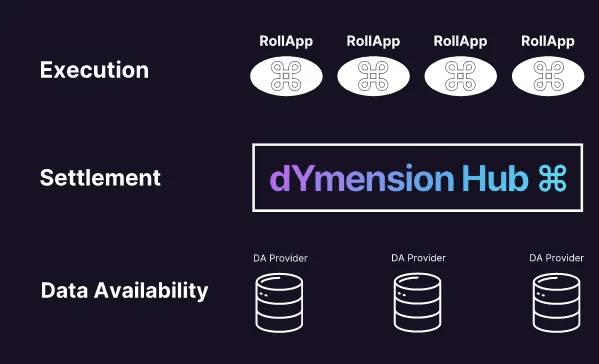
Dymension divides blockchain functions into multiple layers, thus achieving modular combination. Dymension's architecture also includes execution layer, settlement layer, consensus layer and data layer.
The execution layer consists of RollApps: responsible for processing transactions and state calculations. RollApps is also a new crypto vocabulary, and developers can use dYmension's RollApp Development Kit (RDK) to develop RollApps.
Unlike dApps built on general-purpose Rollups, applications built as RollApps have their own autonomy, which refers to the control gained from owning the blockchain execution layer, but must comply with the underlying base layer protocol rules.
The settlement and consensus layer is Dymension Hub: it is a proof-of-stake chain based on the Cosmos SDK, utilizing Tendermint Core’s state replication model for networking and consensus. Dymension Hub provides security, interoperability, and liquidity to serve RollApps.
Data layer: Data availability providers supported by the Dymension protocol. Developers can choose a suitable data availability provider according to their needs, but they will basically choose Celestia.
Dymension and Celestia are the two modular universe giants in this cycle, TIA gold and DYM silver, and the two may be linked in terms of price and other aspects.
On February 9, 2023, Dymension completed a $6.7 million seed round of financing led by Big Brain Holdings and Stratos.
Official website: https://dymension.xyz/
Twitter: https://twitter.com/dymension
Note: This article was written in January 2024, when DYM had not yet been launched on the mainnet.