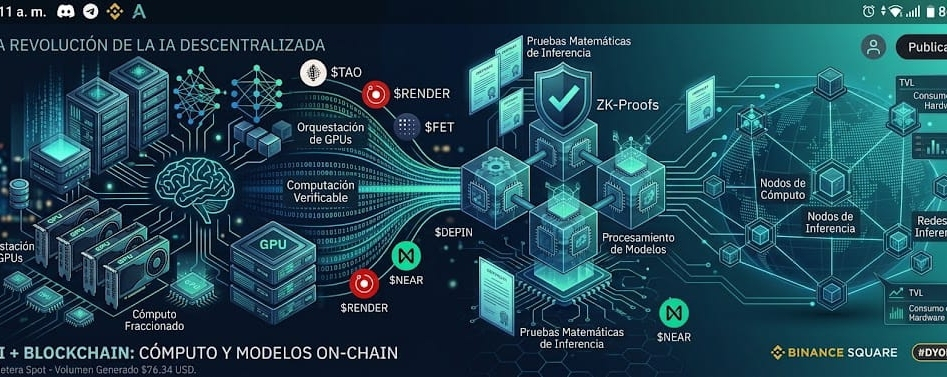

Artificial intelligence has become the dominant technological force of the decade; however, its current development faces a critical barrier: the extreme centralization of hardware and data models. A few global corporations control access to high-performance GPUs and the training of massive models.
In this scenario, the convergence of Blockchain and Artificial Intelligence proposes a paradigm shift: decentralizing access to computing power, verifying transparency in inference processes, and ensuring ownership of data models.
📌 1. The Core Challenge of Traditional AI
Modern AI development requires massive amounts of financial and computing resources, creating clear bottlenecks:
Hardware Monopoly: The global shortage of microprocessors (GPUs) limits innovation to entities with massive capital.
Operational Black Boxes: A lack of transparency about what data was used to train a model and how responses are generated.
Risk of Censorship and Single Points of Failure: Absolute dependence on centralized servers to keep models operational.
🛠️ 2. On-Chain Infrastructure Solutions
Decentralized infrastructure addresses these issues through two fundamental pillars:
A. Decentralized Compute Networks (DePIN)
These networks connect idle GPU capacity around the world in a peer-to-peer network, dramatically reducing training and inference costs compared with traditional cloud providers.
B. Decentralized Inference and Verification
Guarantee that an AI model executes an algorithm exactly as programmed, using cryptographic proofs (including Zero-Knowledge Proofs) to validate the authenticity of results without exposing sensitive data.
📊 3. Key Metrics for Fundamental Analysis
To rigorously evaluate projects in the AI + Crypto narrative from an institutional perspective, it is essential to analyze real adoption metrics on platforms such as DeFiLlama, Token Terminal, or Dune Analytics:
Network Capacity and Hardware Utilization: Number of active GPUs/nodes on the network and the percentage of effective usage relative to total available capacity.
Resource Consumption and Fees Generated: Organic revenue derived from actual network usage (by those seeking computing power), rather than from token inflation.
Node Diversification: Geographic and provider distribution to ensure censorship resistance.
⚠️ 4. Risk Factors and Technical Challenges
Like any emerging infrastructure, AI decentralization faces key challenges:
Latency and Bandwidth: Coordinating globally distributed nodes for heavy computing tasks requires complex optimizations at the network layer.
Tokenomic Sustainability: Designing incentive models that keep hardware providers profitable under varying market conditions.
💡 Conclusion
The intersection of AI and blockchain technology represents a shift from centralized, opaque AI toward an open, auditable, and accessible computing ecosystem. The key to identifying sustainable value lies in prioritizing networks with real infrastructure demand and strong on-chain metrics.
Disclaimer (#DYOR): This content is for educational and informational purposes only and does not constitute financial advice or an investment recommendation. Always do your own research before making decisions in the crypto asset market.
#Aİ #CryptoAI #DePIN #Infraestructura #BİNANCESQUARE