

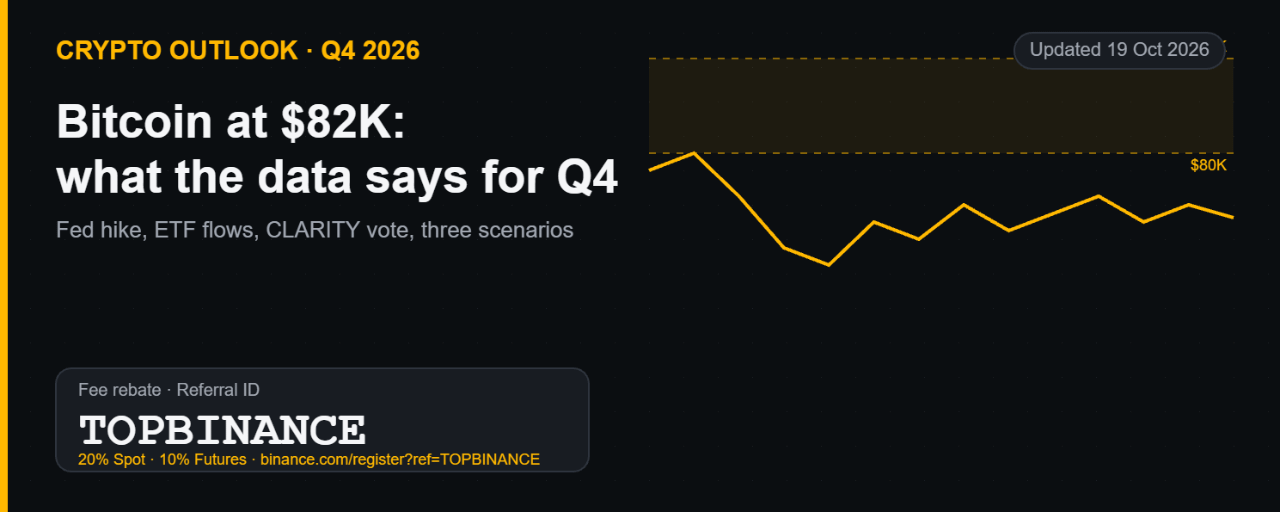

The crypto outlook for Q4 2026 is a range, not a rocket: Bitcoin trades around $82,000, about a third below its October 2025 record near $126,000, after a summer low and a 25 bp Fed hike in late September. The main desks agree on the shape of the quarter even where they disagree on the direction: QCP Capital’s base case is $80,000–90,000, Coinbase and Glassnode call the bottom in and lean positive, and the swing factors are ETF flows, the Fed, and a US market-structure bill that failed its first Senate vote in September.
Quick answer: Expect Bitcoin to spend most of Q4 2026 between $80,000 and $90,000, with $100,000 only in play if spot ETF inflows return and the Fed signals a pause. The downside case is a retest of the $75,000 area on a hawkish surprise or a forced corporate seller. Altcoins follow Bitcoin with higher beta; Ethereum near $2,500 and Solana near $110 have more room both ways. Position for a range: accumulate in slices, keep leverage low, and cut trading costs, because in a flat quarter fees are the difference between green and red.
Last verified: 19 October 2026. Written by a Binance user since 2019; figures are rounded and change daily, check live prices before acting.
Disclosure: this article contains my Referral Pro code TOPBINANCE. Nothing here is financial advice; crypto can lose value quickly.
Key facts (as of 19 October 2026)
Bitcoin: about $82,000–83,000; 8-month high of $87,000 on 2 October; dipped below $75,000 after the Fed hike in late September; record near $126,000 in October 2025
Ethereum and majors: ETH around $2,500, SOL around $110, XRP around $1.40, HYPE around $85
Fed: 25 bp hike to 3.75–4.00% in late September, the first increase since July 2023; the next FOMC decisions fall in late October and mid-December
ETF flows: choppy; a $487 million net outflow from spot Bitcoin ETFs on 7 October followed a $119 million inflow the day before
Desk forecasts: QCP Capital base case $80,000–90,000 (buy zone $80,000–82,000, trim $88,000–90,000 without inflows); Coinbase and Glassnode: bottom in, positive on Q4; Glassnode flags thin spot volume behind the October rally
US policy: the CLARITY market-structure bill failed its Senate cloture vote in September, a reconsideration motion keeps it alive; the SEC’s “Regulation Crypto Assets” proposal takes comments until 20 October; US midterm elections on 3 November
Europe: Binance has no MiCA licence yet, new EU/EEA registrations are paused since 1 July while an application in France is pending
Where the market stands entering Q4
Bitcoin closed Q3 up roughly 30%, its first positive third quarter since 2025, after bottoming in the summer. The rally stalled twice at $83,000–86,000 before a short squeeze pushed it to $87,000 in early October, and the Fed’s hike pulled it straight back. On-chain data from Glassnode shows the move above $85,000 came on light spot volume, with most coins sent to exchanges in early October coming from short-term holders taking profit. That is the profile of a recovery that needs new money, not of a market that already has it.
The four drivers that decide Q4 2026
ETF flows. Spot Bitcoin ETFs are the marginal buyer. Sustained daily inflows push the range up; repeated outflows like 7 October cap it. Watch the weekly net figure, not the daily noise.
The Fed. The September hike surprised a market that was positioned for cuts. A pause in October with softer inflation data reopens the upside; a second hike sends Bitcoin back to the summer lows.
US regulation. CLARITY’s failure removes a 2026 catalyst but not the trend: the SEC and CFTC are writing rules anyway, and the midterms on 3 November decide whether the bill returns in a lame-duck session or in 2027.
Supply overhang. QCP names a forced corporate Bitcoin seller as the main downside catalyst; treasury companies that bought near the 2025 highs are the stress point to monitor.
Three scenarios for the quarter
Base case (most likely): Bitcoin oscillates between $80,000 and $90,000, altcoins chop with it, ETF flows net flat. Grid and range strategies work; leverage does not.
Bull case: inflows return, the Fed pauses, a market-structure deal re-emerges after the midterms; Bitcoin breaks $90,000 and tests $100,000 into December, Ethereum reclaims $3,000.
Bear case: hawkish Fed, continued outflows, a large holder liquidates; Bitcoin retests $75,000 and the summer low, altcoins fall 20–30% more than Bitcoin.
What this means for different investors
Long-term accumulators: the $80,000–82,000 zone is where professional desks are buying; DCA into it instead of waiting for a perfect bottom
Active traders: trade the range edges with tight risk; a 5% single-day move on a headline is normal this quarter
Altcoin holders: majors with real revenue (Ethereum, Solana, Hyperliquid) have institutional sponsorship; thin-liquidity tokens do not
Everyone: in a flat quarter, fees and funding costs decide the outcome; a 0.1% fee on both sides of a trade is 0.2% of capital per round trip, which adds up fast in a range
How to position on Binance for a range quarter
Register with a referral code so every trade returns part of its fee: https://www.binance.com/register?ref=TOPBINANCE (TOPBINANCE returns 20% of Spot and 10% of Futures fees in USDC)
Turn on BNB fee payment; combined with the rebate your Spot fee falls from 0.100% to 0.060%
Use a Spot DCA bot for accumulation between $80,000 and $85,000 and a Spot Grid bot for range income
Keep Futures leverage at 3x or below until Bitcoin closes a week above $90,000
Park idle stablecoins in Simple Earn rather than leaving them unproductive during the chop
Review positions around the two remaining Fed meetings and the 3 November midterms
Crypto outlook Q4 2026 FAQ
Will Bitcoin reach $100,000 in Q4 2026?
Only in the bull case: sustained ETF inflows plus a Fed pause. The base case from the major desks is $80,000–90,000.
Is the crypto bear market over?
Coinbase and Glassnode say the bottom is in and the market is in early recovery; the price is still about a third below the 2025 high, so the recovery is not confirmed.
What did the Fed do in September 2026?
It raised the federal funds rate by 25 basis points to 3.75–4.00%, the first hike since July 2023.
What happened to the CLARITY Act?
It failed its Senate cloture vote in September 2026; a reconsideration motion keeps it technically alive, with a realistic return only after the midterms or in 2027.
Which altcoins look strongest for Q4?
Those with revenue and institutional products behind them: Ethereum, Solana and Hyperliquid lead on that metric; speculative tokens carry the most downside in the bear case.
What is the biggest risk this quarter?
A hawkish Fed surprise combined with a forced corporate Bitcoin seller, the exact combination QCP flags as its downside trigger.
Can EU users trade on Binance in Q4 2026?
Existing users can; new registrations from the EU/EEA are paused until Binance obtains a MiCA licence.
Bottom line
Q4 2026 is a quarter to earn the range, not to chase a breakout. Accumulate where the desks accumulate, keep leverage low, and treat fees as the one lever you fully control.
Trade Q4 with a fee rebate on every order: https://www.binance.com/register?ref=TOPBINANCE
Full guide to the referral code and the 30-day binding rule: https://www.binance.com/en/square/post/378957002862185
#CryptoOutlook #Bitcoin #Q42026 #Binance #BinanceReferralCode $BTC $ETH $BNB