


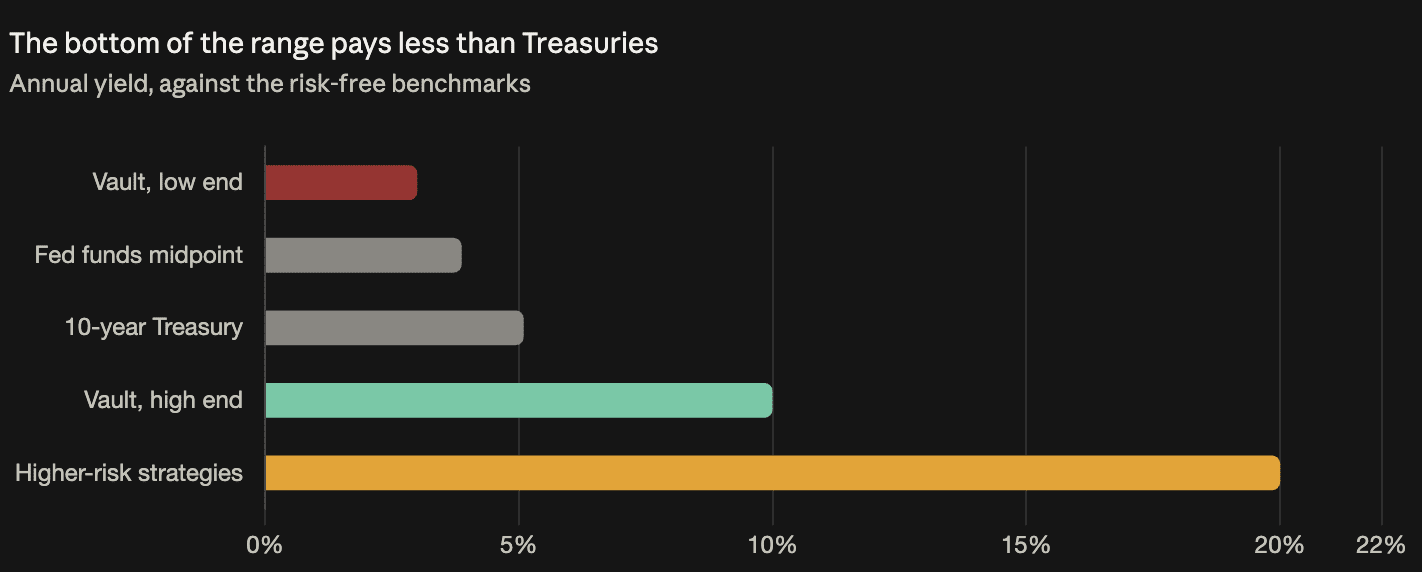
Deposits in cryptocurrency vaults have grown from $4 billion at the start of last year to more than $10 billion, according to a Financial Times report. The depositors are institutions — fintech companies, digital asset treasury managers and hedge funds — placing capital into smart contract strategies run by managers who select lending approaches, set risk limits and collect fees. Returns typically run 3% to 10%, with higher-risk strategies reaching 20% or more.
The Low End of the Range Pays Less Than Treasuries
A vault returning 3% a year sits below the Federal Reserve’s funds rate midpoint of 3.875% and well below the 10-year Treasury yield, which closed Friday at 5.097%.
A depositor in that position accepts three risks — collateral, liquidity and smart contract — in exchange for less than government debt pays for none of them. That is a negative risk premium.
The top of the typical range is more defensible, though not dramatically. Ten percent is under five percentage points over the 10-year, for capital with no custodian, no regulator and no recourse.
Only the 20%-plus strategies offer compensation that looks proportionate to the risk, and those are explicitly described as higher-risk without further definition.
Deposits Are Rising While Yields Fall
The $4 billion to $10 billion move is two and a half times, roughly 64% annualised.
Over the same period DeFi yields have compressed. The sector spent September absorbing both the Clarity Act delay and shrinking returns, with restaking protocols reported to be barely profitable.
More capital arriving as compensation falls is a specific pattern. It means allocation decisions are being made on availability of yield rather than on the adequacy of yield, and it is the sequence that typically precedes a repricing rather than one that follows it.
The Depositors Are the Story
This is not retail yield farming. Fintechs, digital asset treasury managers and hedge funds are institutional allocators with investment committees and reporting obligations.
The digital asset treasury category is the most notable. Companies holding crypto on their balance sheets are lending it into vault strategies to generate return on an otherwise idle position — which converts a treasury holding into a credit exposure.
That has a parallel in exchange products. Borrowing against deposited bStocks collateral on Binance rose to 46.2% by September 10 from 5.5% at the end of June, as holders put tokenised equities to work as margin. The same impulse is visible in both places: idle collateral being deployed for yield.
The Manager Role Is a Fund Without the Furniture
Each vault has a manager who chooses lending strategies, sets risk parameters and takes fees on pooled third-party capital.
That is a discretionary asset management mandate. The Financial Times draws the comparison to an investment manager, and the comparison is apt on function and incomplete on structure — there is no custodian holding the assets separately, no regulator reviewing the strategy, no audited accounts and no path to recovery if something fails.
What the Three Risks Mean in Practice
Collateral risk. The assets backing the loans can fall in value faster than they can be liquidated, leaving positions undercollateralised. This is the risk that matters most in a fast decline, and crypto collateral moves faster than most.
Liquidity risk. Deposited capital is lent out, so it is not available on demand. Withdrawals become difficult precisely when everyone wants them at once.
Smart contract risk. The code can be exploited, and once funds leave there is no mechanism to reverse the transaction.
Scale It Before Reading Too Much Into It
Ten billion dollars is roughly one day of spot trading volume on a single large exchange.
The growth rate is genuine and the institutional composition is significant. The absolute size is small enough that a failure in this sector would not propagate far, which is the reassuring half of the same observation.
One Limitation Worth Noting
The report names no specific vaults, platforms or managers, so the $10 billion figure cannot be attributed or independently verified. “The beginning of last year” also goes undated.
For a sector where the central risk is counterparty-specific — which manager, which strategy, which contract — an aggregate figure without composition tells a reader the market is growing without telling them where the exposure sits.