


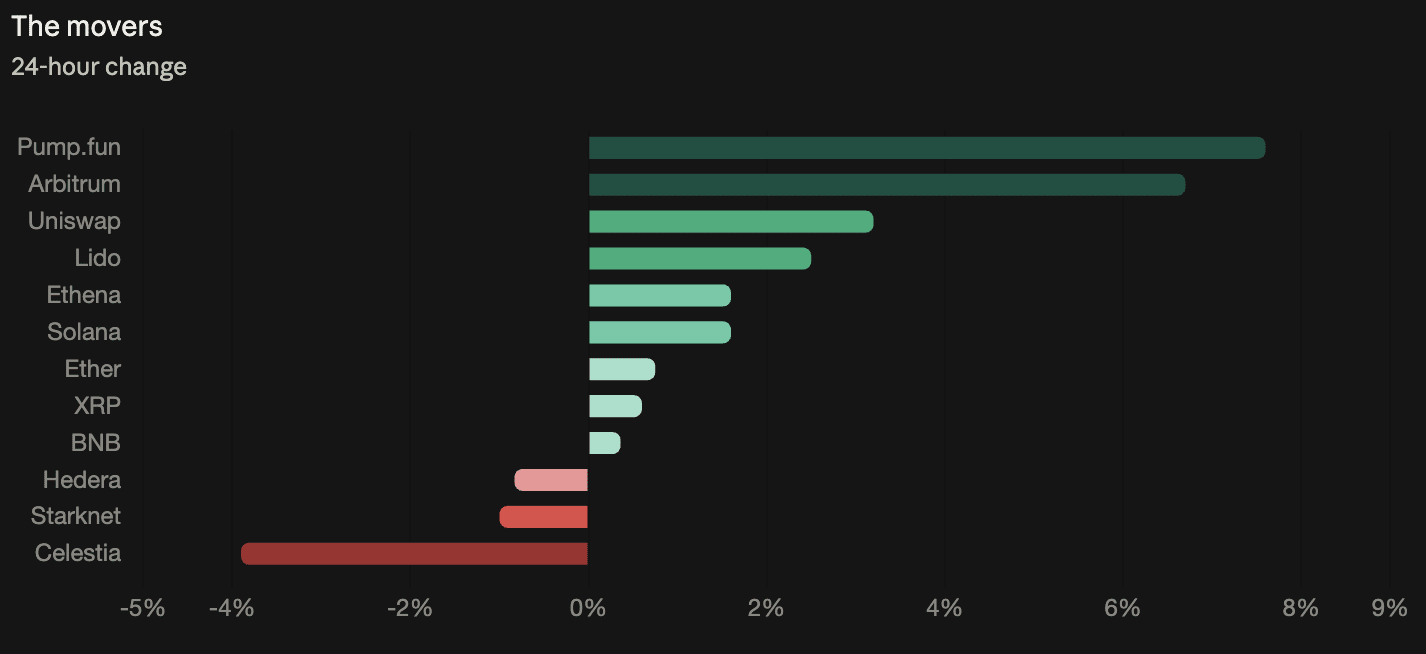
Altcoins outpaced Bitcoin by roughly two and a half times on Monday, with the CoinDesk 80 gaining 0.9% against 0.35% for the Bitcoin-heavy CoinDesk 5. Arbitrum led the broad market with a 6.7% rise and every member of the DeFi sector index advanced. The derivatives data complicates the picture: open interest grew faster than prices across the majors while aggressive buying failed to match aggressive selling, which makes the move leverage-led rather than demand-led.
The Positioning Flipped From Covering to Buying
Two days ago the signature was short covering — open interest rising more slowly than prices, meaning contracts were being closed rather than opened.
That has reversed. Notional open interest on Bitcoin, ether, solana and XRP is now growing faster than their prices, which means fresh capital is entering the contracts. Annualised perpetual funding is positive across all four, so longs are paying to hold.
The qualifier matters. The 24-hour open-interest-adjusted cumulative volume delta is flat to negative, meaning aggressive selling at least matched aggressive buying. Longs are accumulating passively through limit orders while nobody is lifting offers.
Gains built on position-taking rather than on market buying are the fragile kind, because they unwind on the same mechanism that created them.
DeFi Led on Breadth, Not on Size
The DeFi sector index rose 0.81%, which is below the broad CoinDesk 80’s 0.9% — so DeFi did not lead on magnitude.
What distinguishes it is participation. All six members of the sector index were higher, which is unanimous breadth rather than one name carrying an average.
Uniswap rose 3.2% to around $7.42, with lido up 2.5% and ethena 1.6%. The sector is recovering from a difficult September that combined the Clarity Act delay with compressing yields across restaking protocols.
Arbitrum’s 16% Move Cost About $400,000
Arbitrum gained 6.7% to roughly $0.20 and is up 16.45% since Thursday, when the Arbitrum Foundation announced its Stablecoin Growth Program.
The programme commits 2 million ARB — around $400,000 at current prices — to the first ten teams holding $10 million each in USDG, the dollar-pegged stablecoin issued by Paxos Digital Singapore. That is roughly $40,000 per team, or 0.4% on the capital required.
The scale gap is the interesting part. A programme of that size has moved the token 16% in four sessions, which says more about how thinly these incentives are priced than about the economics of the offer itself.
Pump.fun Rose Without a Reason
The Solana memecoin launchpad token jumped 7.6%, recovering part of a weekend slide that took it to about $0.0039 on Sunday.
There was no news catalyst. Twenty-four-hour trading volume doubled to $215 million, which is the whole explanation — a thin market with twice the usual flow moving in one direction.
Cardano Is the Setup Worth Watching
ADA carries annualised perpetual funding of −8%, the only negative print among the majors, with negative cumulative volume delta alongside it.
Negative funding means shorts are paying longs to maintain their positions. A crowded short side paying to stay short while the price grinds higher is the classic squeeze configuration: if the bounce extends, those positions become forced buying.
One caution for publication — the source reports ADA both up almost 1% and down 0.15% in different sections, so confirm the price before running it.
Last Week’s Winners Gave It Back
Celestia fell 3.9% to about 61 cents after Friday’s 16% surge to a 2026 high. Starknet slipped 1% to roughly 6 cents, and its market value has fallen about a quarter since Friday morning.
Among the larger names solana rose 1.6% to about $106, XRP gained 0.6% and BNB added 0.36%. Hedera fell 0.83%.
Dogecoin and uniswap both saw open interest decline, indicating traders closing positions and withdrawing capital rather than opening new short bets.
Altcoin Season Hasn’t Happened in 2026
CoinMarketCap’s Altcoin Season index sits at 56, down from a 2026 record of 63 reached last week.
That record is the figure worth reporting. The index requires 75 before the label applies, so its strongest reading all year fell 12 points short — and it has since given back 7 more.
By this measure, 2026 has produced periods of altcoin outperformance without ever producing an altcoin season. Monday’s 2.6-times outperformance of Bitcoin is one of those periods, and the derivatives data suggests it rests on leverage rather than on rotation.
The Macro Backdrop Did the Work
The rebound followed China’s third-quarter GDP growth of 4.5%, up from 4.3%, and easing oil prices. Nasdaq 100 futures rose more than 1% after the Nasdaq’s 4.5% weekly decline, its worst since June, driven by AI spending and debt concerns that pushed CoreWeave down 25%.
Total crypto futures volume rose 51% to $146 billion while open interest edged up just 1.25% to $141 billion — turnover without commitment. Liquidations were $329 million, little changed.
Bitcoin and ether implied volatility gauges stayed calm even as the VIX spiked on Friday, and the five most-traded options on Deribit were all Bitcoin puts struck below spot. Traders are hedging gains rather than positioning for a fall.
Meta and Tesla report this week, which is where the AI capital expenditure question gets answered.