

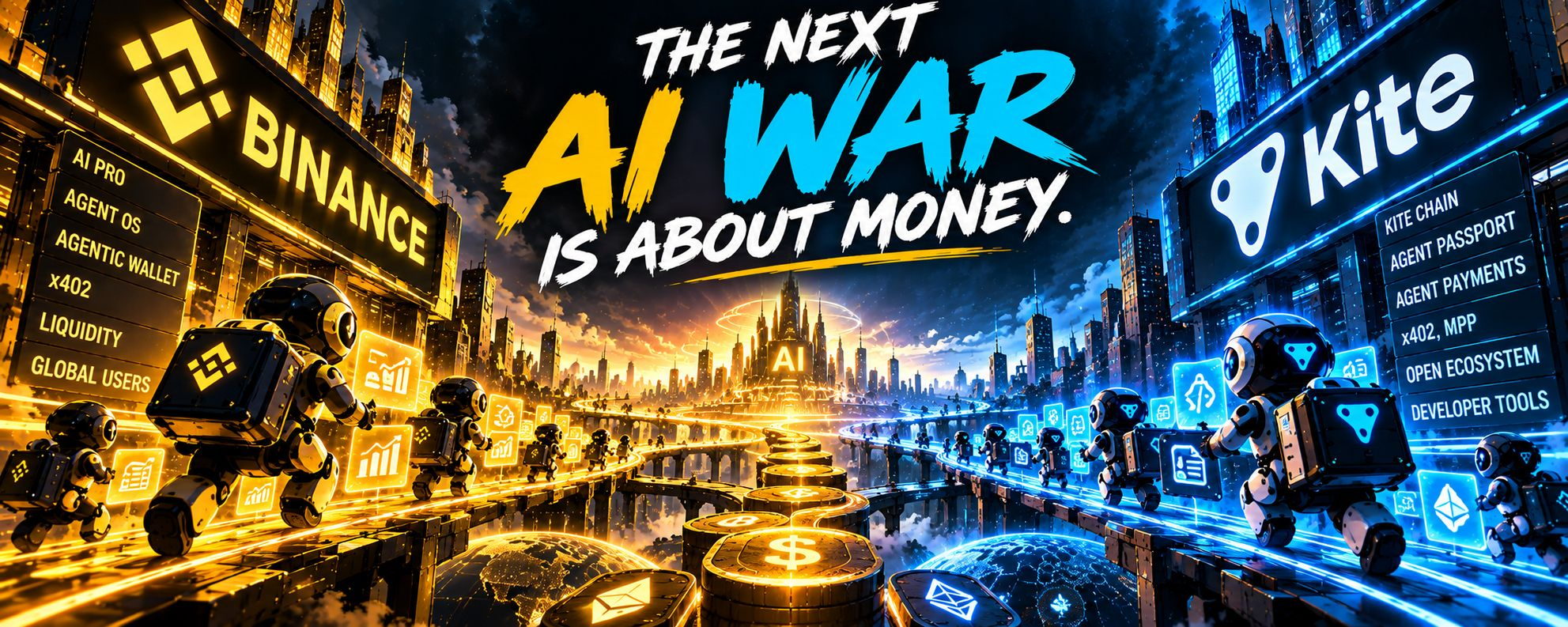

THE NEXT AI WAR IS ABOUT MONEY.
Binance, Kite, and the battle to control the agent economy.
I think the market is asking the wrong question about AI.
Everyone wants to know which model is smarter, which agent works faster, and which company will dominate the next generation of AI.
But imagine a different internet.
Millions of AI agents are buying data, renting computing power, paying for APIs, hiring other agents, and completing entire workflows without waiting for a human to approve every transaction.
In that world, intelligence is only one part of the equation.
The real bottleneck is economic permission: who can transact, under what conditions, and who captures the value?
This is why I find the developments around Binance and @KITE AI particularly interesting.
1. Binance is preparing for an internet where agents can act, not just answer.
Binance Agent OS brings together Binance APIs, Agentic Wallet capabilities, Binance x402, Skill Hub, and MCP into a developer platform with user-controlled permissions.
This matters because an AI agent is only as useful as the tools it can access and the actions it is authorized to perform.
Market data alone does not execute a strategy. A recommendation alone does not complete a transaction. Agents need a controlled path from decision to action.
Binance already has an established financial ecosystem, trading infrastructure, and liquidity. Extending these capabilities to compatible AI agents creates a potential distribution advantage that a new infrastructure network cannot easily reproduce overnight.
But there is a second problem that becomes more important as agents become autonomous.
What happens when one agent needs to pay another agent that operates outside its own platform?
That is where the infrastructure question becomes much bigger than trading.
2. Kite is building for the economic relationship between agents.
Kite Chain and Kite Agent Passport address a different but overlapping part of this problem.
The key idea is not simply giving an AI a wallet.
It is giving an agent an identity, a defined spending authority, and a verifiable record of its transactions.
Consider a practical example.
I authorize an agent to spend $50 on a research task. It can purchase data or services within the approved scope, but it cannot turn that authorization into unlimited access to my funds.
Kite's spending sessions define enforceable payment policies, including maximum spending per transaction, total spending limits, and permitted scopes. Its Passport infrastructure checks authorization at the funding stage. On the seller side, acceptance policies can determine which incoming proposals are allowed automatically.
This is a meaningful distinction.
An agent economy needs more than the ability to move money. It needs rules governing which economic actions are permitted before money moves.
And these rules must work even when the buyer, seller, and payment infrastructure belong to different systems.
Kite is positioning itself around this problem through agent identity, programmable authorization, stablecoin settlement, and support for payment standards such as x402 and MPP.
The opportunity is to make services consumable by agents without requiring developers to build a new payment integration for every interaction.
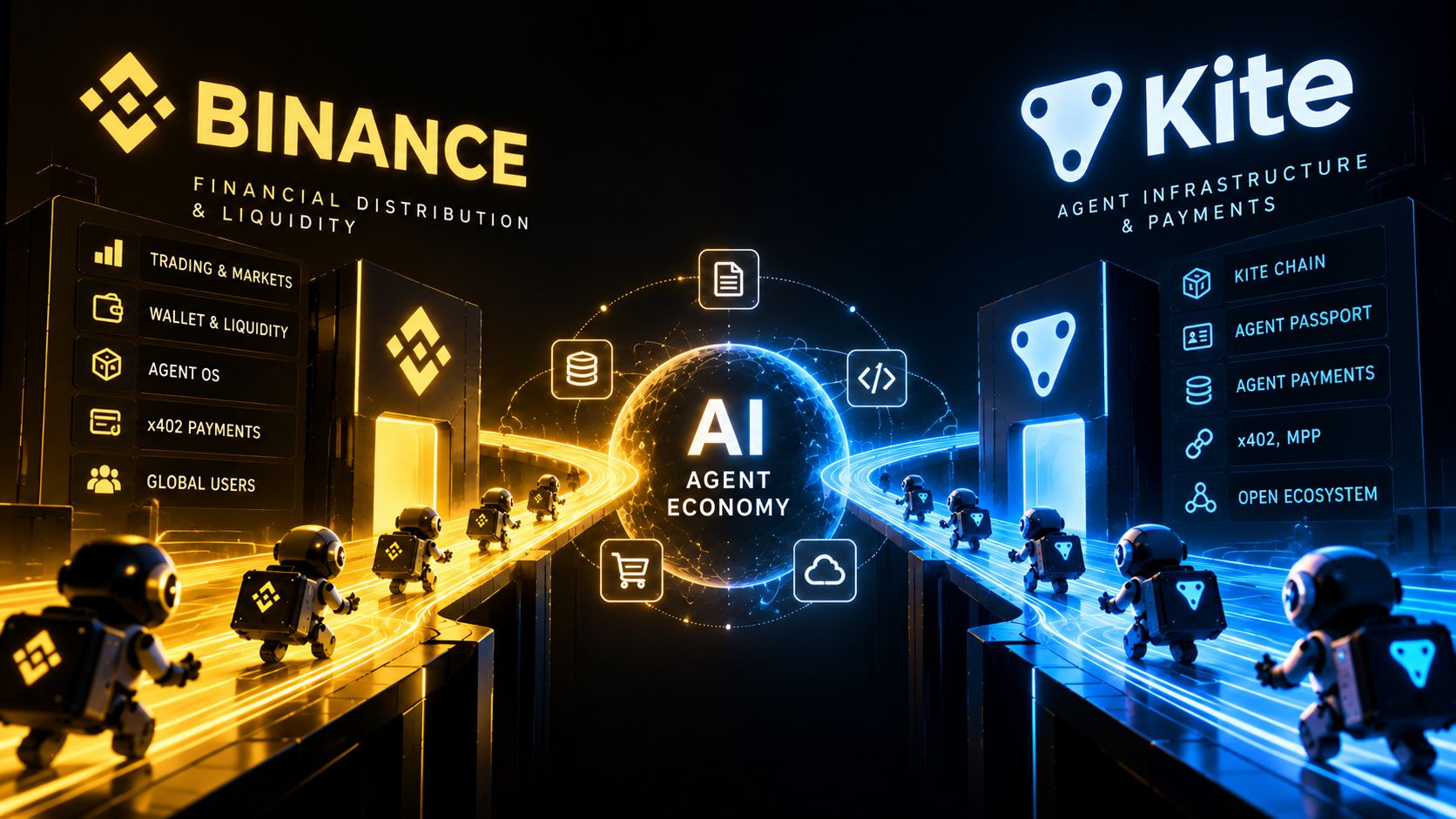
3. The interesting part: Binance and Kite are not simply two sides of the same trade.
Binance has an advantage in financial distribution, existing users, liquidity, and access to crypto capabilities.
Kite is pursuing specialized infrastructure for agent identity, spending authorization, and payments between autonomous services.
Their approaches overlap. Binance's Agent OS and Agentic Wallet also address agent payments and user-controlled permissions. Kite therefore cannot win merely by claiming that agents need wallets or that payments must be automated.
It must demonstrate that its infrastructure provides enough additional value for developers and service providers to adopt it.
That could come from easier integration, portable agent identity, more expressive spending policies, reliable cross-platform execution, or an ecosystem that attracts both buyers and sellers.
This is the competition I would watch.
Not which project uses the word "AI" more often, but which one becomes difficult for developers to replace once their agents depend on it.
4. The $KITE investment thesis has a critical condition.
Here is where I think investors need to look beyond the narrative.
Suppose agent-to-agent payments grow tenfold.
Does that automatically mean $KITE demand grows tenfold?
No.
Kite's published tokenomics describe several mechanisms intended to connect ecosystem activity with KITE demand. These include KITE requirements for ecosystem participation, liquidity commitments for modules with their own tokens, staking, and a Phase 2 mechanism under which protocol commissions from AI service transactions can be converted into KITE for distribution to the network and modules.
If implemented at meaningful scale, these mechanisms could create an economic feedback loop:
More real service usage generates revenue. Revenue-linked mechanisms create demand for KITE. Successful modules attract more developers and users. Greater participation can strengthen the ecosystem.
But every link in that chain needs evidence.
The important distinction is between a mechanism designed to capture value and value capture demonstrated by actual usage.
I would monitor four things:
• Real agent activity and paid service transactions, rather than registrations alone.
• Protocol revenue generated by genuine demand, rather than incentive-driven activity.
• The proportion of revenue that actually translates into KITE demand.
• Token emissions, unlocks, and circulating supply relative to that demand.
A growing agent economy can benefit applications, payment providers, infrastructure networks, and token holders very differently.
The growth of AI is not, by itself, an investment thesis for every AI token.
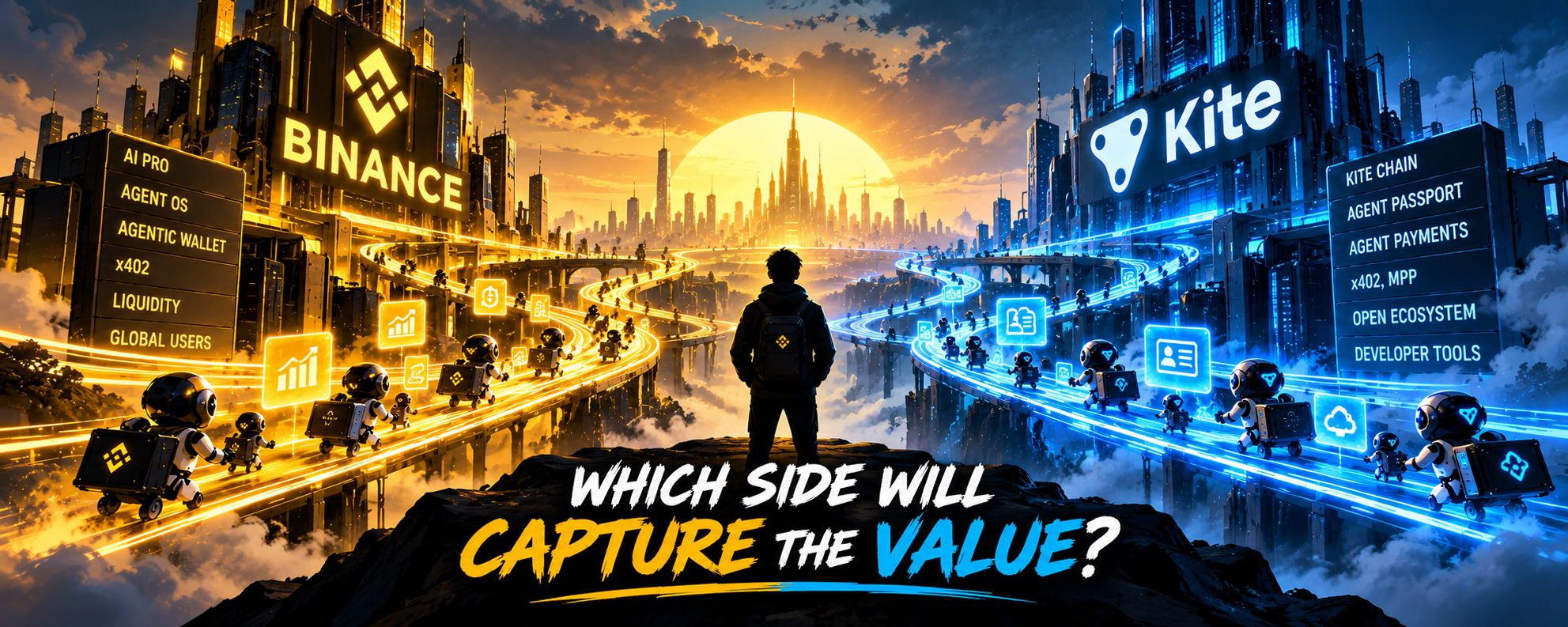
5. My conclusion: the next competitive advantage may be permission, not payment speed.
I believe the agent economy will force the financial industry to rethink how transactions are authorized.
When a human makes a payment, identity, intent, and approval are usually tied to a person performing an action.
When an agent makes thousands of decisions on someone's behalf, those controls must become programmable, enforceable, and auditable.
Binance has a potential advantage in connecting AI agents to an established financial ecosystem.
Kite is betting that the emerging agent economy needs dedicated infrastructure for identity, authorization, and service-level payments.
Neither advantage guarantees a winner. Both must prove that developers will use their products, that the systems remain reliable and secure, and that the resulting economic activity creates durable value.
But the strategic question is clear.
If AI agents eventually become major buyers and sellers on the internet, the most valuable infrastructure may not be the system that processes the most transactions.
It may be the system that determines which transactions are trusted, authorized, and worth executing.
One question for the community: if agent-to-agent payments become a massive market, would you rather invest in the platform that already controls financial distribution, or the specialized infrastructure trying to become the trust layer for autonomous agents?
And more importantly, what evidence would convince you that $KITE captures that value instead of merely benefiting from the AI narrative?