

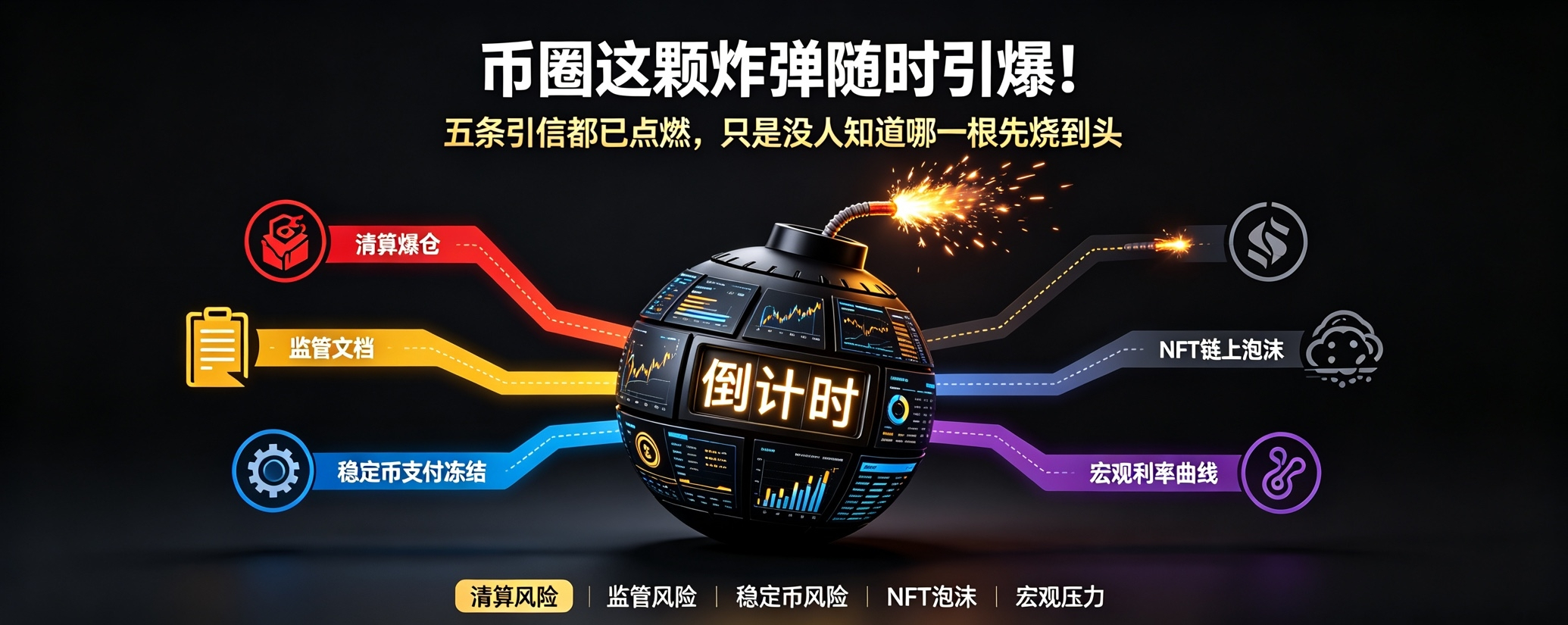

The Crypto Market Bomb Could Explode at Any Moment!—All Five Fuses Are Lit, but No One Knows Which Will Burn Down First
On the surface, the market caught its breath in a “Green Monday” rebound, with Bitcoin climbing back above $83,000 after hitting a low of $80,671. But if you shift your focus from the candlesticks to the underlying structure, you’ll see several fuses burning at once—and they’re not isolated from one another. These aren’t hypothetical events that might happen “if” certain conditions are met; they have already happened, are happening now, or have clear triggers in place.
First fuse: Interest rate expectations and leveraged liquidations have already triggered one explosion
U.S. September CPI, released on October 14, came in at 3.7% year over year, while core CPI was 2.6%; both were above expectations. After the data was released, the probability of an October rate hike jumped from about 22% to 44%–49%, and the 10-year Treasury yield rose to around 5.19%. Highly leveraged long positions piled up in the derivatives market were liquidated en masse within a short period. Over the past 24 hours, 178,000 traders across the market were liquidated, totaling $950 million, including $870 million in long liquidations—nearly 92% of the total. This is not a risk that “might happen”; it is deleveraging that has already taken place. The real question is: as long as rate expectations do not shift, every rebound could become fuel for another round of liquidations.
Second fuse: A flood of token unlocks is being unleashed all at once this week
From October 19 to 25, more than 20 altcoin projects are set to undergo major token unlocks. A single ZRO unlock is worth about $43.3 million, while H’s unlock amounts to as much as 6.84% of its circulating supply. More important is the backdrop: Bitcoin is repeatedly testing the $80,000 level, and liquidity in altcoins is already drying up rapidly. Gate’s analysis notes that concentrated unlocks will further drain buying depth from the altcoin market, putting greater short-term downside pressure on altcoins than on BTC. This is not an isolated issue affecting one project; it is a collective supply-side shock arriving within the same time window. On-chain data will determine whether this becomes a “sell-off trap” or a “golden buying opportunity,” but until then, liquidity’s first response is always to contract.
Third fuse: Regulatory vacuum as the legislative path temporarily stalls
The CLARITY Act failed a procedural vote in the Senate, with 49 votes in favor and 50 against—11 votes short of the 60-vote threshold. On the night of the defeat, nearly $300 million in crypto long positions were liquidated, 115,000 traders were liquidated, Coinbase fell 10.10%, and Circle fell 11.45%. The deeper issue is that this was not an ordinary legislative setback; it marked the evaporation of the “regulatory expectations premium.” The valuations of companies such as Coinbase and Circle included a premium based on the expectation that CLARITY would pass. With the bill defeated, that premium disappeared entirely. BTC itself did not carry this premium, so its decline was relatively limited. But the regulatory timeline for the entire on-chain financial system has been materially delayed, and the repricing of risk premiums is only just beginning.
Fourth fuse: Stablecoins remain “untested under stress”
In its October 13 report, the Financial Stability Board (FSB) noted that the global stablecoin market is worth about $300 billion, with 99% of stablecoins pegged to the U.S. dollar. However, neither existing stablecoins nor their regulatory frameworks have been stress-tested against a true run or insolvency scenario. The FSB singled out two structural vulnerabilities: first, under a “multi-issuer architecture,” reserve assets held in different jurisdictions may not be transferable across borders quickly during a crisis; second, the time gap between 24/7 trading and the closure of traditional asset markets could accelerate a chain reaction of depegging. This is not an “event” about to erupt, but a vulnerability that has yet to be tested. The historical precedent is USDC’s brief depeg to $0.87 during the 2023 Silicon Valley Bank crisis, while today’s system is far more complex than it was then.
Fifth fuse: The quantum threat timeline is being dramatically compressed
In March 2026, research by Google’s Quantum AI team and Oratomic lowered the estimated number of physical qubits needed to break Bitcoin’s elliptic curve cryptography from the millions to fewer than 500,000. Some architectures could derive a private key in five days with as few as 19,000 physical qubits. Google has already moved up its deadline for migrating to post-quantum cryptography to 2029. The real concern is not that “quantum computers will steal crypto tomorrow,” but the race between the time needed to migrate and the accelerating threat. Around 6.9 million bitcoins with exposed public keys face a persistent risk, while “on-route attacks”—deriving a private key and moving funds first during the roughly 10-minute window after a transaction is broadcast—have moved from the fringes of theory into engineering discussions.
Summary
What these five fuses have in common is that none are rumors about something “about to happen.” They are structural risks backed by data, timelines, and verifiable pathways. The fuse linked to rates and leverage has already burned through one round; the token-unlock fuse is being lit all at once this week; the regulatory-vacuum fuse will continue burning through the midterm elections; the stablecoin fuse has yet to be triggered by a stress test; and the quantum-threat fuse is shortening faster than expected.
No one can predict exactly which fuse will explode first or which will fizzle out. But one thing is certain: in this environment, survival depends not on guessing the direction correctly, but on ensuring that when any fuse blows, your position is not among the first to pay the price.
⚠️ The content above is for informational purposes and risk analysis only, and does not constitute investment advice. The crypto market carries extremely high risks. Please make decisions cautiously based on your own risk tolerance.