



Let me start with a fact you may not want to hear.
For the first time this year, the industry and the investment themes have truly diverged.
AI orders are accelerating, while AI stocks are falling.
This is what twilight really looks like: it’s not that the industry is dying—it’s that capital is changing seats.
I’ve pulled together the sector rankings for the second half of the year. Start with these three numbers.
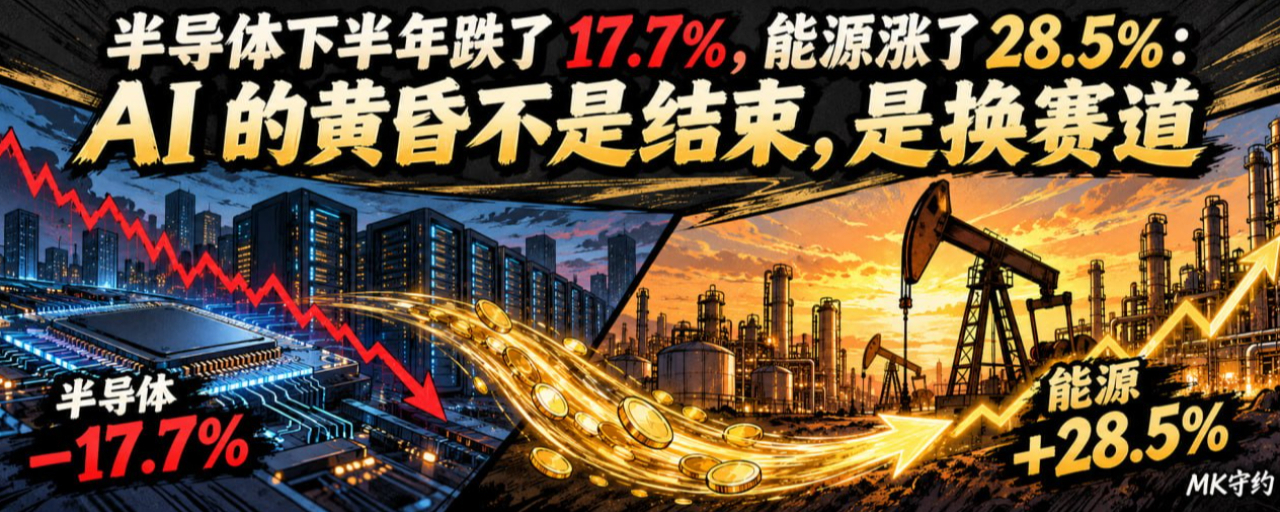
Semiconductors fell 17.7% in the second half of the year.
They were the worst-performing sector of them all.
Energy rose 28.5% in the second half of the year.
Bitcoin rose 37.8% in the second half of the year, placing second.
The top performer in the first half became the worst performer in the second.
This is what we really need to talk about today.
First, let's see how far the AI twilight has progressed.
Last Thursday and the Wednesday before that, TSMC and ASML both reported earnings.
TSMC's third-quarter net profit was NT$763.06 billion, up 68.7% year over year and a record.
Revenue was $46.72 billion, up 41.2% year over year.
Its fourth-quarter guidance came in at $52.3 billion to $54.3 billion.
It raised its full-year growth forecast to slightly above 40%, and also raised its capital spending forecast.
ASML raised its full-year outlook the same day.
On the orders front, each report looked better than the last.
Then we look at the stock prices.
TSMC fell 1.8% on the day it reported earnings and is now 13.4% below its 52-week high.
ASML is 17.1% below its high.
Nvidia is 10.7% below its high.
Oracle fell 8.8% on the day CPI was released, and CoreWeave dropped 15.5% in a single day.
At Friday's Asian open, Samsung fell 9.5%, SK Hynix dropped 11%, and SoftBank fell 9.3%.
In the same week, all the good news was about orders, and all the bad news was about stock prices.
So the dynamics behind this round of the AI twilight aren't on the demand side.
They're on the financing side.
The 10-year Treasury yield is 5.09%, and the 30-year is 5.43%.
Last week, both CPI and PPI came in scorching hot. PPI rose 1.3% month over month, its biggest monthly increase since March 2022.
The market puts the odds of a rate hike in October at just 27.5%, but sees a 78.5% chance in December.
In other words, the market thinks the Fed will wait until after the midterm elections to act.
But companies borrowing money to build data centers can't wait another month or so.
They've already burned through their free cash flow, while financing costs keep climbing.
One strategist put it this way: the tower of AI capital spending is having blocks pulled out from underneath it.
That explains why the better the earnings report, the worse the stock performs.
Now let's answer the question you've been most eager to ask today: where are the opportunities in the second half of the year?
The first theme is physical assets and energy.
The energy sector is up 28.5% in the second half of the year and 52.6% year to date, and it's still at a 52-week high.
Crude oil is now at $97, up 40% in the second half alone.
Here's the counterintuitive part: inflation is scorching hot, but gold hasn't risen.
Gold is up just 3.7% in the second half and is still 21% below its 52-week high.
The 10-year real yield fell from 2.91% to 2.74% this week.
Real yields fell 17 basis points, but gold still couldn't catch a bid.
The winner in this inflation trade isn't gold; it's energy.
The second theme is defensive cash flow.
Consumer staples are up 5.5% in the second half and just 2.7% below their 52-week high.
Healthcare is up 11.4% in the second half and just 0.3% below its high—basically at a record.
They were also the most resilient sectors last week: consumer staples gained 5% in a single week.
Money hasn't left the market; it's simply moved from the most expensive duration into the most reliable cash flows.
The third theme is crypto, on its own terms.
Bitcoin is up 37.8% in the second half, ranking second among the themes.
But it's still 27.8% below its 52-week high.
Binance perpetuals are trading at $82,800 now.
Ethereum is at $2,433, and SOL is at $105.
Crypto has been on its own independent run this time, rather than riding the AI wave.
It's risen a lot, but it's still only halfway up the mountain.
On the other side, there are three figures you need to keep an eye on.
High-yield bonds are now 5.4% below their 52-week high, and are down overall in the second half.
Small caps have fallen 10% in the second half.
One is a measure of credit conditions; the other, of financing conditions.
When both weaken together, that's when the financing pipeline is truly tightening.
Next, the timeline.
The Fed meets on October 28, and the market puts the odds of a rate hike at just 27.5%.
The midterm elections are on November 3.
The Fed meets again on December 9, and the market puts the odds of a hike at 78.5%.
In other words, the real risk window is in December, not October.
There's a month and three weeks until December—enough time to adjust your positions.
Finally, three frank thoughts.
First, the AI twilight doesn't mean the industry is over; it means valuations and financing have hit their limits first.
Don't take strong orders as a reason to buy. The market already acted out that lesson last week.
Second, rotating into another sector doesn't mean chasing a rally.
It really means just one thing: shorten the duration of your portfolio.
Third, don't watch the candlestick charts; watch three numbers.
Are high-yield bond spreads widening? Has the 10-year Treasury yield returned to 5.34%? And what's the funding rate on crypto perpetuals?
If all three move in the wrong direction at the same time, that's when the regime has truly changed.
Until then, the only thing you need to keep under control is your own leverage.
—MK Keeps His Word

Two clarifications: ① I calculated all the sector gains and losses myself today from ETF daily charts (H2 starts from the June 30 close, Q4 from the September 30 close, and the latest figures use the October 15 close); these aren't copied from someone else's rankings. ② For the central-bank-style “second half of the year,” I calculate H2 through yesterday, so the energy sector's +28.5% and semiconductors' −17.7% in the rankings are actual returns over those periods.