

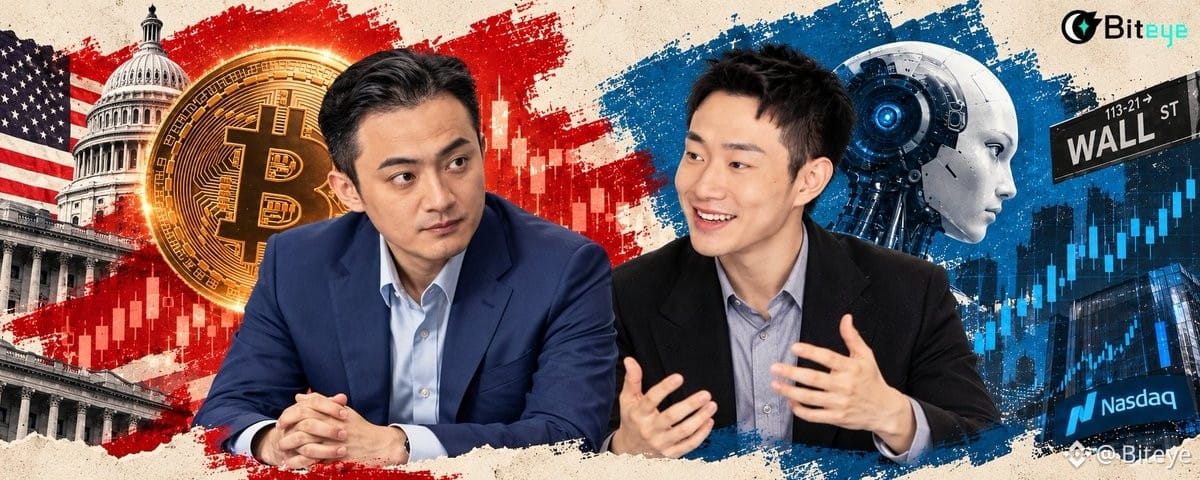
Sun Yuchen @justinsuntron recently had a nearly 50-minute conversation with Jin Ming.
Different interviewers bring out different sides of Sun Yuchen. With Allen Shao, he talked about “Sunology, lean muscles, and blond hair”; with Jin Ming, the conversation quickly turned to his actual positions, quantum computing, U.S. Treasuries, the Nasdaq, and AI investments.
Jin Ming (William Joy), known in the industry as “Sendoh,” is both a tech entrepreneur and a world champion freediver.
In just 50 minutes, the conversation covered Sun Yuchen’s views on a range of market issues, from Bitcoin’s quantum risk and his personal positions to AI applications, U.S. Treasuries, the Nasdaq, and competition between DEXs and CEXs.
Here are the 10 key questions and answers we’ve distilled from the interview 👇
🌟TL;DR:
1. Bearish on BTC: The market is severely underestimating the risk of quantum computing, and large amounts of dormant BTC could become a source of potential selling pressure.
2. Bullish on AI: The real opportunities are in the application layer, especially health management; hardware sectors such as memory and optical modules are already far too crowded.
3. Bearish on the Nasdaq over the medium term, but still holding: AI valuations are too high, and rising Treasury yields are pulling capital away.
🌟1️⃣Could quantum computing be an underestimated risk for BTC?
Justin Sun: Bearish on BTC
I’m personally more bearish on BTC now. My main concern is the development of AI algorithms and the possibility of a Q-Day in the future. It will be difficult for BTC to come through unscathed, but most industry participants underestimate the impact.
BTC has now become a mature ETF product. Many investors who don’t understand its technical foundations hold BTC through institutions such as BlackRock, and they may not understand what Q-Day would mean.
With OpenAI making progress in mathematics, there’s at least one possibility: we may not have to wait for an actual Q-Day—classical computing combined with new algorithms could also threaten Satoshi Nakamoto’s wallet. Many exchange hot wallets also lack appropriate protection, so I think this is a serious risk.
🌟2️⃣Do you still hold BTC? How do you plan to protect your assets?
Justin Sun: I still have a BTC position.
Transfer BTC to a new address that has never been used to sign transactions or send assets externally, and keep it as a cold wallet. After each use, transfer the remaining assets to another new address.
But this only protects your own assets; it can’t ensure that others will take action too. For example, Satoshi Nakamoto won’t proactively move their BTC, so those holdings could be among the first to face risk. If the community wanted to confiscate or freeze these assets, or address them through a hard fork, it would be difficult to reach consensus given BTC’s level of decentralization.
In the past, I conservatively estimated that Q-Day might still be two years away. But given the pace of progress in AI and mathematical algorithms, it’s now something we need to consider within the next year to year and a half. If millions of BTC that were previously out of circulation re-enter the market, that would create enormous selling pressure.
🌟3️⃣Couldn’t BTC solve this in advance by upgrading to be quantum-resistant?
Justin Sun: It’s technically possible to upgrade, but the difficulty is getting every address to migrate.
BTC could add quantum-resistant addresses, allowing holders to move their assets voluntarily. But this would only help those who know about the risk and are willing to act; it’s impossible to require every holder to complete the upgrade.
Satoshi Nakamoto, along with many addresses whose private keys have been lost or whose wallets are damaged, can’t migrate voluntarily. Once the algorithms are broken, BTC that had effectively left circulation could be transferred again—like “dead coins coming back to life.”
The community could also freeze BTC in early blocks, restricting circulation and implementing a hard fork. But it’s impossible to confirm which coins belong to Satoshi Nakamoto, and freezing assets would have no precedent in BTC’s history, making it difficult for miners, developers, and the community to reach consensus. In an extreme scenario, close to two million BTC could re-enter circulation.
🌟4️⃣Given this assessment, shouldn’t you reduce your position now?
Justin Sun: The position is too large; a big ship is hard to turn around
Given this risk scenario, reducing our position would make sense. But our position in this industry is already very large. We’re not ordinary investors holding a small amount of assets that we can exit completely with a quick click the next day.
So the first step isn’t to sell immediately, but to switch the relevant assets to “bunker mode” and reduce the most immediate security risks by isolating them in wallets. This doesn’t come at a high cost; it mainly makes operations and usage more cumbersome.
As for whether to sell BTC next, we still need to watch how the technical community develops. Our stance has shifted from paying no attention at all to quantum risk to monitoring it closely, but we haven’t gone as far as liquidating our holdings.
BTC itself isn’t a major yield-generating asset, so moving it to a cold wallet for isolation has little impact on returns. ETH is different: it needs to participate in DeFi to generate returns. Isolating it completely would be safer, but it would also mean giving up those returns, making it a harder decision.
🌟5️⃣Which part of the AI industry value chain do you find most promising for investment?
Justin Sun: I’m bullish on the AI application layer, especially health management.
I’m now more bullish on companies that can truly apply AI to everyday life—in other words, companies in the application layer.
First, Nvidia’s market capitalization has already reached an enormous size. If we assume that no single company’s market cap can exceed half the size of the U.S. Treasury market, then even if Nvidia keeps growing, its upside is limited.
But in terms of investment returns, the application layer still offers many opportunities for returns of more than four times.
I’m very bullish on AI-powered health management. Products like the Oura Ring are essentially devices for collecting body data. Of course, I haven’t invested in Oura Ring; it’s now publicly listed, so anyone can invest in it themselves.
The Oura Ring is just one product. What I’m really bullish on is the entire sector built around health management: data collection, data processing, and health-related decision-making. This is where AI can be truly put to use and create enormous value.
🌟6️⃣Why are you especially bullish on AI-powered health management?
Justin Sun: AI will shift health management from treating illness after it occurs to continuous monitoring.
In the past, people went to the hospital after they got sick. In the future, health management will start by collecting and analyzing data, then making decisions based on each person’s circumstances.
Some data will need to come from blood tests and specialist examinations, while consumer wearables can continuously collect other types of data. Once all the data is brought together, AI can offer recommendations first, followed by a second opinion from a medical expert.
This could become a global shift, requiring hospitals and insurance companies to adapt. It can achieve more with less money, and it will also spread AI investment opportunities across a wider range of applications.
🌟7️⃣Which parts of the AI industry value chain are overvalued?
Justin Sun: Areas such as memory and optical modules are overvalued.
For now, the market can’t see clear applications beyond large language models, so capital is crowding into large language models, chips, memory, and optical modules—areas seen as relatively certain. Many hardware stocks are already being valued like software companies.
Of these, memory is the sector I think is clearly overvalued. AI applications haven’t truly diversified yet, and investors think they can’t go wrong by stockpiling chips, as if chips were gold.
But as AI capabilities improve, investment themes will gradually diversify, possibly starting as soon as next year, instead of remaining concentrated in a handful of hardware and large-model companies.
🌟8️⃣If you hold Nasdaq stocks, why are you bearish over the medium term?
Justin Sun: I’m slightly bearish on the Nasdaq over the medium term, but I’m not shorting it.
I’m currently slightly bearish on the Nasdaq over the medium term, but I still hold my existing positions.
The main reason is that capital is crowded into the Nasdaq and AI sectors, and signs of overvaluation have emerged. At the same time, U.S. Treasuries are a fundamental source of liquidity for financial markets. When Treasury yields rise, they draw capital away from equity markets.
When risk-free returns are high enough, investors have no need to take on greater risk by buying highly valued stocks. Also, capital flows within the AI industry are closely interconnected, so if one part runs into trouble, other parts could be affected as well.
🌟9️⃣What’s your view of Hyperliquid? Where will the competition between DEXs and CEXs ultimately lead?
Justin Sun: The ultimate outcome of competition between DEXs and CEXs will depend mainly on regulatory boundaries.
Hyperliquid is one of the biggest discoveries to emerge during this market cycle. U.S. stock perpetual futures in particular have opened up new possibilities for the entire industry.
It sits between CEXs and DEXs, and its future will depend on how U.S. regulators define this new model.
If Hyperliquid can obtain a regulatory exemption similar to Uniswap’s, many CEXs may shift to a similar model to reduce compliance costs and operate globally. Traditional CEXs that don’t adapt will come under pressure.
But if it has to meet regulatory requirements similar to those imposed on U.S.-licensed CEXs, it will face significant pressure. In terms of compliant operations, it still can’t compare with companies like Coinbase and Circle.
🌟🔟Which three books does Justin Sun recommend?
Justin Sun: I recommend The Fountainhead, The Golden Age, and Sunology.
The first is Ayn Rand’s The Fountainhead. Her ideas had some influence on “Sunology,” and can be considered one of its intellectual sources.
The second is Wang Xiaobo’s The Golden Age. It’s more than just a novel with erotic elements; through its literary expression, it paints a portrait of an era.
The third is my own book, Sunology.