MiniMax is down 85%, Zhipu down 78%: Has the bubble in Chinese AI model stocks been squeezed out? A look at Zhipu through the lenses of MiniMax and Anthropic
The short answer: By the valuation measures below, much of the froth has already come out of MiniMax. Whether Zhipu’s valuation can hold depends on how long the revenue growth disclosed by the company can continue.
【First, a look at the two stocks】
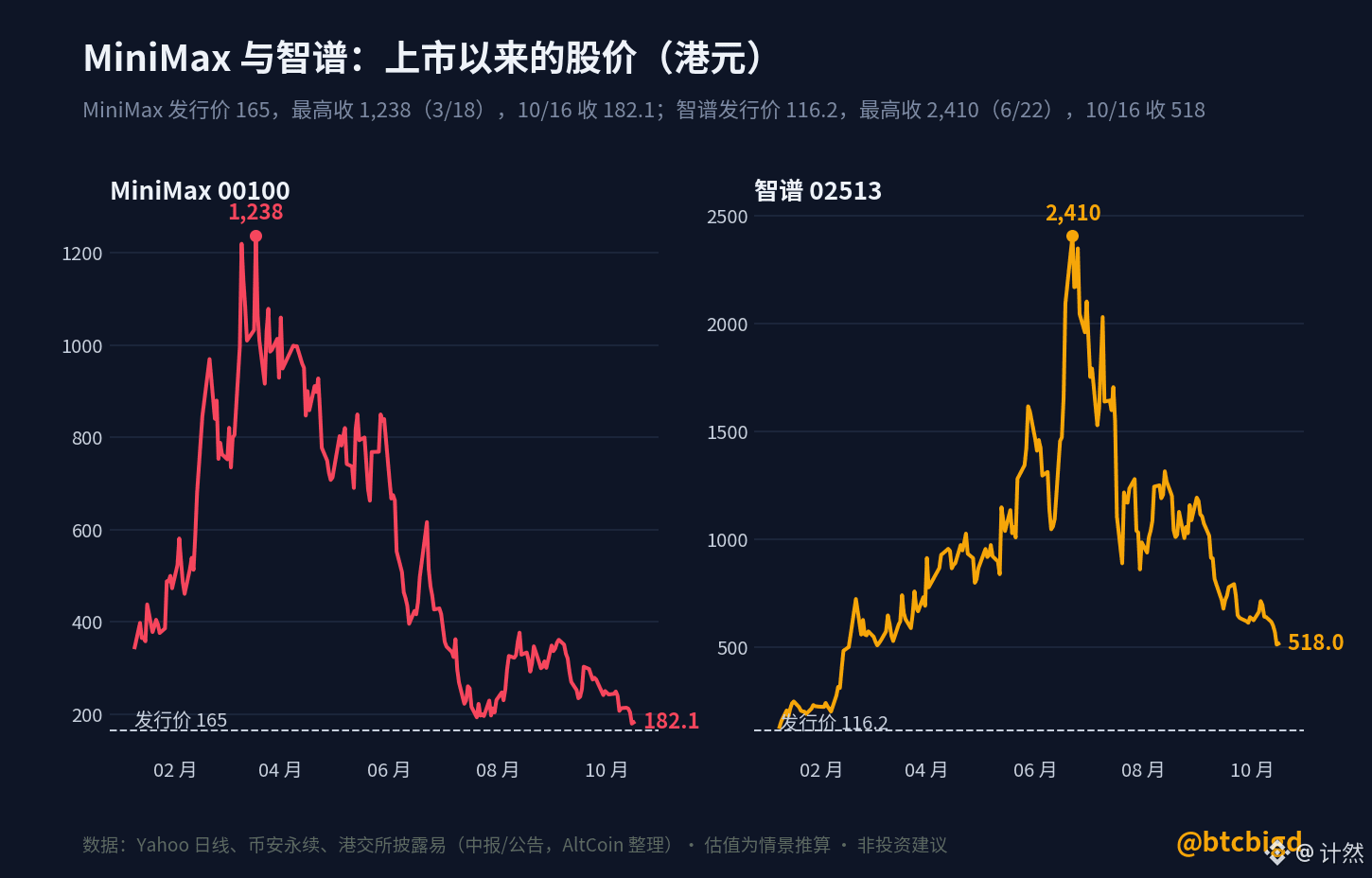
- MiniMax (HKEX 00100; Binance perpetual contract $MINIMAX ): IPO price of HK$165; its highest closing price was HK$1,238 on March 18. It closed at HK$182.1 on October 16, down 85.3% from its peak but still about 10% above its IPO price.
- Zhipu Z.AI (HKEX 02513; $ZHIPU ): IPO price of HK$116.2; its highest closing price was HK$2,410 on June 22. It closed at HK$518 on October 16, down 78.5% from its peak but still 4.5 times its IPO price.
- In the week from October 9 to 16, the two stocks fell 14.5% and 19.3%, respectively. From October 17 to 18, both perpetual contracts fell another roughly 3%, potentially putting the shares under pressure at the open on October 19.
- Since July 20, the two stocks’ betas to the Hang Seng Tech ETF have been 2.7 and 1.9, and their correlation with each other has been 0.67. Their correlation with CoreWeave on the previous day was just 0.07. This looks more like trading in “Hong Kong-listed AI stocks” than following US AI stocks.
【First, how many times annualized revenue are the valuations?】
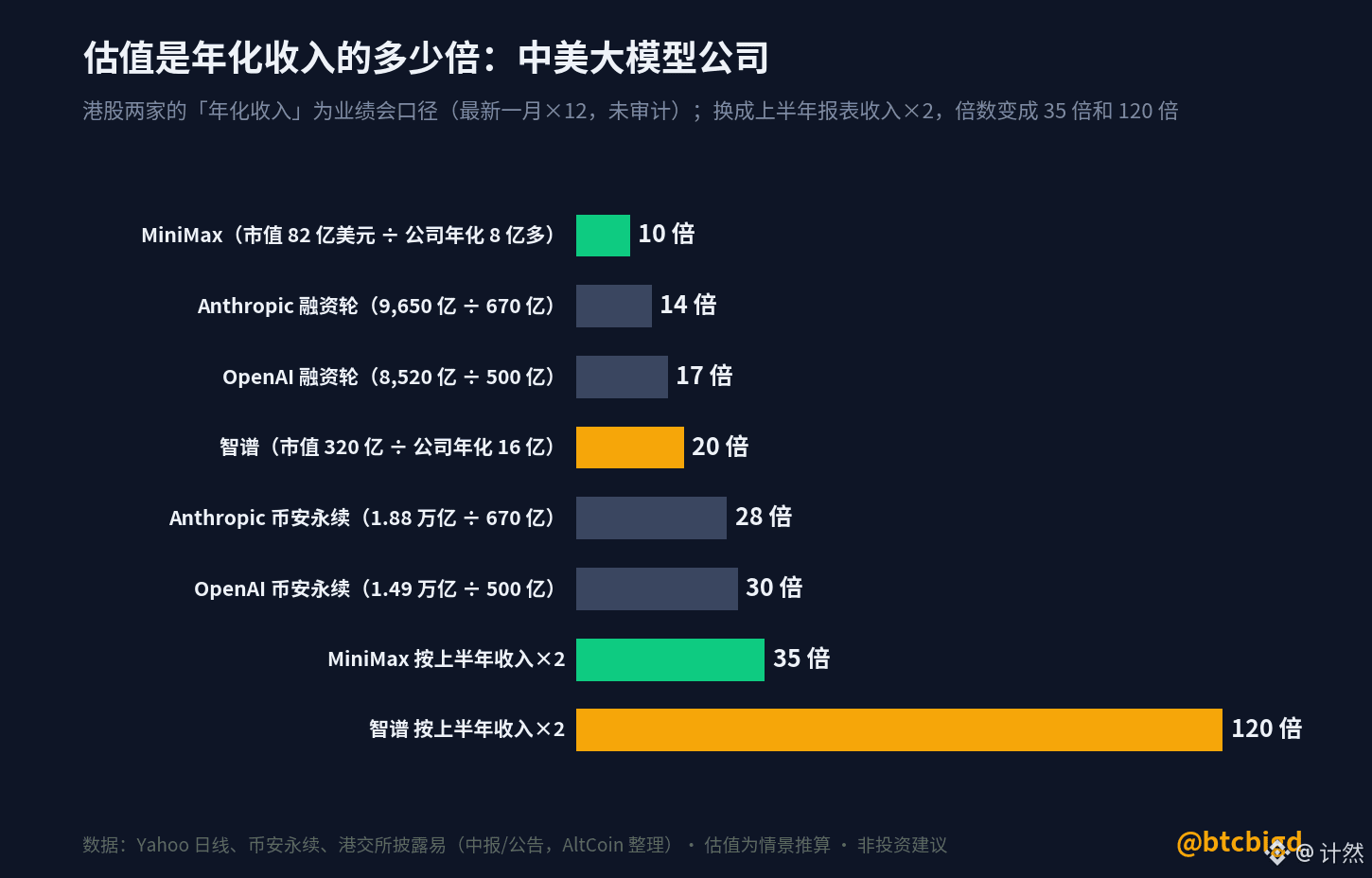
- Anthropic: Implied valuation from Binance perpetuals of about $1.88 trillion, versus $965 billion in its May funding round; annualized revenue of about $67 billion (third-quarter revenue of $16.8 billion multiplied by four; unaudited). That works out to about 28x and 14x, respectively.
- OpenAI: Implied valuation from perpetuals of about $1.49 trillion, versus $852 billion in its funding round; annualized revenue of about $50 billion (according to the FT). That works out to about 30x and 17x.
- Zhipu: Market cap of about $32 billion; company-disclosed annualized revenue of $1.6 billion; about 20x.
- MiniMax: Market cap of about $8.2 billion; company-disclosed annualized revenue of more than $800 million; about 10x.
- But the annualized revenue figures for the two Hong Kong-listed companies use figures given at earnings calls (the latest month multiplied by 12; unaudited, and not included in the interim reports). Using first-half revenue multiplied by two, the multiples are 35x and 120x, respectively. That’s a big gap, but it alone doesn’t mean the companies have overstated revenue: according to Zhipu’s interim report, token call volume has grown more than 40-fold since the start of the year, and the average API price has risen about 101%. Based on volume multiplied by price, monthly API revenue in August is estimated at about RMB 900 million, or roughly $1.5 billion annualized—within the same ballpark as $1.6 billion. That reflects the August run rate; subsequent disclosures will show how long it can be maintained.
【What would Zhipu be worth at MiniMax’s valuation? (Scenario estimates)】
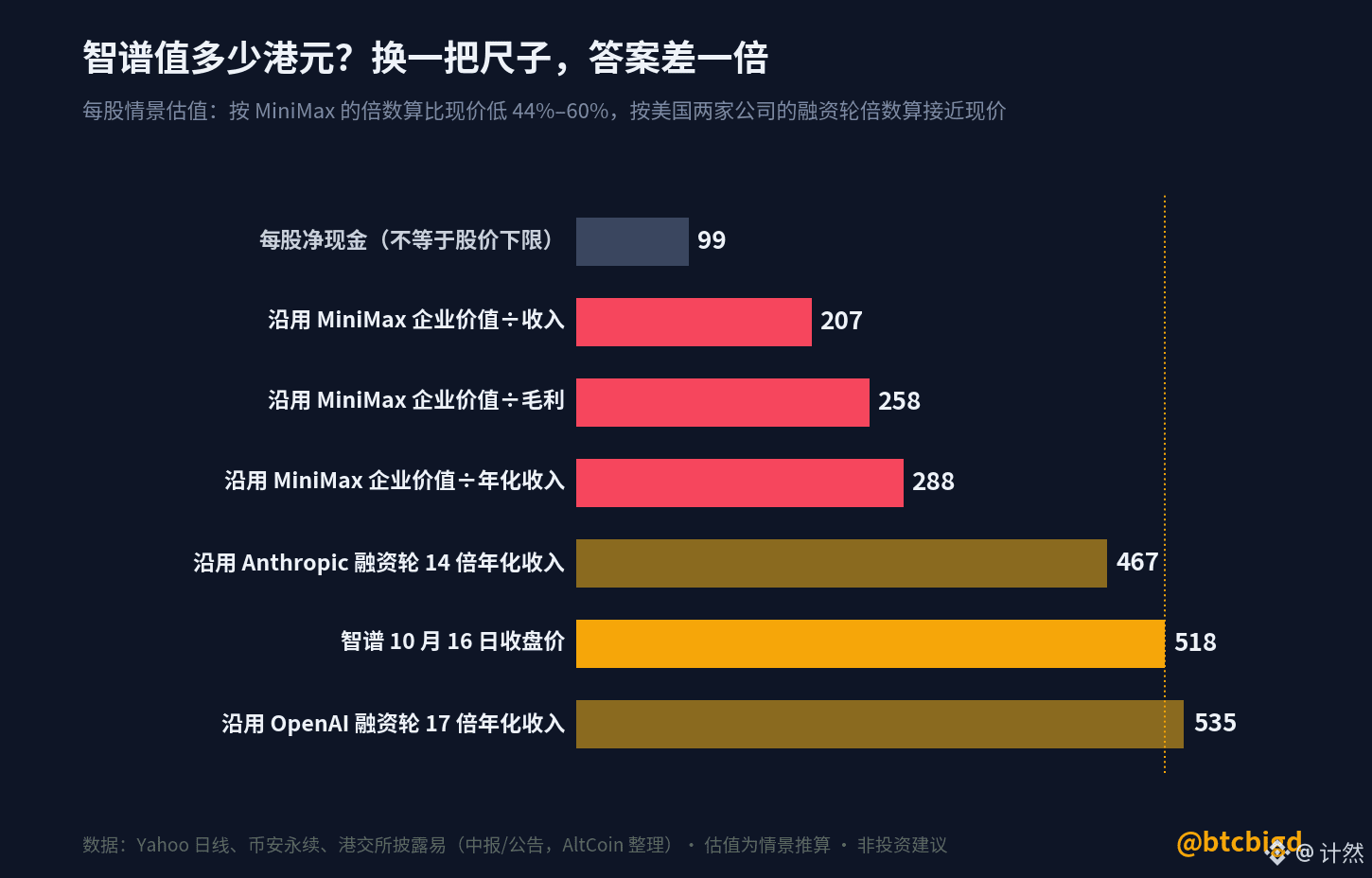
- Zhipu has about HK$48 billion in net cash, equivalent to roughly HK$99 per share. This does not mean the share price has a floor at that level.
- The two companies had similar first-half revenue (about $130 million vs. $120 million), yet Zhipu’s enterprise value (market cap minus net cash) is 4.4 times MiniMax’s.
- Using HK$518 as the reference price: applying MiniMax’s enterprise value-to-revenue multiple implies HK$207 (60% lower); its enterprise value-to-gross-profit multiple implies HK$258 (50% lower); and its enterprise value-to-annualized-revenue multiple implies HK$288 (44% lower). Applying Anthropic’s 14x funding-round multiple implies HK$467 (10% lower); applying OpenAI’s 17x funding-round multiple implies HK$535 (3% higher).
- Valuing Zhipu using MiniMax’s measures puts it 44%–60% below the current price; using the US companies’ funding-round valuations puts it near the current price. The key to this wide gap is whether Zhipu can sustain its revenue going forward.
【How fast does growth need to be to support the current price?】
Assuming a 10% annual return and a 25x price-to-earnings ratio in five years: based on first-half reported revenue, Zhipu would need revenue to grow 84%–90% annually for the next five years, versus 43%–49% for MiniMax. Starting from annualized revenue of $1.6 billion would bring Zhipu’s required growth rate down to 39%; if it reaches Goldman Sachs’ year-end forecast of $3.2 billion, the rate falls to 21%.
【Another hurdle: the lock-up expiry around January 2027 (estimate)】
About 178 million Zhipu H shares will come out of lock-up, 2.1 times the roughly 85 million H shares currently in free float. That’s equivalent to 38 days of trading volume, based on the average over nearly the past 20 trading days. If 10% of those shares are sold, that would amount to about HK$9.2 billion, or four days of trading value. MiniMax already went through a lock-up expiry in July: about half its share capital was unlocked, and the stock fell 26% over two days.
According to company announcements, Zhipu raised about HK$70.5 billion after listing. Its placement prices of HK$1,588 and HK$714, and conversion price of HK$892.5, are all above the current share price. Its cash can support the business for about ten years. MiniMax’s placement price of HK$268 and conversion price of HK$335 are also above the current price. Funding pressure is low, but investors holding shares at higher prices could create selling pressure during a rebound.
【What to watch next】
- Whether Southbound Stock Connect funds sell for two consecutive weeks.
- The 2026 annual reports: if the companies maintain their disclosed annualized run rates, Zhipu’s full-year revenue should be at least about 6.3 billion yuan, and MiniMax’s at least about $500 million.
- Anthropic’s reported IPO pricing in mid-November: a successful listing could prompt the market to compare valuation multiples across the two markets again; a weak debut could weigh on valuations for similar companies.
- Whether Zhipu’s major shareholders agree to extend their lock-ups before January 2027; and the listing progress of Kimi and DeepSeek.
These are valuation estimates under different assumptions, not share-price forecasts.
If you could hold only one: would you choose MiniMax, which has already fallen sharply and is cheap but growing slowly, or Zhipu, which is still 30% more expensive but was growing at a blistering pace in August? Or would you short AI model stocks, following the plunge in Korean equities, semiconductors, and memory stocks? Leave your pick in the comments~