After that final in Beijing, she lay on the court, covering her face as she cried. Over the next ten-plus days, her name was crossed off four entry lists, one by one.
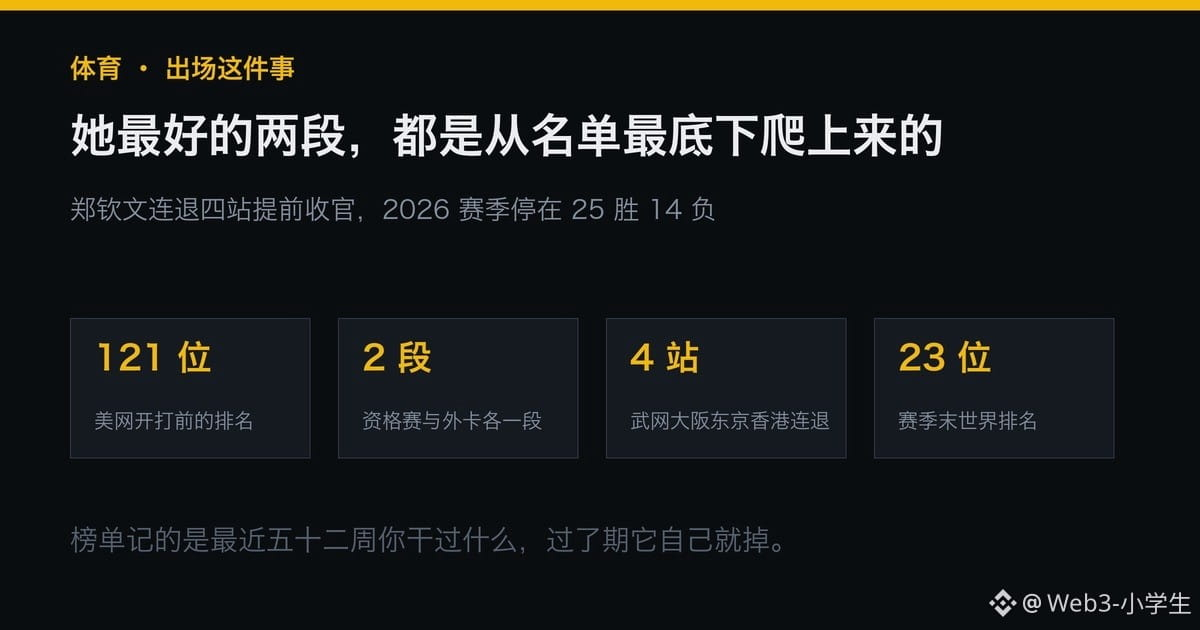
The statement issued on the 18th at the Hong Kong stop was brief. Right shoulder. Injury. Withdrawal. Same story in Tokyo—she wasn't even playing qualifying. Before that, there were Wuhan and Osaka. Four lists, emptied one after another. No farewell match. No final game. Just like that, the season was over. Quietly, too.
Her form hadn't dipped. Her shoulder had. Four tournaments. Not one played.
A lot of people think withdrawing means losing points, taking a hit. But that's not how the math works. She didn't play Wuhan last year, so there were no points coming due to be deducted. Withdrawing this year cost her nothing. The thousand points she won at the China Open were already in the bank, putting her back at No. 23 and leaving her Australian Open seeding for next year all but secure. On paper, this withdrawal came at almost zero cost. It does sound a little cold.
What do you think sponsors are paying for—the trophy? There are only so many trophies each year. They're paying for how many times a player can take the court in a year, whether her name is on the schedule, whether she's there on opening day. Points are just a lagging record. By the time they drop off, the contracts have already been signed and the money has already been paid out. No one can change anything in time.
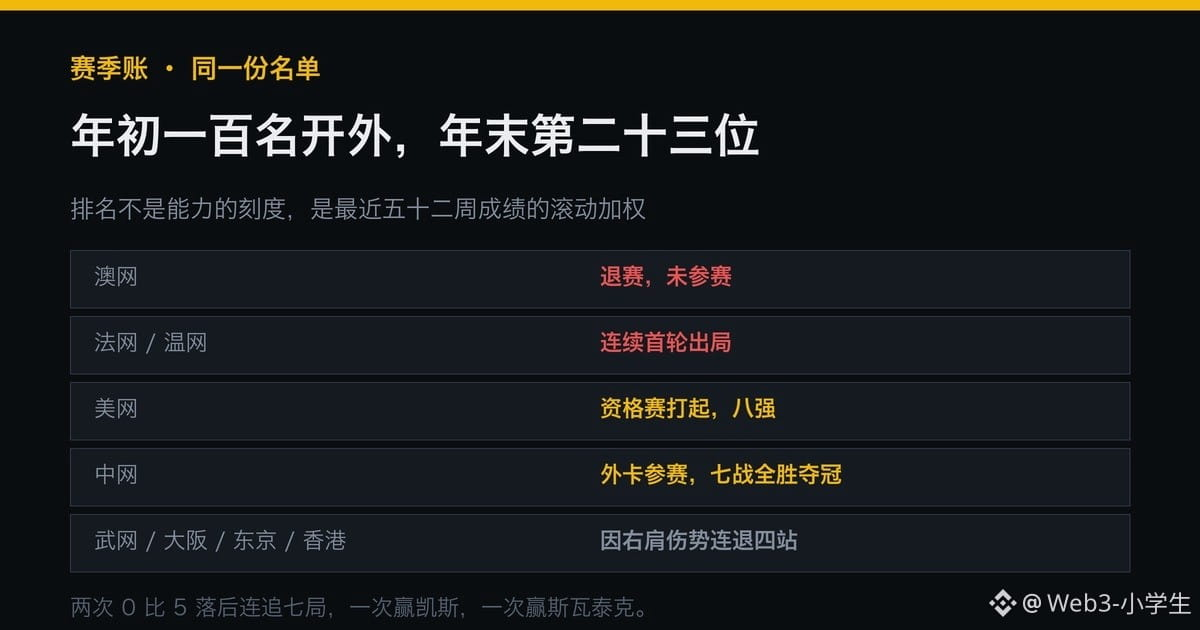
The most compelling part of this season was really that one month in the middle. Early in the year, her ranking fell outside the top 100. She lost in the first round at the French Open and Wimbledon back to back, and didn't even go to the Australian Open. At the US Open in late August, she started in qualifying, ranked No. 121 in the world. She won all three qualifying rounds to reach the main draw. In the third round, against Keys, she was down 0–5 in the deciding set, then won seven games in a row to turn it around. In the fourth round against Świątek, she went down 0–5 again, then won seven straight games again. She lost to Rybakina in the quarterfinals. Then she got a wild card into the China Open and won all seven matches.
Two brilliant runs. Both starting from the very bottom of the list.
The rankings record what you've done over the past fifty-two weeks. Once that period expires, the points fall away automatically. They don't record what you're actually capable of. That's why her ranking curve this season was so steep: from No. 121 to No. 52, then from No. 54 to No. 23—all in two months. And then it stopped. Just like that. Pretty decisive.
As for her record, media reports don't agree. Some say 25 wins and 14 losses, counting only main-draw matches; others say 25 wins and 15 losses, including qualifying. There's no single official figure, so I'm keeping both in mind. As for how far along her right shoulder has recovered, the team said only that she's taking time off as a precaution. There's no clear answer about the injury itself. Winter training in Barcelona, two coaches, and Baghdatis as the new addition—those details can be verified. Everything else is speculation.
There's no “health” field on-chain. Perpetual futures know the price, the funding rate, and who opened a position at what level. The one thing they don't know is that the person on the other side just had surgery on their right shoulder last month—or whether they'll still be able to lift their arm tomorrow. For the chain to know whether an athlete can compete, someone outside it has to write that information in and feed it to the contract. The most expensive variable of all has nowhere to go on-chain. It's an awkward thing to think about.
It works the other way, too. Spend long enough on-chain and it's easy to get the impression that if you don't move, you can't lose. But in the real world, plenty of things expire: driver's licenses, medical checkup reports, membership status, rankings. If you don't renew them, they disappear on their own. The balance in your wallet is one of the few things that doesn't expire. Leave it alone, and it's still there.
She started this year by withdrawing from the Australian Open and ended it by withdrawing in Hong Kong, with two seven-match winning streaks in between. She has no points to defend before next year's Australian Open. The spots on the entry lists will fill back up, one by one.
$CHZ $LINK $BTC
#郑钦文 #网球 #ChinaOpen