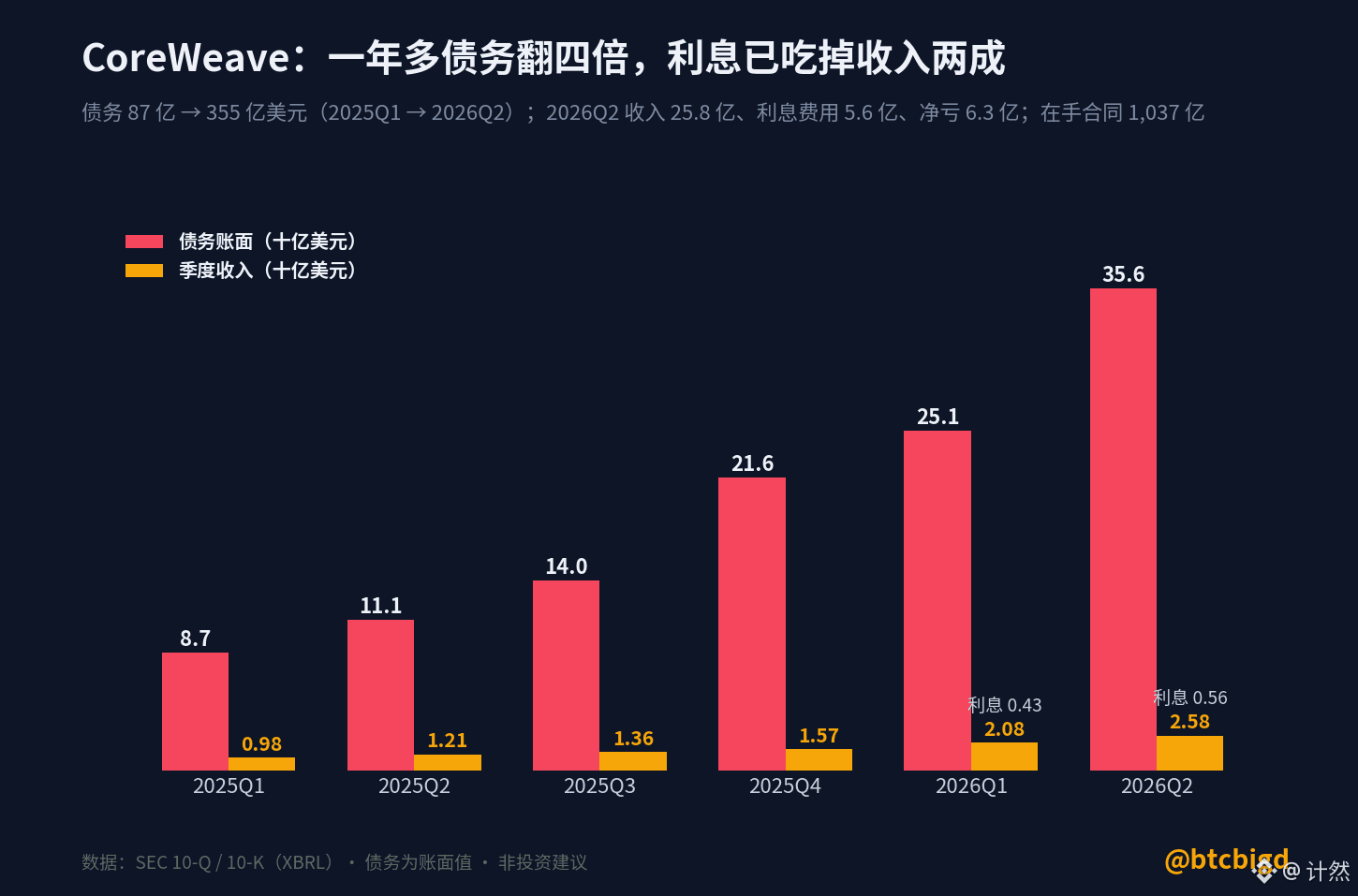
AI’s money is borrowed: CoreWeave ($CRWV ) fell 25% in a week, and its bond yields reportedly approached 15%. Why does a tremor there shake the entire AI chain?
【First, who are they?】
CoreWeave, ticker CRWV on Nasdaq, started out as an Ethereum mining company and pivoted to GPU cloud computing in 2019: it buys Nvidia GPUs, builds data centers, and rents them out under contracts to customers like OpenAI, Microsoft, and Meta. It doesn’t build models or sell chips; it’s the link in the AI supply chain that “borrows money to stock up on GPUs, then rents them out.” Companies like this are called neoclouds. It went public at $40 on March 28, 2025, peaked at a closing price of $183.58 on June 20, and closed at $61.39 on October 16.
【The books (SEC 10-Q, as of June 30, 2026)】
- Revenue: $2.575 billion in Q2, up 112% year over year; $103.7 billion in contracted backlog; 98% of revenue came from signed contracts; the three largest customers accounted for 36%, 26%, and 10%
- Losses: Q2 net loss of $626 million; first-half loss of $1.37 billion
- Debt: $35.55 billion on the books, up from $8.7 billion in March 2025—more than quadrupling in just over a year
- Interest: $558 million in Q2, or $2.2 billion annualized—more than a fifth of revenue
- First-half capital expenditure was $14.1 billion, while it issued $16.7 billion in debt over the same period: virtually all the money it spent was borrowed
- Total liabilities: $72 billion; shareholders’ equity: $5 billion; $6.2 billion comes due within a year
- The cost of new debt: an August $2.6 billion loan at SOFR plus 5.5 percentage points; then $3 billion in convertible bonds issued in September
【What happened this week?】
- On October 14, the stock fell 15.5% in a single day. Yields on bonds maturing in 2031 and 2032 reportedly approached 15%. In an internal letter to employees that day, the CEO expressed confidence in funding, sales, and orders, according to Bloomberg, saying that “the weaknesses of competitors have seeped into the narrative.”
- It closed at $61.39 on October 16, down 25% for the week and 67% from its peak
- High-yield bond spreads: 311 bp on October 9 → 325 bp on October 14 → 323 bp on October 15
【Why does a tremor there shake the entire chain?】
In this AI capacity buildout, the giants rely on their own cash flows, while neoclouds and memory manufacturers rely on borrowing. As interest rates rise—with the 10-year Treasury at 5.1%—the first link to buckle is the one with the heaviest debt and thinnest cash flow. CoreWeave’s bond yields are the market’s price quote for “the cost of financing AI capacity.” When that quote jumps, positions across the board—from triple-leveraged semiconductor plays to Hynix to $BTC long positions—get repriced overnight.
【Don’t overstate either side】
- It’s not a shell company: $103.7 billion in contracts, revenue doubled, and customers include OpenAI, Microsoft, and Meta. The catch is that it has to spend the money to build capacity before it can fulfill those contracts—and that money is borrowed at double-digit interest rates.
- It’s not safe either: debt has quadrupled, interest eats up a fifth of revenue, and $6.2 billion comes due within a year. Its ability to refinance depends entirely on the mood of credit markets.
【What to watch】
- Its bond prices, which speak before the stock price does
- Whether high-yield bond spreads can fall back below 310 bp
- Meta’s capital expenditure in its October 21 earnings report: if customers ramp up spending, CoreWeave’s contracts become more valuable; if customers pull back, it’s still the first link in the chain to take a hit
Is a 15% bond yield a bargain created by excessive selling—or a warning sign?